
Trump’s Return to Power: Legal Protection, Political Retribution and Family Business—What the Evidence Shows
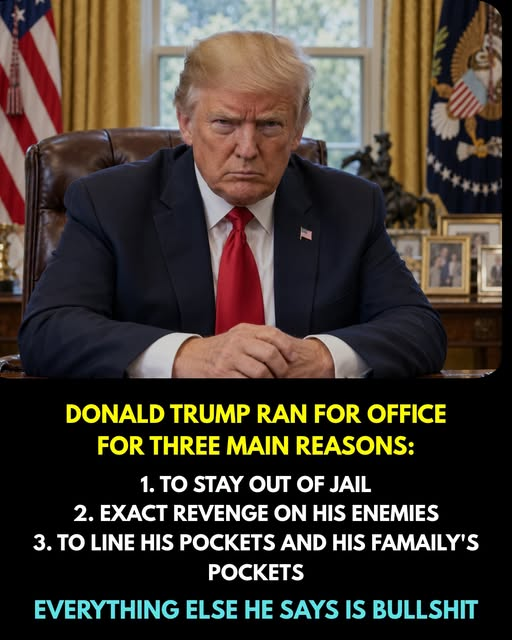
A viral graphic presents three motives for Donald Trump’s political comeback. The record contains documented legal battles, public promises to pursue perceived adversaries and extensive family business activity—but it cannot establish that these were the three reasons he ran for president.
A provocative political graphic circulating ahead of the November 2026 midterm elections makes a sweeping claim about why Donald Trump sought and regained the presidency: to avoid prison, retaliate against political enemies and increase the wealth of himself and his family. Its final line dismisses everything else he says as false.
That is a political interpretation, not an established account of Trump's private motives. But the three subjects it raises are not invented out of thin air. Trump entered the 2024 campaign while facing criminal investigations and civil litigation; he repeatedly promised consequences for people he regarded as political opponents; and his family's business interests have expanded substantially during his second administration, raising questions about conflicts of interest.
The important distinction is between what can be documented—court records, public statements, financial arrangements and government actions—and what remains an inference about the president's intentions.
1. Did Trump run for president to stay out of jail?
Trump's legal troubles were an unmistakable feature of his 2024 campaign. By the time voters went to the polls, he had been indicted in four criminal cases, including the New York prosecution involving business records, the federal classified-documents case and two cases connected to efforts to overturn the 2020 election results.
On May 30, 2024, a New York jury found Trump guilty on all 34 felony counts of falsifying business records. The case concerned payments made before the 2016 election to suppress potentially damaging information. Trump denied wrongdoing and described the prosecution as politically motivated.
After winning the 2024 election, Trump sought to have the New York case dismissed, arguing that his return to the presidency changed the circumstances. On January 10, 2025, Judge Juan Merchan imposed an unconditional discharge: the conviction remained on the record, but Trump received no jail time, probation or fine.
The federal classified-documents case was dismissed by a judge in July 2024, who ruled that special counsel Jack Smith's appointment was unconstitutional. The Justice Department later abandoned its appeal against Trump after his election victory, consistent with its longstanding position that a sitting president cannot be federally prosecuted. The federal election-interference case was also dismissed after the election under the Justice Department's policy on prosecuting a sitting president.
These developments explain why Trump's legal exposure became a major issue in the campaign. They do not, however, prove that avoiding prison was his reason for running. The graphic offers no direct evidence—such as private communications, testimony or a documented admission—that establishes that motive.
There is also an important legal point: the Constitution's presidential qualifications do not automatically disqualify someone because of a criminal indictment or conviction. A person can run for president while facing criminal charges, and a felony conviction alone does not remove the constitutional qualifications for the office.
2. Revenge against political opponents: A campaign theme with a public record
The second accusation has a more direct foundation in Trump's own public language.
In March 2023, as he launched his 2024 campaign, Trump told supporters: “I am your warrior. I am your justice. And for those who have been wronged and betrayed, I am your retribution.” The phrase became a recurring part of his political messaging.
In June 2024, days after his New York conviction, Trump told Fox News host Sean Hannity that he would have “every right to go after” his political opponents because of what he said they had done to him. In another interview, he acknowledged that revenge could sometimes be justified.
He also offered a different message at times. In January 2024, Trump said he would not have time for retribution because he intended to focus on making the country successful. His campaign rhetoric therefore included both promises of payback and assurances that governing would take priority.
The debate has taken on a new dimension in the second administration. In the days before the 2026 midterms, the Justice Department has pursued politically sensitive cases involving prominent Trump critics and former officials. The Associated Press reported on October 29 that the department had escalated investigations involving Democratic Representative Ilhan Omar, former FBI officials and former FBI Director James Comey. It also reported an unsuccessful attempt to indict former White House aide Cassidy Hutchinson.
Critics argue that the selection of targets, the timing and Trump's public comments create the appearance of political retaliation. The Justice Department rejects that interpretation, saying it is following evidence and the law. Attorney General Todd Blanche has defended the department's actions, while defendants and their lawyers have disputed the cases and alleged political motivation.
The distinction is important: an investigation or prosecution involving a political opponent is not automatically evidence of retaliation. The evidence must be assessed case by case, including the legal basis, the conduct under investigation, prosecutorial decisions and any evidence of improper direction from the White House.
Still, Trump's own repeated use of the word “retribution” makes the question of political influence over law enforcement a legitimate subject of public scrutiny.
3. The Trump family's business interests and potential conflicts
The third accusation concerns the financial interests of Trump and his relatives. Here, the public record contains extensive reporting on business activity, cryptocurrency ventures, foreign partnerships and investments in industries affected by federal policy.
An Associated Press investigation published in April 2026 reported that the Trump Organization had pursued eight overseas deals during the first year of Trump's second term, including projects in Qatar, Vietnam and Saudi Arabia. The report also described the family's expanding cryptocurrency business and investments by Trump's sons in companies seeking government contracts.
Reuters published a separate investigation in June 2026 estimating that Trump and his family had earned approximately $2.3 billion from four cryptocurrency ventures. The analysis covered World Liberty Financial, the $TRUMP meme coin, ALT5 Sigma and American Bitcoin. Reuters also reported that outside investors had suffered substantial losses in those ventures. These are the news organization's estimates based on financial disclosures and available records, not a final audited accounting of the family's total wealth.
The business interests have also intersected with policy decisions. A PBS NewsHour report in April highlighted investments by Trump's sons in drone companies and the possibility that those businesses could compete for government contracts. It also examined the family's cryptocurrency and energy-related ventures.
The potential conflict is not simply that family members own businesses. It is that some of those businesses operate in industries where federal policy, regulation, government procurement or foreign relations can affect their commercial prospects. When a president's family has financial interests in those areas, questions arise about transparency, access and whether public decisions could benefit private interests.
The White House has rejected allegations of improper influence. In a statement quoted by the Associated Press, the administration argued that Trump acts in the public interest and denied that the family's business arrangements create conflicts. The existence of a potential conflict does not, by itself, establish that a specific government decision was made to enrich the family.
The issue is attracting additional congressional attention. Reuters reported on September 28 that Democrats were preparing potential investigations into Trump family business dealings if they gained control of either chamber in the midterm elections. Areas of interest included cryptocurrency ventures, Jared Kushner's private equity firm and investments connected to companies seeking federal funding. The administration has characterized such proposed investigations as politically motivated.
What the viral graphic leaves out
The graphic's three-part description is rhetorically effective because it brings together three genuine areas of controversy. But it presents interpretations as if they were proven facts about Trump's personal motivation.
A more precise assessment looks like this:
|
Viral accusation |
|---|
What the available evidence establishes
Trump ran to stay out of jail
He campaigned while facing criminal cases, was convicted in New York and later benefited from the legal consequences of his election. His private motive is not established.
Trump ran to exact revenge
He repeatedly used “retribution” language and promised to pursue perceived opponents. Whether specific DOJ actions constitute unlawful retaliation must be assessed individually.
Trump ran to enrich his family
His family businesses and cryptocurrency ventures have expanded, with substantial reported earnings and potential conflicts. That does not prove that personal enrichment was his reason for seeking office.
The wider constitutional question is whether the presidency can be used to protect a president's personal interests or direct the machinery of government against political opponents. The American system contains checks intended to prevent that: congressional oversight, independent courts, federal and state laws, ethics requirements and public disclosure rules. How effectively those checks operate is itself a matter of continuing political and legal debate.
The Supreme Court's 2024 decision in Trump v. United States also matters to this discussion. It recognized immunity from criminal prosecution for certain presidential official acts, while distinguishing those acts from unofficial conduct. It did not establish that a president can disregard the law or use presidential authority for any purpose without limits.
The real story behind the political fight
The viral image is not proof of Trump's motivations, and its final declaration that everything else he says is false is an opinion rather than a verifiable factual conclusion.
But the underlying issues deserve examination. Trump's criminal cases and conviction are documented. His public statements about retribution are on the record. His family's business expansion and the questions it raises about potential conflicts have been investigated by major news organizations. The Justice Department's recent actions against prominent critics are also documented, alongside the administration's defense that those cases are based on evidence rather than political instructions.
The crucial questions for voters and lawmakers are therefore concrete: Are federal investigations being conducted consistently and independently? Are the president's financial interests sufficiently separated from public decision-making? Are congressional oversight and judicial review functioning effectively? And are official explanations supported by documents and evidence?
Those questions can be investigated without pretending to know a politician's private motives. Ultimately, the strongest assessment of the claims in this graphic will come not from its slogans, but from court records, financial disclosures, government documents and independently verified reporting.
Comments (0)
Loading comments...
May You Like


TRUMP'S BIGGEST THANKSGIVING “PARDON”? WHY IS HE BACKING NVIDIA'S JENSEN HUANG?

U.S. REPORTEDLY STRIKES OIL TANKER NEAR IRAN — COULD GAS PRICES SURGE?













