
Trump’s “Right Fight” Message Raises a Bigger Question: What Is at Stake?
Trump’s “Right Fight” Message Raises a Bigger Question: What Is at Stake?
A short message attributed to President Donald Trump is circulating alongside a photograph of him pointing toward an audience: “It’s not an easy fight, but it’s the right fight.” The phrase captures the language of perseverance that has long been central to his political appeal, but the image alone does not establish when or where he said it.
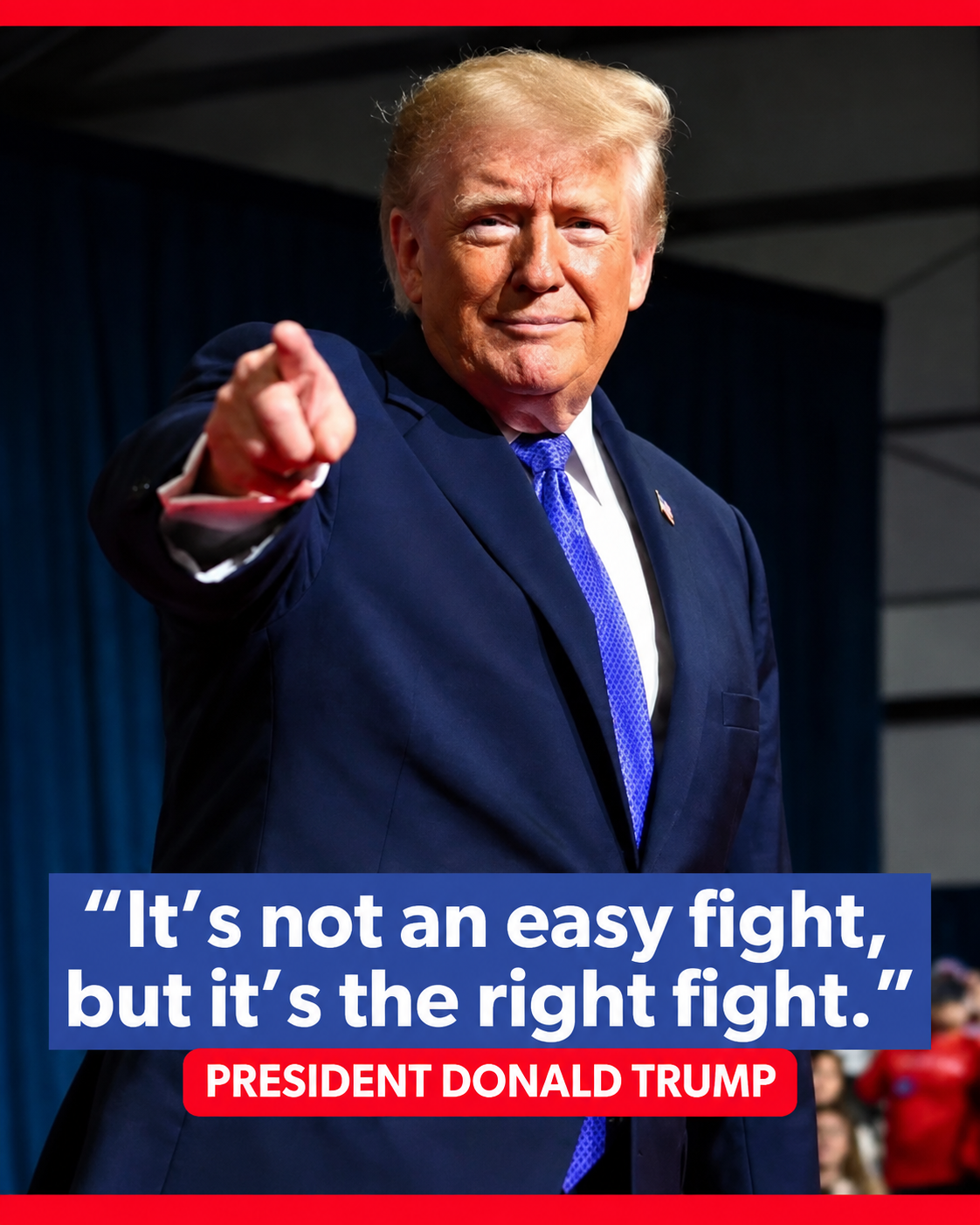
The distinction matters. Political graphics often combine authentic photographs with text added later, and even a plausible quotation should not be treated as a verified transcript without an identifiable speech, interview, or official record.
Still, the sentiment offers a window into how Trump presents political conflict: not merely as a contest over legislation or elections, but as a struggle over the direction of the United States.
For his supporters, the idea of a difficult but necessary fight can evoke disputes over immigration enforcement, trade, government spending, and the role of federal institutions. For critics, the same rhetoric can suggest confrontation at the expense of compromise.
Trump has repeatedly cast himself as an outsider confronting an entrenched political establishment, even while serving as president. That framing helps explain why messages about resistance and endurance resonate with his political base.
His opponents offer a sharply different account. They argue that dramatic claims of national crisis can heighten polarization, distract from policy details, and make routine democratic disagreement feel existential.
The resulting debate is about more than one sentence. It concerns how elected leaders define the problems facing the country and what kinds of action they ask the public to accept in response.
Immigration is one example. Trump and his allies describe stronger border controls and tougher enforcement as necessary to protect national sovereignty and public safety. Civil-rights advocates and immigration groups question the humanitarian, economic, and legal consequences of some proposed measures.
Economic policy reveals a similar divide. Trump emphasizes domestic production, tariffs, and bargaining leverage, while critics warn that broad trade barriers can raise prices and disrupt businesses that depend on international supply chains.
Foreign policy introduces another set of difficult choices. A president may argue that military pressure and hard negotiations deter adversaries, while opponents caution that escalation can bring civilian suffering and unpredictable regional consequences.
These disputes cannot be settled by slogans alone. Their consequences depend on implementation, court rulings, congressional decisions, economic conditions, and events beyond any administration’s control.
The image’s wording also highlights a familiar feature of modern political communication: a compact phrase can travel faster than the full speech or policy explanation from which it may have originated.
Social platforms reward material that is easy to recognize, emotionally direct, and simple to share. A striking photograph and a few words can become a political statement even when crucial context is missing.
That speed creates risks for readers. An accurately quoted remark may be stripped of context, while an invented or paraphrased line may be circulated as though it were a verbatim presidential statement.
A useful first step is to separate three questions: whether Trump actually said the words, what issue he was discussing if he did, and whether the underlying policy argument stands up to scrutiny.
In this case, the graphic does not provide a date, venue, or source for the quotation. Without those details, the safest description is that the image attributes the line to Trump, not that a specific recent speech has been confirmed.
The broader political significance remains clear. Appeals to sacrifice, persistence, and national purpose are powerful because they invite voters to see political choices through the lens of character and commitment.
But citizens can agree that governing is difficult while disagreeing profoundly about which battles are justified. A policy described as necessary by one group may be regarded as harmful by another.
As the country debates its next steps, the central test is not how forcefully leaders describe a fight. It is whether their decisions produce measurable results, respect legal limits, and withstand public scrutiny.
The message in the image ends with certainty. The more important question for voters is what specific fight it refers to—and what evidence would show that pursuing it is truly right.
Comments (0)
Loading comments...
May You Like

U.S. REPORTEDLY STRIKES OIL TANKER NEAR IRAN — COULD GAS PRICES SURGE?

AMERICAN FLAG BURNING IN CHICAGO — FREE SPEECH OR DISRESPECT TOWARD AMERICA?

I-75 THANKSGIVING NIGHTMARE — MAIL TRUCK CRASH RAISES OVERPASS COLLAPSE FEARS!













