
The Global Chessboard Is Shifting: Trump’s Russia Diesel Deal, Ukraine’s Satellite Crisis and the Battle for Energy Security
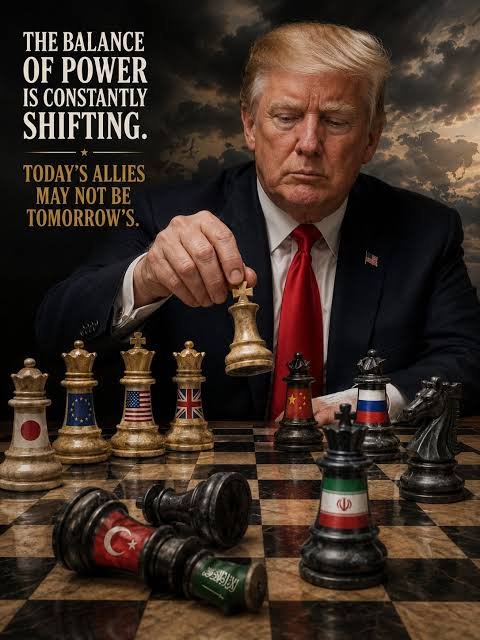
Washington is pursuing energy cooperation with Moscow while Kyiv faces new restrictions on a critical military communications system. At the same time, attacks in the Middle East are threatening energy infrastructure and shipping routes, forcing European governments to reconsider their strategic dependencies. The result is a growing clash between economic interests, military commitments and the future of international alliances.
The supplied graphic illustrates shifting global power relationships. It is a conceptual image, not documentary evidence of a specific diplomatic meeting or agreement.
WASHINGTON, October 16, 2026 — A series of developments involving the United States, Russia, Ukraine, China and the Middle East is exposing the competing priorities shaping global diplomacy. A new U.S.–Russia diesel arrangement, reported restrictions on Ukraine’s military satellite communications, and attacks on Gulf energy infrastructure are converging at a moment when governments are under pressure to secure fuel supplies, preserve military partnerships and avoid a wider regional escalation.
The events do not prove that a single secret strategy is directing the world’s major powers. Instead, they reveal how countries can pursue cooperation in one area while remaining adversaries in another. Washington is seeking cheaper fuel, Moscow sees opportunities for renewed economic engagement, Kyiv fears that its defense could be weakened, and European governments are attempting to protect their own security and economic interests.
One of the most consequential developments came on October 9, when President Donald Trump announced that Russia had agreed to supply diesel fuel to the United States and global markets. Reuters reported that the initial delivery was expected to exceed 300,000 metric tons, with additional shipments announced for November and afterward. The administration also temporarily lifted U.S. sanctions affecting Russian fuel imports, allowing the arrangement to proceed under a Treasury Department license valid through April 7.

Illustrative image: Fuel storage and distribution infrastructure. The photograph does not depict a verified shipment under the U.S.–Russia agreement.
The arrangement has been presented as an effort to relieve pressure on American fuel prices, which have risen sharply amid the conflicts involving Iran and Ukraine. Diesel is particularly important because it powers much of the trucking, agricultural and freight sectors. Higher diesel costs can increase the expense of transporting food, industrial materials and consumer goods, meaning that fuel-market disruptions can affect household budgets far beyond the gas station.
Trump announced the agreement following what he described as a successful discussion with Russian President Vladimir Putin. The Kremlin subsequently portrayed the arrangement as a potential opening for broader economic cooperation between the two countries. Reuters reported that Kremlin envoy Kirill Dmitriev said the agreement could serve as a model for future investment and commercial projects.
However, the deal has generated criticism because revenue from Russian energy exports can support Moscow’s government while Russia continues its war against Ukraine. Ukrainian President Volodymyr Zelenskyy condemned the arrangement at a European Union summit in Brussels on October 16, arguing that it could channel additional money to Russia without resolving the underlying conflict. Italian Prime Minister Giorgia Meloni also described the decision as a risky choice that could undermine efforts to pressure Moscow toward negotiations.
The distinction between the agreement and claims of a “secret oil deal” is important. The diesel arrangement was publicly announced by Trump; the controversy concerns its terms, its implications for sanctions policy and its potential effects on Russia’s wartime finances. The available reporting does not establish that it was a covert agreement designed to produce a wider realignment of global alliances.
The dispute became more serious when Ukrainian military officials reported unexpected restrictions affecting Starshield, SpaceX’s military-grade satellite communications service. The system supports communications and drone operations, making reliable connectivity important for some Ukrainian missions. On October 14, Ukrainian officials said that speed-related limitations had disrupted operations and forced some missions to be cancelled. The following day, Ukrainian commanders said the interruptions had affected drones and other military systems.

Illustrative image: Satellite communications equipment used in a field environment. It is not verified as the specific Starshield equipment affected by the reported restrictions.
The issue moved beyond a technical dispute on October 15, when Reuters reported, citing two U.S. officials and a senior Western official briefed on the matter, that the instruction to limit Starshield’s use in Ukraine had originated within the White House. The officials did not identify who made the decision. A U.S. official separately denied that Trump had ordered a deliberate slowdown, and the White House did not clarify whether another administration official had been responsible.
That distinction remains central. The reporting points to an order originating inside the White House, but it does not establish that Trump personally made the decision. Nor does it prove that SpaceX independently initiated the restrictions. The competing accounts leave important questions about authority, responsibility and the process behind the change.
For Ukraine, the immediate concern is operational. Starshield and Starlink have become significant components of the country’s communications infrastructure, and there is no ready-made European system that can fully replace the capability in the short term. European satellite operators are exploring alternatives, while the restrictions have renewed debate about the risks of relying on technology controlled outside a country’s own defense institutions. Reuters reported on October 16 that shares in European satellite companies Eutelsat and SES had risen as investors reassessed the prospects for alternatives to SpaceX’s network.

Illustrative image: Satellite broadband infrastructure. European operators are exploring ways to reduce reliance on a single provider, although their current capabilities do not fully replace Starlink in the near term.
The satellite dispute has intensified the diplomatic fallout from the diesel agreement. Kyiv sees the combination of sanctions relief for Russian fuel and interruptions to a crucial communications service as evidence of increased uncertainty in its relationship with Washington. European leaders, meanwhile, are discussing how to sustain Ukraine’s defense if American support becomes less predictable. Zelenskyy told EU leaders that Ukraine could face a financing gap and requested an additional €70 billion for defense, weapons and resilience in 2027.
The wider energy situation is adding urgency. The war involving Iran has put pressure on oil supplies and shipping through the Strait of Hormuz, one of the world’s most strategically important maritime routes. Renewed attacks by Yemen’s Iran-aligned Houthi movement against Saudi targets have increased concerns about the security of energy infrastructure and transport networks. Reuters reported that Houthi attacks had targeted Riyadh’s airport and the headquarters of Saudi Aramco, exposing vulnerabilities for a major U.S. partner in the Gulf.

Illustrative image: Oil infrastructure in Saudi Arabia. The image is not presented as a photograph of the reported attack on Aramco’s facilities.
These regional developments create a difficult equation for energy markets. Additional Russian diesel supplies may provide some relief, but they cannot by themselves neutralize the impact of prolonged conflict or serious disruption to shipping through the Gulf. Reuters reported that Brent crude had climbed above $106 a barrel amid escalating Middle Eastern tensions, while energy prices remained a major topic at the EU summit.
The pressure is also political. With U.S. midterm elections scheduled for November 3, higher fuel prices pose a domestic challenge for the Trump administration and Republican candidates. The diesel arrangement is intended to add supply and ease price pressures, but analysts cited by Reuters cautioned that the volumes involved may be insufficient to sustain a significant decline in prices. The policy therefore places two goals in tension: reducing immediate costs for American consumers and maintaining economic pressure on Russia over its invasion of Ukraine.
At the same time, Washington is signaling that its relationship with Moscow and Beijing is not limited to immediate disputes over energy or war. On October 15, Trump said the United States was holding discussions with Russia and China aimed at denuclearization. His comments came months after the New START treaty expired, removing the last major bilateral treaty framework limiting the strategic nuclear arsenals of the United States and Russia. Trump’s announcement suggests an effort to open a new arms-control discussion, although no new treaty or agreement has been established.
That creates a complex picture of international relations. The United States can seek cooperation with Russia on fuel supplies and nuclear diplomacy while continuing to disagree with Moscow over Ukraine. Washington can also engage China on nuclear issues while competing with Beijing over trade, technology and strategic influence. These overlapping relationships do not mean that old alliances have disappeared; they show that governments increasingly pursue different objectives through separate negotiations, sometimes creating friction with their existing partners.
For Europe, the resulting challenge is to maintain support for Ukraine while responding to high energy costs and uncertainty over the reliability of American commitments. At the Brussels summit, EU leaders discussed energy prices and their economic relationship with China as well as Ukraine’s military and financial needs. The same meeting therefore brought together questions of defense, trade and affordability—issues that are often treated separately but are becoming harder to disentangle.
The global picture is consequently more complicated than a simple division into permanent allies and adversaries. The diesel agreement reveals how energy needs can drive cooperation between countries that remain strategically opposed. The Starshield dispute shows how reliance on private or foreign-controlled technology can become a vulnerability during wartime. The attacks in the Gulf demonstrate how regional conflicts can affect oil prices and infrastructure well beyond the immediate battlefield. And the renewed discussion of nuclear arms control highlights the continuing need for diplomacy even when relations between major powers are strained.
The central question is not whether a single secret plan has overturned the global balance of power. It is whether governments can manage these competing pressures without undermining their own security objectives or the trust of their partners. For Ukraine, the immediate priority is reliable communications and sustained support. For Europe, it is strengthening defense and energy resilience. For Washington, it is balancing fuel affordability, relations with Moscow and Beijing, and commitments to existing allies. For energy markets, it is whether additional supply can offset the risks created by conflict and disrupted shipping.
As of October 16, the evidence points to a period of significant strategic uncertainty—but not to a settled new world order. The diesel agreement has been publicly announced, the Starshield restrictions have been reported by Ukrainian officials and attributed by Reuters sources to an order from within the White House, and the competing accounts over responsibility remain unresolved. The outcome will depend on the next round of diplomatic decisions, the implementation of the energy arrangement and whether Ukraine and its partners can restore confidence in the systems and commitments on which their security depends.
Comments (0)
Loading comments...
May You Like

WEYMOUTH HORROR—80-MPH WIND GUSTS, FIRE TRUCK FLIPS, 3 FIREFIGHTERS CRITICAL!

EAST COAST STORM CRISIS—5 MILLION AT RISK OF BLACKOUTS, WATER, AND HEATING FAILURES!

STAR DIED AT 38, $10M LIFE INSURANCE INCREASED JUST 30 DAYS BEFORE WWE BRONSON REED'S DEATH!








Popular Posts




