
Trump’s Russia Diesel Deal Triggers Bipartisan Backlash as Sanctions Waivers Put Ukraine Policy Under Pressure
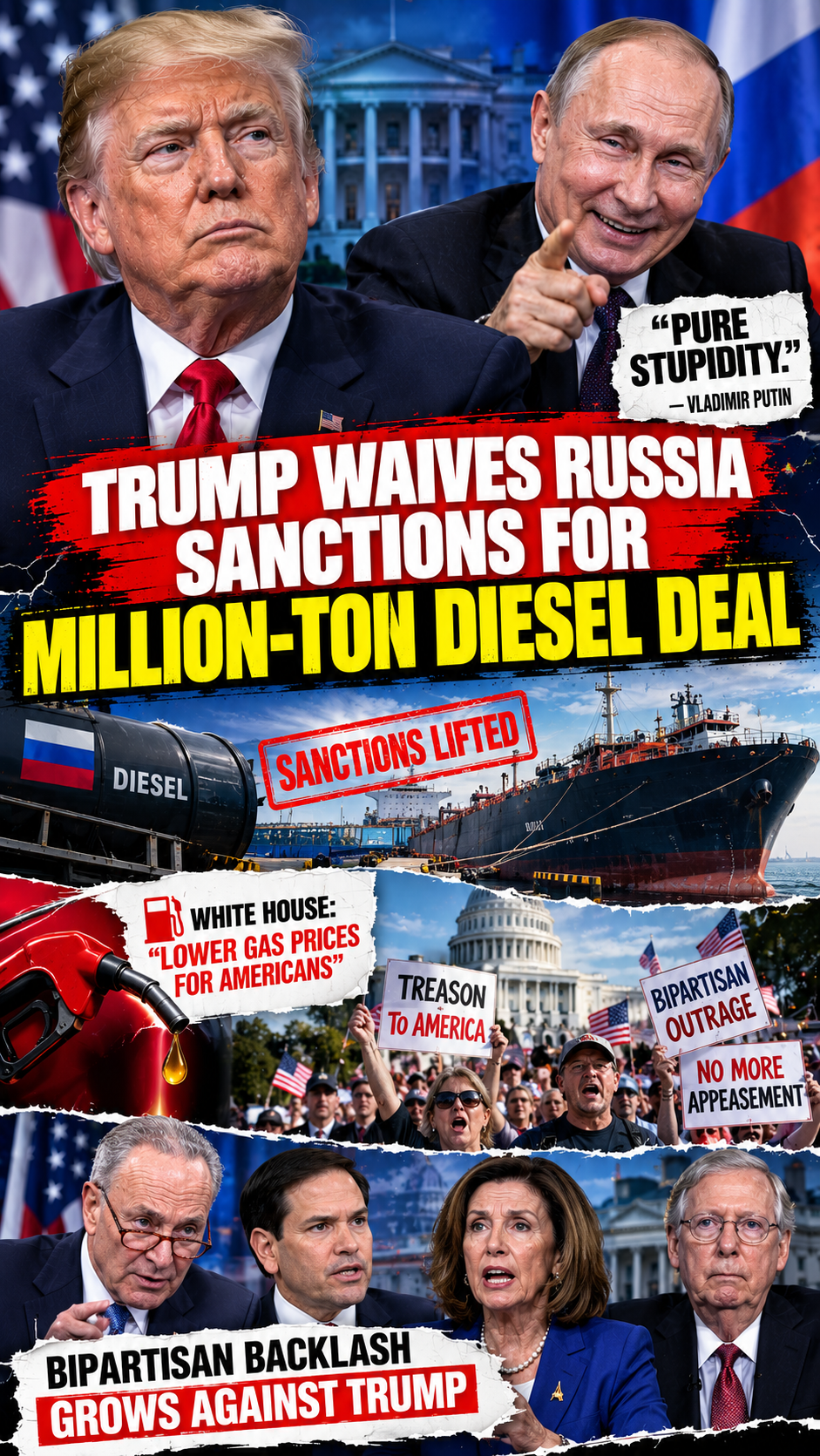
Washington, October 27, 2026 — President Donald Trump’s decision to ease restrictions on Russian energy exports and waive newly enacted sanctions has opened a fresh political dispute in Washington, putting the administration’s energy-price strategy under scrutiny while raising concerns about continued pressure on Moscow over its war against Ukraine.
The controversy centers on two related moves: an agreement announced by Trump on October 9 to increase Russian diesel supplies to the United States and global markets, followed by an October 16 executive order waiving broad provisions of a new Russia sanctions law. The administration has presented the measures as being in the national interest, while critics from both parties argue that easing economic pressure on the Kremlin risks undermining Ukraine and weakening the credibility of American sanctions policy.
The dramatic image accompanying this story uses the phrase “Pure Stupidity” and attributes it to Russian President Vladimir Putin. However, the available reporting reviewed for this article does not establish that Putin made that specific statement about this diesel agreement. It should not be treated as an authenticated quotation without a verifiable recording, transcript or reliable report confirming the words and context.

A sanctions reversal with significant consequences
The first concrete sign that the agreement is moving beyond political announcements emerged on October 23, when shipping data showed that the Malta-flagged tanker Agioi Fanendes was carrying approximately 40,000 metric tons of Russian ultra-low-sulfur diesel toward New York. The vessel loaded its cargo at the Russian Baltic port of Primorsk on October 22 and was expected to arrive on November 7, according to Reuters reporting based on shipping data. Its buyer and seller had not been publicly identified.
The cargo is important because it represents a tangible step toward resuming Russian diesel deliveries to the American market after years of restrictions. But it is not evidence that the entire proposed supply arrangement has been completed. The first shipment is one component of a much larger plan announced by Trump, and the ultimate volumes delivered will depend on commercial arrangements, available refining capacity and the practical operation of the sanctions exemptions.
On October 9, Trump said Russia would initially supply more than 300,000 metric tons of diesel, followed by 500,000 tons in November and another one million tons afterward. He also described the possibility of a further three million tons, depending on the condition of Russian refineries. These were announced commitments, not proof that all the promised fuel had already been produced, sold or delivered.

For the administration, the immediate economic argument is straightforward: more fuel entering the market could help ease supply pressures and potentially reduce costs for businesses and consumers. Diesel prices affect freight transportation, agriculture, construction and other industries that rely heavily on fuel. Higher operating costs can feed through to prices across the economy.
However, the size of the expected benefit remains disputed. The initial 40,000-ton shipment amounts to roughly 300,000 barrels, a relatively small volume compared with American daily diesel consumption. The Associated Press reported that energy experts considered the initial cargo unlikely to make a substantial difference to prices at the pump. The ultimate effect would depend on the scale and timing of subsequent shipments, broader market conditions and the availability of competing supplies.
That distinction matters politically. The administration can point to the arrival of additional fuel as evidence that the deal is progressing, but a shipment reaching a port does not automatically translate into a measurable reduction in the prices American households and businesses pay.
Why the sanctions waiver has angered lawmakers from both parties

The diesel agreement has become part of a broader dispute over the direction of American policy toward Russia. In September, Trump signed a bipartisan sanctions measure championed by the late Republican senator Lindsey Graham. The law was designed to increase pressure on Moscow and on countries continuing to purchase Russian oil and gas.
On October 16, Trump issued an executive order waiving the application of major provisions of that law, including measures that would have imposed substantial tariffs on certain purchasers of Russian energy and additional restrictions connected to Russian financial institutions. The order cited the national interest, while leaving the administration with substantial discretion over whether and when to apply the waived measures.
The administration's rationale has not been presented in precisely the same terms by every official. Trump has emphasized fuel prices and his effort to negotiate an end to the war. Energy Secretary Chris Wright defended the diesel arrangement as a potential incentive in negotiations, while Secretary of State Marco Rubio argued that the fuel would have been sold regardless of the agreement with Washington. Those explanations point to different assessments of how much leverage the deal gives the United States.
The objections from Congress have been unusually cross-party. A group of 12 senators, including Republicans and Democrats, urged Trump to reverse course, arguing that allowing Russian diesel into American markets could weaken pressure on the Kremlin and conflict with the purpose of the sanctions regime. Their criticism was not simply about the commercial transaction; it concerned whether easing restrictions would provide Russia with economic benefits while its war against Ukraine continued.

Republican critics have questioned whether the administration is giving Moscow too much room to maneuver. Democratic lawmakers have argued that the decision risks undermining Ukraine and the broader international effort to impose economic costs on Russia. Their objections reflect a dispute over whether short-term energy-market relief justifies relaxing restrictions originally intended to limit the Kremlin's revenue and international economic reach.
There is also an important legal distinction: the president did not simply erase every existing sanction on Russia. The October order waived provisions of the newly enacted law, while earlier sanctions imposed through other legal authorities remained in place. The precise scope of the waiver therefore matters when assessing claims that the United States has abandoned its entire sanctions policy.
The political reaction has nevertheless moved beyond statements of concern. On October 23, Roll Call reported that lawmakers had introduced legislation intended to reverse the administration's authorization of Russian energy purchases and prevent similar waivers in the future. The proposals illustrate how the dispute is becoming a question of congressional oversight as well as executive foreign policy.
Moscow sees an opening as Washington debates the costs

The agreement also gives the Kremlin an opportunity to present renewed energy trade with the United States as evidence that economic cooperation remains possible despite the war and years of sanctions.
Putin discussed the planned deliveries during an October 21 meeting with U.S. envoy Steve Witkoff, according to reporting by S&P Global. Putin said international diesel prices had fallen by between 5% and 6% after the agreement was announced. That was his account of the market response; it does not by itself establish that the agreement caused the entire decline or that consumers would experience a comparable reduction in retail prices.
The Kremlin's interests are not limited to the immediate value of the fuel. A renewed commercial channel could help Russia diversify its outlets, restore export activity and argue that sanctions can be relaxed when Washington's economic priorities change. At the same time, the United States is seeking additional supplies during a period of elevated energy costs. Both governments therefore have reasons to emphasize the potential benefits of cooperation, even though they disagree sharply on Ukraine and European security.
The economic realities remain complicated. Russian refining capacity has been affected by Ukrainian attacks on oil infrastructure, and Moscow has had to balance export ambitions against its own domestic fuel requirements. Reuters reported on October 26 that Russian refiners were increasing diesel output after export quotas were granted following the agreement. The report indicates that supplies are being adjusted in response to the new arrangement, but it does not establish that Russia can immediately meet every volume Trump announced.
Ukraine faces the strategic consequences

For Ukraine, the concern is that relaxing economic pressure could benefit Russia while the war continues. President Volodymyr Zelenskyy criticized the sanctions decision, warning that reducing pressure on Moscow could encourage further aggression. Ukrainian officials have repeatedly urged allies to restrict Russian energy revenues because those earnings help sustain the country's economy and state capacity during wartime.
The administration's approach reflects a different calculation: that energy-market relief and continued negotiations may serve American economic and diplomatic interests. Yet the effectiveness of that approach depends on results that remain uncertain. If the additional supplies are too limited to materially lower prices, the economic justification could weaken. If Russia gains meaningful revenue while sanctions pressure diminishes, critics may argue that the strategic costs exceed the benefits.
Neither outcome can be established simply from the announcement of a deal. The relevant evidence will include the amount of fuel actually delivered, changes in American wholesale and retail diesel prices, the financial benefits accruing to Russian exporters, and whether the arrangement produces any measurable diplomatic progress.
The midterm election adds political pressure
The timing is difficult to separate from domestic politics. The November 3 midterm elections are approaching, and high energy costs have become a major concern for the administration. Trump has presented the Russian diesel arrangement as one effort to address the problem. The first reported tanker is expected to arrive in New York on November 7, after Election Day, meaning the initial shipment itself cannot demonstrate a pre-election reduction in American prices.
That timing creates a political test for the administration. Supporters can argue that securing additional supplies is a practical response to a difficult energy market. Critics can counter that the expected benefit is uncertain and that easing pressure on Russia could compromise a policy intended to constrain Moscow's war effort.
The debate also highlights a broader challenge for any president: economic and foreign-policy goals can conflict. A government may seek lower fuel prices at home while trying to limit the revenues of a foreign state abroad. When those objectives collide, officials must weigh immediate costs against longer-term strategic consequences—and explain why their chosen trade-off serves the national interest.
What is confirmed—and what remains unproven?
The central facts are clear: Trump announced a Russian diesel supply agreement on October 9; the administration issued sanctions waivers; bipartisan lawmakers publicly opposed the moves; and shipping data subsequently showed a tanker carrying Russian diesel toward New York. Congress has also seen efforts to reverse or constrain the policy.
Other claims require more caution. The full announced volume has not been delivered simply because the deal exists. The extent to which the agreement will reduce American fuel prices is uncertain. And the image's attribution of “Pure Stupidity” to Putin has not been substantiated by the reporting reviewed here. Without a reliable source for that exact wording, it should not be presented as a confirmed quote.
The dispute is therefore about more than one tanker or one sanctions waiver. It is a test of how the Trump administration balances the price of energy at home, the use of economic pressure against Russia, congressional authority and support for Ukraine. As the first cargo approaches the United States and lawmakers push for a policy reversal, the consequences will be measured not by the drama of political slogans, but by what the agreement delivers—and what it costs.
Comments (0)
Loading comments...
May You Like

WWE BRONSON REED—STAR COLLAPSES AT COMPANY EVENT, FATAL DRUG REACTION SUSPECTED!

WWE BRONSON REED DEAD AT 38, STIMULANTS DETECTED, $10M INSURANCE PAYOUT FROZEN!

1,000+ MILITARY FAMILY RECORDS BREACHED, 200+ MILITARY SITES AT RISK!










Popular Posts



