Trump’s “Shock Move” Sends Canada Into Panic? The Viral Graphic Mixes Iran War Talk With a Separate Trade Fight

Verdict: MISLEADING — REAL TRUMP WARNINGS, BUT THE GRAPHIC CONNECTS TWO SEPARATE STORIES
A dramatic viral graphic claims that “Trump’s Shock Move!” has sent Canada into panic after Trump’s Iran warning, suggesting that a major new development involving Iran has suddenly changed the U.S.-Canada relationship.
There is a real story underneath the graphic—but it is not quite the story the image tells.
In September 2026, President Donald Trump has simultaneously been escalating a major trade dispute with Canada while the United States remains involved in a prolonged war with Iran. Trump has also recently compared Canada’s desire for a trade deal with Iran’s desire for a deal.
But there is no evidence that a new Iran warning suddenly caused Canada to panic or triggered the latest U.S.-Canada trade confrontation.
The two issues have developed alongside each other, but they are being conflated in the viral presentation.
What Trump actually said about Canada and Iran
One of the most striking recent Trump comments came on September 12, 2026, when reporters asked him about the future of the U.S.-Mexico-Canada trade agreement.
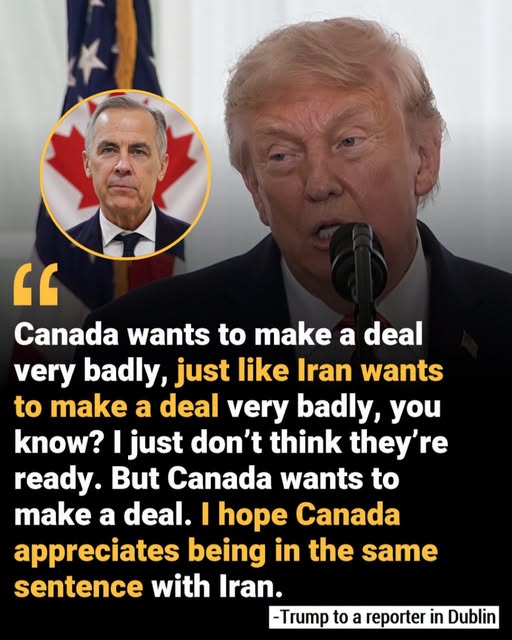
Trump said Canada wanted a deal “very badly,” and then compared Canada with Iran, which is negotiating over the war with the United States.
“Canada wants to make a deal very badly, just like Iran wants to make a deal very badly.”
Trump then added:
“I hope Canada appreciates being in the same sentence with Iran.”
He said both Canada and Iran could eventually reach agreements with Washington, although he argued that neither was ready.
That statement is real and helps explain why some online accounts are now combining the Canadian trade dispute with the Iran conflict.
But Trump did not announce an Iranian military action against Canada, nor did he say Canada would face military consequences because of Iran.
What actually happened with Canada this week
The major new development involving Canada was economic and diplomatic, not military.
On September 16, European Commission President Ursula von der Leyen proposed that Canada become the European Union's first associate member, as part of a much deeper Canada-EU partnership.
The proposal followed Canada's effort under Prime Minister Mark Carney to diversify its economic and strategic relationships amid worsening relations with Washington. Von der Leyen proposed cooperation in defense, energy, critical minerals, technology and other areas.
Carney welcomed the proposal and described the emerging Canada-EU relationship as a way to increase Canada's strategic autonomy.
Canada's own government said the two sides were working toward deeper cooperation in critical minerals, energy, defense, research and advanced technology.
That is the development that produced Trump's most recent major warning about Canada.
Trump threatened Europe over Canada’s proposed EU relationship
On September 16, Trump reacted angrily to the possibility of Canada becoming an EU associate member.
He called the idea “laughable” and said that if Canada's relationship with the EU represented a hostile act against the United States, Washington could impose “very serious tariffs” or even stop trading with Europe in certain areas.
That is a significant escalation in rhetoric.
But it is important to distinguish the actual statement from the viral graphic:
Trump threatened potential economic retaliation against Europe if the Canada-EU arrangement were considered hostile. He did not announce a new military action against Canada.
And Canada did not “panic” in any documented official sense.
In fact, Carney continued his European trip and pursued deeper cooperation with European governments.
Canada is already in a serious trade confrontation with Washington
There is, however, a genuine economic crisis behind the dramatic imagery.
The United States has imposed 50% tariffs on $27.6 billion of Canadian goods under Section 338 measures, while Canada responded with matching counter-tariffs on U.S. products beginning September 8.
The Trump administration subsequently announced additional measures affecting Canadian imports.
On September 8, Washington announced restrictions that will exclude certain Canadian dairy and alcoholic-beverage products from U.S. imports beginning September 29, while other Canadian products were shifted within the tariff regime.
And on September 16, Trump signed a presidential memorandum directing the U.S. government to identify steps to remove or restrict Canadian-origin goods from federal civil procurement.
So there really is a major U.S.-Canada economic confrontation.
The misleading part is attributing it to a sudden Iran warning.
Iran is a separate—and much larger—crisis
The United States and Iran have been involved in a prolonged conflict since the U.S. and Israel launched attacks on Iran in February 2026.
The conflict has had major consequences for energy markets, particularly because of the continuing crisis around the Strait of Hormuz.
In early September, Trump warned that the United States would respond forcefully after renewed fighting around the strategic waterway. Oil prices rose as markets worried about another escalation.
By September 12, Trump was saying that the United States was in a strong position and that Iran wanted a deal.
And on September 16, Trump said he hoped the Iran war was approaching its end while continuing to discuss negotiations.
Thus, there is a real connection between the Iran conflict and the global economic environment—but that is different from saying “Trump warned Iran, therefore Canada panicked.”
The Iran war does affect Canada economically
This is where the viral graphic has a kernel of truth.
The war has contributed to higher energy and transportation costs. Those pressures are occurring at the same time that U.S.-Canada tariffs are increasing costs for businesses.
The Associated Press reported this week that Canadian and American small businesses are dealing with the combined effects of the trade conflict and higher costs associated with the Iran war.
The Bank of Canada has also warned that Middle East tensions and damage to refining capacity could keep fuel prices elevated, while new U.S. trade measures add further inflationary pressure.
So the two crises interact economically.
But interaction is not the same as causation.
Canada is actually moving closer to Europe
One of the biggest omissions in the graphic is what Canada is doing in response to its deteriorating relationship with Washington.
Carney has openly pursued stronger relationships with Europe.
On September 16, Canada formally applied to join the U.K.-led Joint Expeditionary Force, a military cooperation group involving 10 NATO countries.
Canada is also already participating in the EU's SAFE defense procurement initiative, and Ottawa has been discussing deeper cooperation with European countries on defense, energy, critical minerals and technology.
That means the Canada-EU story is not simply a reaction to one Trump statement.
It represents a broader strategic shift that has been developing as U.S.-Canada relations have deteriorated.
What the viral graphic gets right
There are several genuine developments behind the dramatic presentation:
- Trump has issued strong warnings involving Iran.
- The Iran conflict remains a major international crisis.
- Trump recently compared Canada's desire for a trade deal with Iran's desire for a deal.
- U.S.-Canada trade relations have deteriorated sharply.
- The United States has imposed major tariffs and additional restrictions on Canadian goods.
- Canada has retaliated with its own tariffs.
- Canada is pursuing substantially closer economic and defense ties with Europe.
- Trump has now threatened potentially serious economic retaliation if the EU's proposed relationship with Canada is considered hostile.
What the graphic gets wrong or exaggerates
The headline “Canada in panic after Trump's Iran warning” goes beyond the evidence.
There is no documented Canadian government announcement saying that Canada is in panic because of Trump's Iran warning.
Nor did Trump announce a new Iran-related action against Canada.
The more immediate reason for the latest Trump-Canada confrontation is trade and Canada's developing relationship with Europe, particularly the proposed Canada-EU associate-member arrangement.
The graphic therefore combines several real stories into one dramatic narrative.
The timeline matters
February 2026: U.S.-Israeli war with Iran begins.
August 2026: U.S.-Canada trade negotiations collapse.
August 22: U.S. 50% tariffs on roughly $27.6 billion of Canadian goods take effect.
September 8: Canada begins matching counter-tariffs; Washington expands restrictions on selected Canadian products.
September 12: Trump compares Canada's desire for a trade agreement with Iran's desire for an Iran deal.
September 16: Von der Leyen proposes Canada become the EU's first associate member.
September 16: Trump threatens serious tariffs or possible trade restrictions against Europe if he regards the Canada-EU move as hostile.
That timeline tells a substantially different story from the graphic.
Bottom line
The viral image is built around real geopolitical developments, but it presents them as a single dramatic chain of events that the evidence does not establish.
Trump really has warned Iran, and the Iran war is affecting global energy and economic conditions. Trump has also sharply escalated his trade confrontation with Canada.
But Canada's latest strategic move was not caused by a sudden Iran warning. Canada's government has been pursuing deeper ties with Europe for months, and the immediate September escalation with Washington concerns tariffs, trade negotiations and Canada's proposed closer relationship with the EU.
The most significant new development is actually the EU's proposal to make Canada its first associate member, followed by Trump's threat of economic retaliation if he views that arrangement as hostile.
Verdict: MISLEADING — REAL IRAN AND CANADA DEVELOPMENTS, BUT THE GRAPHIC CONFLATES SEPARATE EVENTS AND EXAGGERATES CANADA'S REACTION.
SEO Setup
Comments (0)
Loading comments...
May You Like

Obama Steps Back Into the Political Spotlight as Democrats Target Trump’s

Russian Drone Strikes Kyiv Bridge as German Chancellor Arrives in Ukraine

OBAMA STUNS ON INSTAGRAM: MESSAGE MARKING 34-YEAR MILESTONE SPARKS A BUZZ