
Trump’s Tax Cuts: GOP Defends Its Economic Record
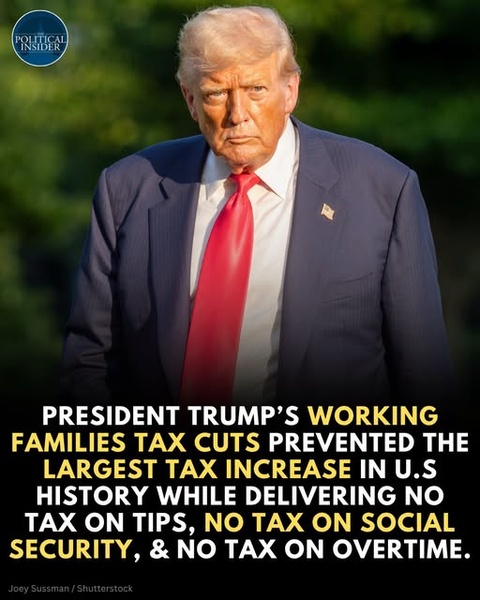
WASHINGTON — President Donald Trump and congressional Republicans are increasingly turning to the administration’s sweeping tax law as a centerpiece of their 2026 midterm campaign, portraying it as a historic victory for working Americans.
The White House has branded the legislation the “Working Families Tax Cuts” and says it delivered the largest tax relief in American history, highlighting provisions that reduce federal income taxes on certain tips and overtime earnings and provide a new deduction for some seniors receiving Social Security.
But the political message is more straightforward than the underlying tax code.
Several of the claims circulating online — particularly that the law created “no tax on Social Security” or delivered the largest tax cut in U.S. history — require important qualifications.
A Major Tax Package Signed by Trump
The tax provisions are part of the sweeping One Big Beautiful Bill Act, which Trump signed into law in July 2025.
The legislation extended many of the individual tax provisions originally enacted during Trump's first administration while adding new deductions and credits.
Among its most prominent changes are deductions for qualifying tip income and overtime compensation, a larger child tax credit, a higher standard deduction and a new additional deduction for many older Americans.
Republicans have increasingly presented the package as proof that Trump delivered on his campaign promise to reduce taxes on working Americans.
At the Republican National Convention in Dallas this week, GOP lawmakers repeatedly highlighted the tax provisions as evidence that the party was fighting for working-class voters.
What “No Tax on Tips” Actually Means
One of Trump's most prominent campaign promises was to eliminate federal taxes on tips.
The legislation does provide a new federal income-tax deduction for qualified tips. Eligible workers can deduct up to $25,000 in qualified tip income, subject to income limits and other requirements.
However, the policy does not mean that tipped workers pay no taxes of any kind on their tips.
The deduction applies to federal income tax. It does not eliminate Social Security and Medicare payroll taxes, and state and local taxes may still apply. The provision is also currently scheduled to apply from 2025 through 2028.
That distinction is significant because the phrase “no tax on tips” sounds broader than what the law actually provides.
Overtime Workers Also Receive a New Deduction
The law similarly created a deduction for certain overtime compensation.
Eligible workers can deduct up to $12,500 of qualified overtime compensation, or up to $25,000 for married couples filing jointly, subject to income limitations.
The provision is currently scheduled to run through 2028.
The White House estimates that the policy could put more money into workers' pockets and encourage employees to take additional shifts. The administration has highlighted the measure as one of its most direct benefits for hourly workers.
But again, the deduction does not make every dollar of overtime completely tax-free.
“No Tax on Social Security” Is More Complicated
Perhaps the most misleading part of the viral graphic is the statement that Trump delivered “no tax on Social Security.”
The law did not eliminate federal taxation of Social Security benefits for everyone.
Instead, it created an additional deduction for many seniors receiving Social Security benefits. The provision can reduce or eliminate federal income tax liability for some older taxpayers, depending on their income and circumstances.
The distinction matters because Social Security benefits remain part of the federal tax system, and the new provision does not simply repeal taxation of Social Security across the board.
The administration nevertheless prominently promotes the policy as tax relief for seniors. The Treasury Department says the broader package provides substantial benefits to lower- and middle-income households.
Did Trump Prevent the “Largest Tax Increase in U.S. History”?
Republicans have also framed the legislation as preventing a massive tax increase that would otherwise have occurred.
That's because several individual provisions from Trump's 2017 tax law were scheduled to expire at the end of 2025.
The new legislation extended those provisions, meaning many taxpayers did not experience the tax increases that would have occurred if Congress had allowed them to expire.
Republican lawmakers therefore argue that the legislation prevented a major tax increase.
Sen. John Barrasso, speaking at the GOP convention, described Republicans as having blocked what he called the “largest tax increase in American history.”
But that is a political characterization, not a settled economic fact.
The claim depends on treating the expiration of existing tax provisions as an impending tax increase and comparing the hypothetical outcome with the law that Congress ultimately passed.
The “Largest Tax Cut in History” Claim Also Faces Scrutiny
The Trump administration has repeatedly described its tax program as the largest tax cut in American history.
The Treasury Department has promoted the legislation as delivering historic relief, particularly to working families and lower- and middle-income households.
But independent fact-checking has challenged some of the administration's broader claims about how much typical workers are saving.
FactCheck.org reported in August that it could not substantiate several White House claims about the number of Americans supposedly saving thousands of dollars through the new tip, overtime and Social Security provisions.
The distinction between total tax relief created by legislation and the amount an individual household actually saves is therefore important.
A tax cut can be historically large in aggregate without every working family receiving a large reduction in its tax bill.
Republicans See the Law as a Midterm Campaign Weapon
The timing is politically significant.
Republicans are preparing for the November midterm elections while defending narrow congressional majorities. Trump has made himself central to the campaign despite not appearing on the ballot.
The GOP's strategy is to point to legislation passed during Trump's second term — particularly the tax package — as evidence that voters should keep Republicans in power.
The White House argues that the tax cuts give workers more take-home pay while encouraging additional work and investment.
Democrats, however, have attacked the legislation as disproportionately benefiting higher-income households while simultaneously cutting federal health and food-assistance programs.
An Associated Press review published this week found that the law has produced mixed effects: millions of taxpayers have received new or extended tax breaks, while millions are also expected to lose access to some federal benefits. The legislation is also projected to add substantially to federal deficits.
A Historic Tax Victory — or a Political Sales Pitch?
There is no question that Trump's tax legislation represents one of the most consequential changes to the U.S. tax code in years.
It delivered new tax deductions for tips and overtime, extended major provisions of Trump's 2017 tax law and expanded several benefits for families and seniors.
But the viral graphic goes further than the underlying facts.
“No tax on tips” does not mean no taxes of any kind on tips. “No tax on Social Security” does not mean Social Security taxation has been eliminated for every recipient. And describing the package as preventing the “largest tax increase in U.S. history” is a political interpretation rather than an uncontested economic measurement.
What is clear is why Trump and Republicans are emphasizing the issue now.
With the 2026 midterms approaching, they are betting that voters will remember lower taxes and new deductions more strongly than the complicated details of the legislation — and that the promise of keeping more money in Americans' pockets will translate into votes for the Republican Party.
Comments (0)
Loading comments...
May You Like

TRUMP’S OHIO WARNING UNDER THE SPOTLIGHT

Shocking news from Ohio: an unexpected development ahead of Trump's rally

Jack Smith Defends His Integrity as Trump Investigations Face Renewed Political Firestorm













