
TRUMP'S WAR CLAIMS
Trump Says America Didn’t Start the Iran War — But the Timeline Tells a More Complicated Story
November 4, 2026
President Donald Trump is renewing a contentious argument about the war with Iran, telling supporters that the United States did not start the confrontation. The assertion has become a flashpoint because it connects decades of hostility with the much more recent decision to launch American military strikes.
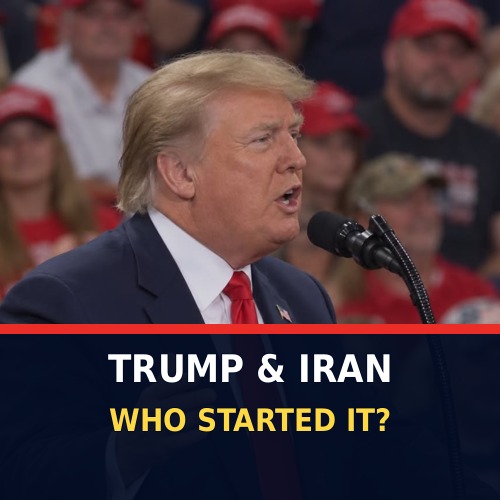
At a campaign rally in Corpus Christi, Texas, on October 27, 2026, Trump told the crowd that Iran had been waging a conflict against Americans since 1979. He returned to the same theme at a rally in Daytona Beach, Florida, on October 30, framing the military campaign as an overdue response to long-standing threats.
Photograph unavailable from the image host
His argument turns on what the word 'start' means. If it refers to the origins of hostility between Washington and Tehran, the relationship has indeed been marked by decades of crises. If it refers to the opening of the current American military campaign, the timeline is more specific and more recent.
On February 28, 2026, Trump publicly announced that the United States had begun major combat operations in Iran. That announcement establishes when the current direct U.S. campaign began, regardless of how the administration describes the deeper roots of the confrontation.
Trump traces those roots to the Iranian Revolution of 1979 and the seizure of the U.S. Embassy in Tehran, a crisis that transformed relations between the countries. The hostage-taking remains one of the defining events in the diplomatic history of both nations.
The years that followed saw sanctions, regional rivalries, attacks involving U.S. personnel, and disputes over Iranian support for armed groups. Those episodes explain why Washington has treated Tehran as a persistent security concern, but they do not erase distinctions between separate confrontations and the launch of a new war.
Photograph unavailable from the image host
At his October rallies, Trump portrayed the current campaign as a way to prevent Iran from obtaining a nuclear weapon. The administration has repeatedly argued that military pressure is necessary when it believes diplomacy and economic restrictions are insufficient.
Critics challenge that reasoning on several grounds. They question the evidence used to justify attacks, the legal basis for expanding hostilities, and the danger that further strikes could produce retaliation rather than a durable political settlement.
A second debate concerns America's partners in the region. Israel, Gulf governments and other governments have different assessments of the risks posed by Iran, and they do not always agree about the appropriate balance between military pressure and negotiations.
For civilians, the stakes extend beyond the leaders making public speeches. Strikes and retaliation can endanger communities, interrupt supplies, damage infrastructure, and create long-lasting humanitarian and economic consequences.
Photograph unavailable from the image host
The Strait of Hormuz is one of the most sensitive points in this crisis. A prolonged disruption to shipping there could affect energy flows and prices far beyond the Middle East, amplifying pressure on households and businesses worldwide.
American naval deployments help explain why the confrontation has an international dimension. Carriers, escorts and supporting forces can protect shipping and project military power, but their presence also increases the consequences of a miscalculation.
The president has sought to project confidence in U.S. military capabilities. Yet battlefield claims and political messaging require careful separation from independently established facts, particularly when the precise condition of Iranian facilities remains contested.
The nuclear issue adds another layer of uncertainty. Inspectors, policymakers and security analysts must distinguish between destroyed infrastructure, remaining enriched material, technical knowledge and the capacity to rebuild a program.
Photograph unavailable from the image host
Even a successful attack on a physical site does not automatically resolve the political dispute over enrichment, verification and international guarantees. Those issues usually require sustained monitoring and negotiations.
Domestic American politics also shape how the conflict is discussed. During the 2026 midterm campaign, Trump used the Iran issue to argue that his administration was defending U.S. security and confronting threats that earlier presidents had failed to settle.
Opponents argue that voters deserve an accounting of the strategic goals, financial costs and exit conditions of any military operation. Supporters counter that a credible threat of force may strengthen Washington's position at the negotiating table.
On November 4, Trump signaled that another U.S. strike was not immediately planned while saying the military remained prepared if necessary. That stance underscores the administration's effort to combine pressure with an opening for diplomacy.
Photograph unavailable from the image host
The apparent contradiction between declaring that America did not start the war and acknowledging American strikes is partly a dispute over historical responsibility. It is also a contest over which moments in a long, complicated relationship should define the present conflict.
Ultimately, the more consequential question may be what comes next: whether Iran and the United States can reach a verifiable agreement, whether both sides can avoid another escalation, and whether leaders can explain to the public what a lasting end to the confrontation would actually require
Comments (0)
Loading comments...
May You Like


IOWA ENVIRONMENTAL DISASTER: 5-TON WASTE BLAST DISPLACES 3,000 FAMILIES!

IOWA CRISIS — 150+ WITH LEAD AND MERCURY POISONING, 69 CRITICAL!

Latest Posts









Popular Posts



