
U.N.-Backed Investigators Say U.S. Strikes in Iran May Constitute War Crimes
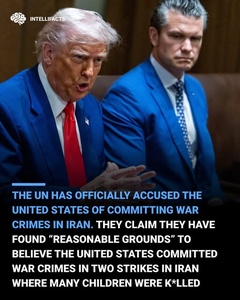
Independent investigators say they found “reasonable grounds” to believe two U.S. strikes on civilian sites violated the laws of war. Washington rejects the findings, while the same inquiry accuses Iran of crimes against humanity.
GENEVA — Independent investigators commissioned by the United Nations Human Rights Council say they found reasonable grounds to believe U.S. forces committed war crimes during two deadly strikes in Iran earlier this year.
The findings were released September 17 by the Independent International Fact-Finding Mission on Iran, a three-member investigative body created by the Human Rights Council in 2022.
Investigators focused on two attacks carried out on February 28, the opening day of the 2026 U.S.-Israeli military campaign against Iran, according to the mission’s findings.
The first involved the Shajareh Tayyebeh school in Minab, southern Iran, where Iranian authorities say 168 people were killed, with women and children accounting for most casualties.
The U.N.-backed investigators described the school as a clearly identifiable civilian object and said they found no evidence demonstrating that the building was being used for military purposes.
Their conclusion goes further than describing the deaths as accidental collateral damage. Investigators said evidence indicated the school building itself was the intended point of impact.
That finding challenges explanations attributing the school strike to targeting problems or an attack intended for an Iranian Revolutionary Guard facility located nearby.
Reuters previously reported that an internal U.S. military investigation indicated American forces were likely responsible for the deadly Minab strike, although the Pentagon subsequently elevated its investigation.
The Pentagon has not publicly released preliminary findings from that investigation, leaving important questions about targeting decisions and responsibility unresolved in the public record.
The second incident examined by investigators occurred in Lamerd, another southern Iranian city, where a strike hit a sports complex and affected surrounding residential areas.
The mission said Precision Strike Missiles dispersed tungsten pellets across a clearly identifiable sports facility and residential area, killing and injuring 22 civilians while damaging nearby buildings.
Investigators concluded that attack was indiscriminate and therefore constituted a war crime under international humanitarian law, according to Reuters’ account of the report.
U.S. Central Command has disputed responsibility for the Lamerd incident, saying in March that American forces did not conduct strikes inside the city on February 28.
Taken together, the two incidents killed at least 178 civilians, according to the fact-finding mission, although casualty accounting remains complicated by the continuing conflict and limited access.
The mission said it had reasonable grounds to believe the United States committed the war crime of launching indiscriminate attacks causing civilian deaths, injuries or damage to civilian objects.
That language is legally significant but requires an important qualification: “reasonable grounds to believe” is an investigative standard, not a criminal conviction or final judicial determination.
The fact-finding mission is an investigative body. It does not operate as an international criminal court and cannot itself prosecute President Trump, Defense Secretary Pete Hegseth or American military personnel.
Its findings can nevertheless contribute to a larger evidentiary record and potentially be considered in future accountability proceedings conducted through courts or other international mechanisms.
The investigation drew on interviews with 73 people, along with satellite imagery, photographs, videos, documents and information supplied by organizations and experts considered credible by the mission.
Investigators said their work was hampered by limited cooperation. Nearly three dozen requests for information from Iran went unanswered, while requests sent to the United States also received no substantive cooperation.
The Trump administration strongly rejected the report. White House spokesperson Anna Kelly accused the Human Rights Council of producing what the administration considers politically biased and unreliable findings.
The State Department similarly said Washington did not consider the report credible, pointing to the Trump administration’s withdrawal from the Human Rights Council and longstanding U.S. criticism of that institution.
The White House instead accused the Iranian government of committing war crimes, citing Tehran’s treatment of its population, attacks abroad and military activities throughout the region.
Importantly, the U.N.-backed mission itself also delivered extremely serious findings against Iran, meaning its report was not confined to investigating American military conduct.
Investigators said Iranian authorities conducted a widespread and systematic attack against civilians during anti-government protests beginning late last year.
The mission documented allegations involving unlawful killings, torture, arbitrary detention, enforced disappearances, restrictions on expression and violent repression by Iranian security forces.
It concluded that numerous violations amounted to crimes against humanity, including murder, imprisonment, torture and other inhumane acts committed as part of a widespread and systematic attack.
Iranian authorities have disputed international characterizations of their crackdown, blaming terrorists, rioters and foreign-backed opponents for much of the violence surrounding the protests.
The mission said the Iranian government’s official figures reported 3,038 deaths and approximately 25,000 injuries, but investigators believe the true casualty totals could be substantially higher.
Earlier U.N. human-rights experts had already raised concerns about the Minab school attack. A July communication to Washington specifically cited reports that at least 168 people were killed there.
That communication warned that attacks affecting schools, medical facilities, women and children raised serious questions under international humanitarian and international human-rights law.
The September findings are more consequential because investigators have now moved beyond expressing concern and concluded there are reasonable grounds for a war-crime determination concerning the two attacks.
Still, the graphic’s statement that “the UN officially accused the United States of committing war crimes” compresses an important institutional distinction.
More precisely, independent experts appointed by the U.N. Human Rights Council found reasonable grounds to believe U.S. forces committed war crimes in two specific February 28 strikes.
They did not find the United States “guilty” through a judicial proceeding, and the report does not itself establish criminal responsibility for Trump, Hegseth or any individual American commander.
Determining individual criminal responsibility would require additional evidence concerning who authorized particular actions, what commanders knew, what targets were selected and whether applicable requirements of distinction and proportionality were violated.
The report nevertheless represents a serious international challenge to Washington’s account of the Iran war, particularly because investigators concluded a clearly identifiable school was intentionally selected as a point of impact.
For Washington, the dispute now has two parallel tracks: an unfinished Pentagon investigation and an external U.N.-backed investigation whose findings the Trump administration rejects.
For victims and their families, the mission recommended something more immediate: both the United States and Iran should end violations and provide full reparations to victims of abuses documented by investigators.
Comments (0)
Loading comments...
May You Like


Russian Drone Strikes Kyiv Bridge as German Chancellor Arrives in Ukraine

Obama Steps Back Into the Political Spotlight as Democrats Target Trump’s












