UN-Backed Investigators Say U.S. Strikes in Iran May Have Constituted War Crimes
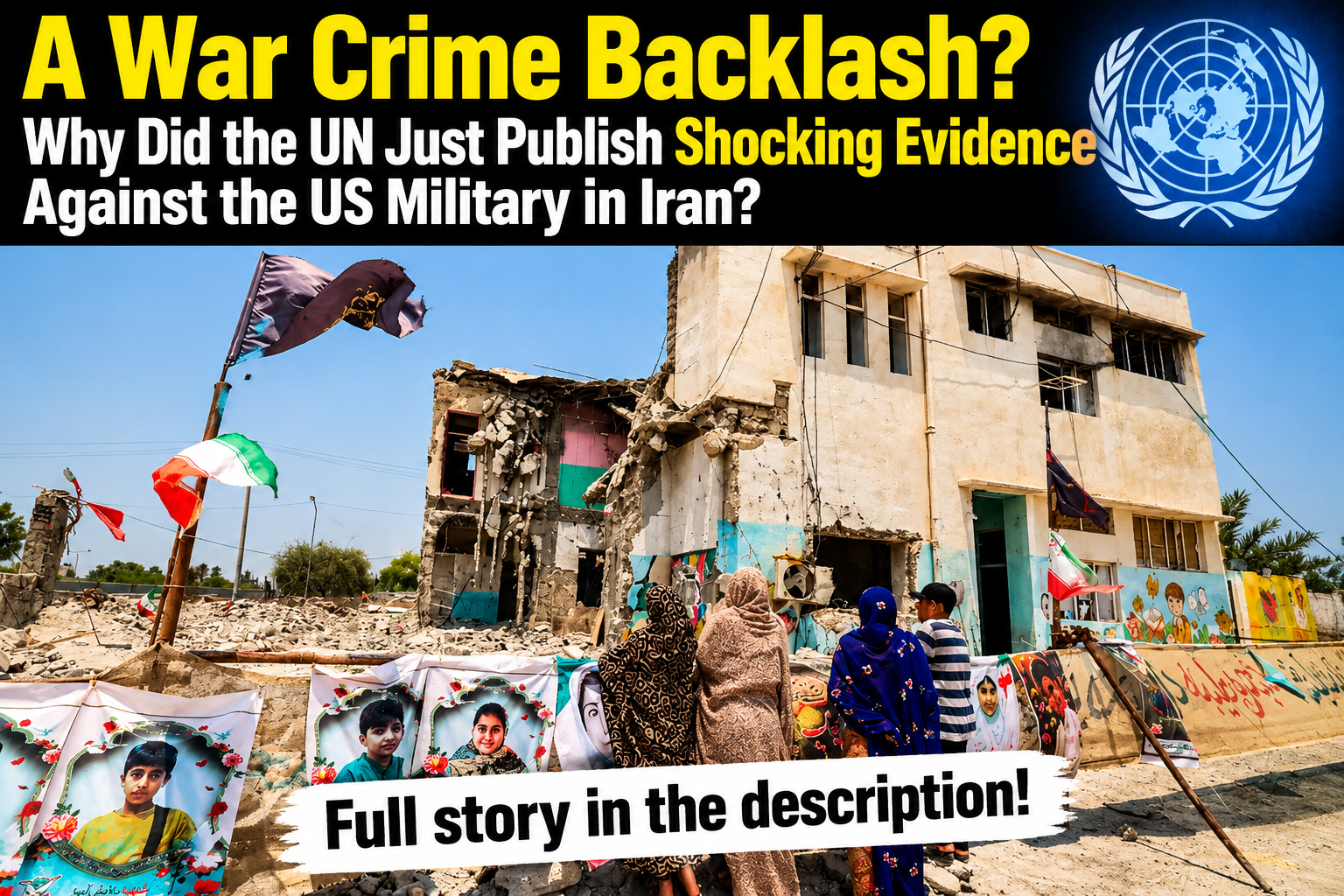
GENEVA — September 18, 2026 — A United Nations-backed fact-finding mission has concluded that there are “reasonable grounds” to believe the United States committed war crimes in two February airstrikes in Iran, including an attack on a primary school in Minab that killed scores of civilians, many of them children.
The findings mark one of the most serious international legal allegations yet made against the U.S. military over its conduct in the war with Iran.
The mission examined two incidents: the February 28 strike on the Shajareh Tayyebeh Primary School in Minab and a separate attack in Lamerd involving a sports facility and surrounding residential areas. Investigators said the attacks raised serious concerns over the principles of distinction, precaution and protection of civilians under international humanitarian law.
At the same time, the same UN-backed investigation accused Iranian authorities of crimes against humanity during their crackdown on anti-government protests that began in late 2025.
The report therefore does not present the conflict as a one-sided record of alleged abuses. It examines serious allegations against both the U.S. military and the Iranian government.


The February 28 strike on the Shajareh Tayyebeh Primary School in Minab became one of the war's most controversial incidents involving civilian casualties.
What Did the UN Investigation Actually Find?
The wording of the report is important.
The investigators did not announce that an international court had convicted the United States of war crimes.
Instead, the independent fact-finding mission mandated by the UN Human Rights Council said it found “reasonable grounds to believe” that the United States committed the war crime of launching indiscriminate attacks that caused civilian deaths, injuries or damage to civilian objects.
That is an investigative finding, not a criminal judgment.
The mission's conclusions will be presented to the UN Human Rights Council in Geneva. The fact-finding body itself does not have the power to prosecute individuals or impose criminal penalties. Its documentation could, however, potentially contribute to future accountability proceedings.
That distinction is essential when describing the story.
In simple terms:
The UN-backed investigators are saying there is enough evidence to believe war crimes may have occurred.
They are not saying a court has already established individual criminal responsibility.
The Minab School Strike
The most significant case examined by the investigators was the February 28 attack on the Shajareh Tayyebeh Primary School in Minab, in southern Iran.
The school was struck during the opening phase of the U.S.-Israeli military campaign against Iran.
The exact death toll has varied between reports because Iranian authorities, international investigators and media organizations have used different counts.
The UN-backed mission said the two strikes it examined together killed at least 178 civilians. Reuters reported that more than 150 people died in the Minab attack alone, including approximately 120 children.
Earlier reporting based on U.S. officials familiar with a preliminary military investigation indicated that an American missile likely struck the school because military targeting information incorrectly treated the location as part of an Iranian military installation.
The Washington Post reported that the school had previously been associated with a naval facility but had been physically separated from it years before the strike.


The school had previously been associated with a military site, but reporting and satellite analysis indicated that it had functioned as a civilian school for years before the attack.
Why the “Outdated Intelligence” Issue Matters
The UN findings are particularly significant because they follow months of reporting about failures in the U.S. targeting process.
In March, U.S. officials briefed the Associated Press that a preliminary military investigation indicated outdated intelligence likely contributed to the strike.
Later reporting provided additional details.
The Los Angeles Times reported that an intelligence analyst had identified changes to the site years before the attack, including evidence that the former military location had become a school. The analyst's observation apparently remained in a separate digital system and was not transferred into the database used for official targeting decisions.
The Washington Post similarly reported that the school had been separated from the nearby naval installation and that satellite imagery showed features associated with a functioning school.
These reports are important because international humanitarian law does not simply ask whether civilians were deliberately targeted.
Military forces must also take feasible precautions to distinguish civilian objects from military objectives and minimize civilian harm.
Human Rights Watch argued in March that even if the school was not intentionally targeted, the reported reliance on outdated targeting information raised serious questions about whether the United States had taken all feasible precautions.
The UN Mission Says the School Was Readily Identifiable as Civilian
The UN-backed investigators went further.
According to the mission's findings, photographs and videos showed characteristics that should have indicated the building's civilian nature.
These included:
- child-oriented murals;
- school signage;
- playground areas;
- and visible evidence of children using the facility.
The investigators also considered satellite imagery that appeared to show children gathered in the school courtyard before the attack.
The mission therefore concluded that the United States had failed to do everything feasible to verify whether the location was actually a military objective before attacking it.
That conclusion is at the center of the war-crimes allegation.
A Second Strike in Lamerd
The UN investigation did not focus solely on the Minab school.
It also examined a separate strike in Lamerd, where a sports facility and nearby residential areas were hit.
According to Reuters, the attack resulted in 22 civilian casualties. The mission concluded that the strike also raised concerns over whether adequate precautions had been taken to protect civilians.
Taken together, the two incidents formed the basis for the mission's conclusion that there were reasonable grounds to believe the United States had committed war crimes through indiscriminate attacks.
Washington Rejects the Findings
The Trump administration has rejected the allegations.
White House officials criticized the UN Human Rights Council and disputed the characterization of U.S. military actions.
White House spokeswoman Anna Kelly argued that Iran itself has committed serious human-rights abuses and defended the administration's broader policy toward Tehran.
The U.S. response also highlights an important limitation of the investigation: American officials did not cooperate with the mission in the way investigators had requested.
Reuters reported that neither the Iranian nor U.S. missions in Geneva immediately responded to requests for comment when the findings were released.
The mission consequently relied on available evidence, including publicly available information, imagery and testimony.
Iran Is Also Accused of Crimes Against Humanity
The report does not only criticize Washington.
The same UN-backed mission found that Iranian authorities committed crimes against humanity during a violent crackdown on nationwide protests that began in late December 2025.
Investigators documented allegations including:
- unlawful killings;
- torture;
- arbitrary detention;
- enforced disappearances;
- suppression of freedom of expression and assembly;
- and executions following trials that the investigators considered seriously deficient.
UN reporting said killings by Iranian security forces occurred on a massive scale across the country. The mission also documented the killing of at least 221 children during the crackdown and said tens of thousands of people were subjected to arbitrary detention.
At least 29 men were reportedly executed in connection with the protests following summary trials, according to the mission.
This parallel finding is important because the report is examining two separate categories of alleged violations: U.S. conduct during the international armed conflict and Iranian authorities' treatment of protesters inside Iran.


The UN-backed mission also investigated alleged crimes against humanity during Iran's crackdown on anti-government protests.
What Exactly Is a “War Crime”?
The phrase is often used loosely in political debate, but it has a specific legal meaning.
International humanitarian law requires parties to an armed conflict to distinguish between:
Military objectives
Targets that can lawfully be attacked under the applicable rules.
Civilian objects
Buildings and facilities that are not legitimate military objectives.
Proportionality
Even when attacking a legitimate military objective, parties must consider expected civilian harm and whether that harm would be excessive relative to the anticipated military advantage.
Precautions
Parties must take feasible measures to verify targets and reduce civilian casualties.
The UN investigators' argument is centered heavily on these principles.
The issue is therefore not simply whether the United States intended to kill civilians.
It is also whether the targeting process sufficiently verified the nature of the target and whether the foreseeable civilian risks were adequately addressed.
The Controversy Over Intent
This is one of the most important distinctions in the story.
Earlier U.S. reporting suggested that the Minab strike was likely an error caused by outdated intelligence, rather than an intentional attack on children.
The UN mission's finding does not require the conclusion that U.S. personnel deliberately wanted to kill children.
Instead, investigators focused on whether the attack was indiscriminate and whether the United States failed to fulfill its obligations to verify the target and protect civilians.
That distinction helps explain why two statements can appear contradictory:
“The school was not intentionally targeted.”
and
“The attack may nevertheless constitute a war crime.”
Under international humanitarian law, those propositions are not necessarily mutually exclusive.
Why the Report Is Emerging Now
The timing is significant.
The report comes as the U.S.-Iran conflict enters its seventh month and Washington is again discussing the possibility of diplomacy.
President Donald Trump said September 16 that he hoped the war was approaching its end and was expected to discuss the postwar situation with Gulf Cooperation Council leaders during the UN General Assembly in New York.
The release of the findings therefore comes at a particularly sensitive diplomatic moment.
It puts renewed attention on civilian casualties just as Washington is discussing how the conflict might eventually end.
The Findings Could Matter Beyond the Headlines
A UN fact-finding report does not automatically trigger criminal prosecution.
But documentation of alleged violations can become important in future accountability efforts.
Reuters reported that the mission cannot itself initiate prosecutions, although its findings could potentially be used in future national or international legal proceedings.
Possible future questions include:
- whether the United States conducts or publishes a complete investigation;
- whether Congress seeks additional information about the targeting process;
- whether families of victims pursue legal remedies;
- whether other international bodies investigate;
- and whether future military operations change their targeting procedures.
The Pentagon's own investigation into the Minab strike has been the subject of controversy because key findings have not been publicly released. Earlier reporting indicated that the investigation had encountered delays in completing standard intelligence reviews.
What the Viral Image Gets Right — and What It Leaves Out
The supplied graphic asks:
“A War Crime Backlash? Why Did the UN Just Publish Shocking Evidence Against the US Military in Iran?”
The core event is real, but several details need clarification.
| Claim in the image | What the evidence shows |
|---|---|
| The UN published evidence concerning U.S. military actions | Broadly accurate. A UN Human Rights Council-mandated independent fact-finding mission released findings concerning two U.S. strikes. |
| The report says the U.S. committed war crimes | The mission said there were “reasonable grounds to believe” the U.S. committed war crimes. This is an investigative finding, not a court conviction. |
| The Minab school was attacked by the U.S. | Supported by multiple investigations and reporting. Earlier U.S. preliminary findings indicated an American strike likely hit the school. |
| The school was deliberately targeted | Not established. Earlier U.S. findings indicated the strike was likely caused by outdated intelligence and a targeting error. |
| More than 100 children were killed | Supported by multiple reports, although exact casualty figures vary. The UN mission cited approximately 120 children among those killed in Minab. |
| The UN has convicted U.S. officials | False. The fact-finding mission does not function as a criminal court. |
| Iran was not criticized | False. The same investigation accused Iranian authorities of crimes against humanity during the protest crackdown. |
The Bigger Question: Accountability During War
The Minab strike has become a test case for a difficult question in modern warfare:
What happens when a military strike is based on incorrect intelligence and civilians are killed?
Modern militaries rely heavily on satellite imagery, databases, automated systems and rapidly changing intelligence.
The reporting surrounding Minab suggests that the problem was not necessarily a lack of information. Instead, information indicating that the location had become a school may have existed but failed to reach the systems and commanders responsible for approving the strike.
That distinction could have major implications for future military investigations.
The central legal question becomes not simply:
“Was the strike intentional?”
but also:
“Were reasonable and feasible precautions taken to ensure that the target was legitimate?”
That is precisely the question the UN-backed investigators have now placed at the center of the international debate.
What Happens Next?
The findings will be presented to the UN Human Rights Council, where they are likely to generate further political and diplomatic debate.
The United States is expected to continue rejecting the mission's conclusions, while Iran is likely to use the findings to press its case against Washington.
At the same time, Iran itself faces serious allegations from the same investigators concerning its treatment of protesters.
The report therefore creates two parallel accountability questions:
For the United States:
Were civilian-protection and targeting rules adequately followed during the strikes?
For Iran:
Did state security forces commit widespread and systematic abuses against protesters amounting to crimes against humanity?
Neither question is resolved simply by the publication of the report.
But the findings ensure that civilian casualties and possible violations of international law will remain part of the diplomatic and legal consequences of the Iran war long after individual battles have ended.


The UN Human Rights Council is expected to consider the fact-finding mission's findings as international scrutiny of the Iran war intensifies.
Comments (0)
Loading comments...
May You Like
Shocking news from Ohio: an unexpected development ahead of Trump's rally
TRUMP’S OHIO WARNING UNDER THE SPOTLIGHT
Jack Smith Defends His Integrity as Trump Investigations Face Renewed Political Firestorm