
US Adds 165,000 Jobs in Surprise Hiring Surge
U.S. Economy Adds 165,000 Jobs in Surprise Hiring Report — What the Numbers Could Mean for Trump and American Workers
A new headline about the American economy is drawing attention to a reported surge in hiring, with a Fox Business graphic announcing that U.S. employers added 165,000 jobs, exceeding expectations.
The figure, if confirmed by official employment data, would offer an encouraging indication that businesses are continuing to hire despite economic uncertainty.
For President Donald Trump, employment figures are an important measure of how the economy is performing under his administration.
For millions of Americans, however, the most important questions are more personal: Are employers creating stable jobs? Are wages keeping pace with living expenses? And is the economy providing enough opportunities for workers and families?
The headline suggests a stronger-than-expected labor market, but the image does not identify the reporting month, the original forecast or the government data release.
That distinction matters because a single employment figure cannot establish the overall strength of the economy without additional context.

Why 165,000 Jobs Would Be Significant
Monthly employment growth is one of the most closely watched indicators of economic activity in the United States.
When businesses hire additional workers, it can suggest that employers expect continued demand for their products and services.
Hiring can also support consumer spending by providing income to more households.
A reported gain of 165,000 jobs would represent a meaningful increase in employment.
However, the significance of that figure depends on several factors.
Economists would want to know whether the jobs were created in the private sector or government, which industries were hiring, and whether previous months' estimates had been revised.
They would also examine whether the unemployment rate changed and whether wage growth accelerated or slowed.
Without those details, it is difficult to determine whether the headline represents a sustained improvement or an isolated monthly result.
What Does “Beating Expectations” Actually Mean?
Financial headlines often compare employment results with economists' forecasts.
If the economy creates more jobs than analysts expected, the result is typically described as exceeding expectations.
But that does not automatically mean the labor market is stronger than it was in previous years.
A report can exceed a weak forecast while still reflecting slower hiring than historical averages.
Conversely, a result that falls short of a high forecast may still represent substantial job creation.
The relevant comparison is therefore important.
The supplied graphic does not state how many jobs economists expected.
It also does not identify whether the 165,000 figure refers to total nonfarm payrolls, private employment or another hiring measure.
Those details would be necessary to verify the precise claim.
Official Data Confirms the October Hiring Surprise
The latest figures are now confirmed by the U.S. Bureau of Labor Statistics.
Released on November 6, the October employment report showed that employers added 165,000 jobs, substantially exceeding the approximately 65,000 positions economists had forecast.
The unemployment rate also declined from 4.2% to 4.1%.
Jobs added
165,000
October 2026Economists' forecast
65,000
Approximately 100,000 fewerUnemployment rate
4.1%
Down from 4.2%Prior-month revisions
+84,000
August and September combinedThe October gain was particularly notable because hiring had averaged just 48,000 jobs per month over the preceding 12 months.
Revisions also revealed that employment growth during August and September had been stronger than initially estimated.
Together, the latest figures point to an improvement in hiring momentum.
Which Industries Are Creating Jobs?
October 2026, thousands of jobs added
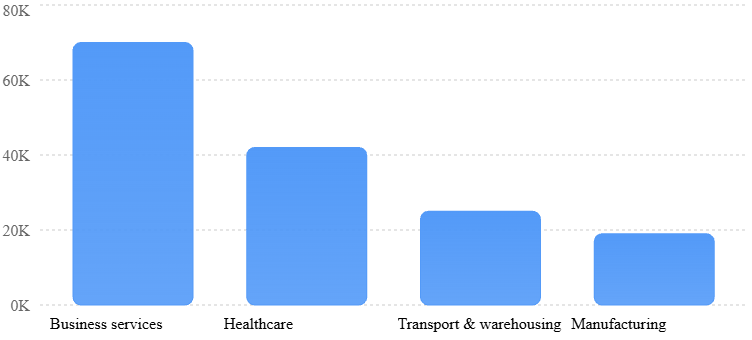
Professional and business services recorded the largest increase, adding 70,000 jobs.
Healthcare added another 42,000 positions, reflecting continued demand for hospital workers, home healthcare employees and outpatient services.
Transportation and warehousing contributed 25,000 jobs, while manufacturing employment increased by 19,000.
The manufacturing increase is particularly relevant to Trump's economic agenda, which has emphasized domestic production and industrial investment.
However, hiring remained relatively unchanged across several other major industries, including construction, retail trade and government.

Trump's Administration Welcomes the Results
The White House celebrated the employment report as evidence of improving economic conditions.
Administration officials highlighted the strength of private-sector hiring, the increase in manufacturing jobs and the upward revisions to previous months.
They also pointed to domestic investment and industrial policies as important parts of the administration's economic strategy.
The employment figures support the conclusion that hiring accelerated in October, although a single report cannot establish how much of that growth resulted from any particular government policy.
The Federal Reserve Faces a New Challenge
The stronger employment report also creates complications for the Federal Reserve.
A resilient labor market can support consumer spending and economic growth.
But strong hiring and wage increases may also make it more difficult to bring inflation under control.
Average hourly earnings rose 0.4% in October and 3.1% over the preceding 12 months.
With inflation remaining a concern, financial markets began placing greater weight on the possibility of another interest-rate increase.
Federal Reserve officials must balance the strength of employment against the risks posed by persistent inflation.
What Does This Mean for American Families?
For workers, stronger hiring can mean more opportunities to find employment or change jobs.
Businesses competing for qualified employees may also face pressure to offer competitive compensation.
However, the benefits of employment growth depend on the quality of the jobs being created.
Workers need wages that can support housing, transportation, food and healthcare expenses.
The report also showed that the number of people working part time for economic reasons increased to 4.8 million.
That detail illustrates why a positive headline figure does not necessarily mean every household is experiencing improved financial conditions.

A Strong Report, but Important Questions Remain
The October employment figures provide clear evidence of stronger-than-expected hiring.
Employers added significantly more jobs than economists anticipated, unemployment edged lower and earlier estimates were revised upward.
Those developments offer encouraging signs about the resilience of the American labor market.
Nevertheless, economic challenges remain.
Inflation, borrowing costs, housing affordability and international uncertainty continue to influence household finances and business decisions.
For Trump, the report provides a positive economic development at a politically consequential moment.
For the Federal Reserve, it introduces additional questions about the appropriate direction of interest rates.
And for American workers, the most important test will be whether stronger hiring translates into sustained wage growth, stable employment and greater purchasing power.
The October report delivered a genuine upside surprise. The next question is whether the improvement can continue without adding further pressure to inflation and household costs.
The next official employment report, covering November, is scheduled for December 4, 2026.
Comments (0)
Loading comments...
May You Like

BANGCHAK REFINERY DISASTER IN THAILAND—120,000 BARRELS A DAY SHUT DOWN, U.S. OIL PRICES SURGE 10%!

NYC EMERGENCY—MILLIONS FACE EVACUATION RISKS, MACY'S GIANT BALLOONS REMOVED FOR SAFETY!

FCC CLEARS SPACEX FOR ONE MILLION AI SATELLITES AS ASTRONOMERS SOUND ALARM

Latest Posts








Popular Posts



