
U.S.–Cuba Tensions Escalate as Marco Rubio Publicly Urges Cubans to Work With CIA, Trump Raises Prospect of Warships Near Island
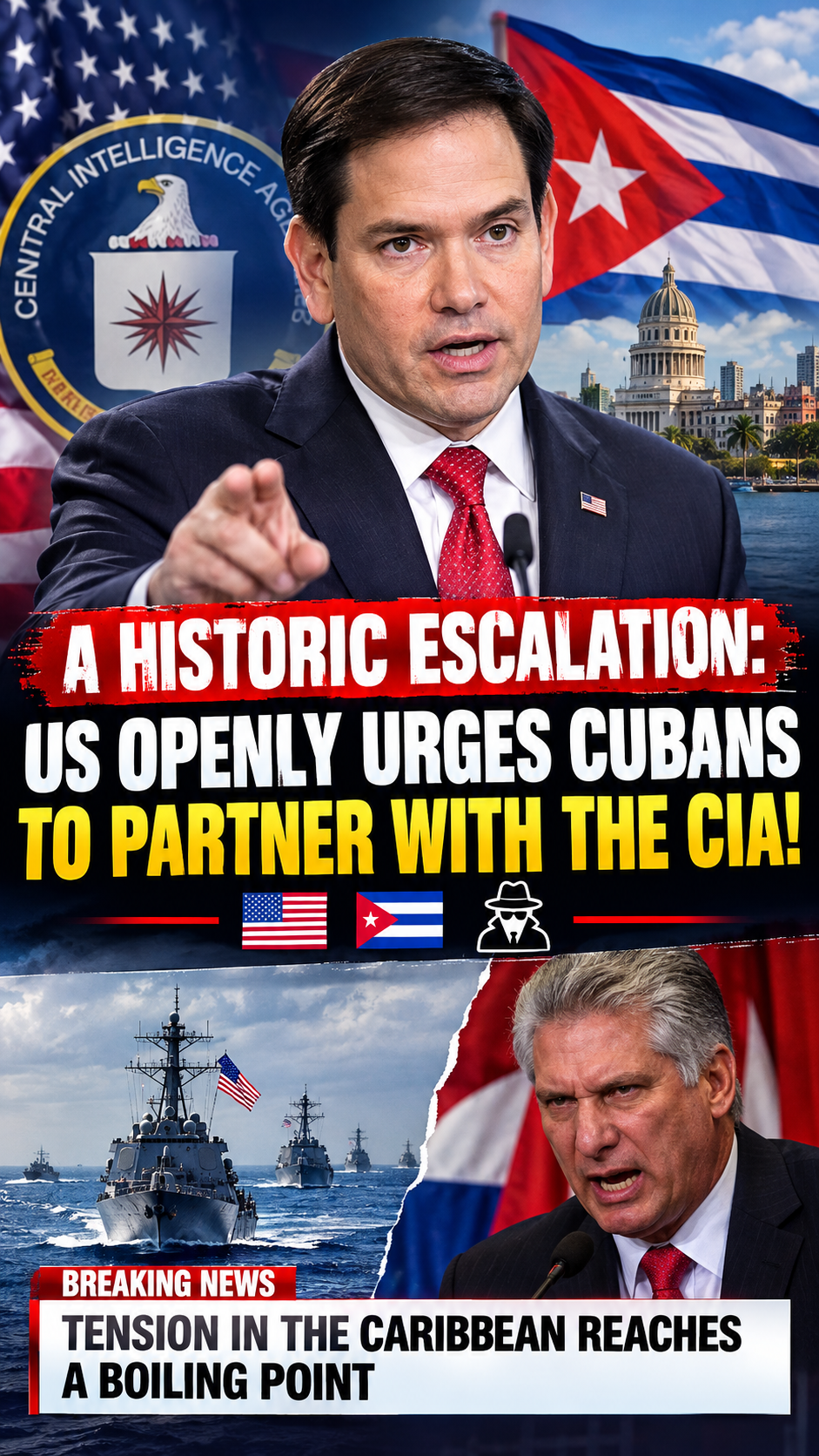
The confrontation between Washington and Havana entered a new phase Friday as U.S. Secretary of State Marco Rubio publicly encouraged Cubans seeking political change to establish contact with the Central Intelligence Agency, while President Donald Trump suggested American warships returning from operations involving Iran could stop near the Caribbean island.
The extraordinary combination of a public intelligence appeal and renewed military rhetoric has intensified a long-running dispute between the United States and Cuba, raising questions about Washington’s intentions toward the communist government and the potential consequences for an island already struggling with severe economic and energy shortages.
Rubio's statement, published on social media on October 23, represented an unusually direct appeal from America's top diplomat to people inside another country to cooperate with a U.S. intelligence service. Cuban officials quickly condemned and mocked the move, describing it as evidence of Washington's frustration with its inability to achieve its political objectives on the island.
The developments were significant not only because of Rubio's language but also because of their timing. They followed months of increased American economic pressure, diplomatic friction and discussions about possible military options involving Cuba. However, the public statements do not establish that an invasion has been ordered or that a new covert operation has begun.
Rubio, the son of Cuban immigrants and a longtime critic of Havana's communist leadership, addressed his message directly to Cubans dissatisfied with their government.
“To those who seek to create positive change in Cuba — now is the time.”
He went on to criticize corruption, broken promises and privileges enjoyed by a small segment of Cuban society, urging those seeking change to pursue a “discrete partnership with the CIA.” His post did not identify a specific intelligence operation, explain what assistance Washington expected or describe any organized plan to overthrow the government.


The CIA subsequently released Spanish-language material explaining how individuals could submit information to the agency. That follow-up gave the public appeal a more concrete dimension, although the agency did not publicly disclose the identities of potential sources or details of any intelligence activity resulting from the campaign.
For Washington, the announcement was consistent with the administration's broader strategy of increasing pressure on Cuba's leadership. For Havana, it was another example of what Cuban officials characterize as U.S. interference in the country's sovereignty.
Cuban Deputy Foreign Minister Carlos Fernández de Cossío responded sharply on X, ridiculing the United States for resorting to public intelligence recruitment. He suggested that the campaign reflected desperation within the CIA and compared its publicity efforts to commercial advertising.
The response highlighted the profound distrust between the two governments, whose relationship has been shaped by decades of sanctions, intelligence operations, diplomatic confrontation and competing political visions.
The timing of Rubio's appeal was especially striking because Trump had spoken earlier Friday at a political rally in Fort Myers, Florida, where he discussed Cuba in the context of American military operations involving Iran.
Trump told supporters that U.S. ships could pass near Cuba and that Rubio might then be sent to conclude an agreement with the island's government.


At one point, Trump suggested that an American warship could stop roughly 50 yards off the Cuban coastline. His comments were accompanied by an assertion that Rubio could handle the final stages of a deal.
The remarks attracted attention because of their military implications, but they did not amount to a formal announcement of a naval deployment or an operational order. Trump did not identify a specific ship, a timetable or the terms of any proposed agreement. His administration has previously suggested that diplomatic negotiations could resolve the dispute without military intervention.
Nevertheless, Havana treated the rhetoric seriously.
Cuban Foreign Minister Bruno Rodríguez responded by warning against hostile approaches to the island's shores. He described Cuba's coastline as difficult terrain for anyone arriving with aggressive intentions, a message widely interpreted as a rejection of Trump's suggestion that American vessels could approach the island to force a political outcome.
The exchange added another layer of tension to a relationship already strained by U.S. sanctions, disputes over regional security and Washington's stated desire for political change in Cuba.
The administration's strategy has developed over the course of 2026. Earlier in the year, Washington increased pressure on Cuba's energy supplies, threatening sanctions against countries providing fuel to the island. The measures aggravated an already difficult economic situation marked by aging infrastructure, unreliable electricity generation, shortages of essential goods and persistent inflation.
Cuba's government has blamed U.S. restrictions for worsening the country's economic problems, while Washington has argued that the island's political leadership and economic system bear substantial responsibility for its difficulties.
Both factors feature prominently in the broader debate over Cuba's economic future. The U.S. embargo and recent restrictions constrain external trade and energy access, while domestic policy decisions and structural weaknesses have also affected production, investment and public services.


The consequences for ordinary Cubans are considerable. Repeated blackouts disrupt homes, hospitals and businesses. Fuel shortages complicate transportation and the delivery of goods. Inflation has weakened purchasing power, and years of economic uncertainty have contributed to emigration.
Against that backdrop, Rubio's invitation to cooperate with U.S. intelligence services introduces a new political dimension to an already difficult situation. Individuals dissatisfied with the Cuban government may see Washington's appeal as a sign of support for political change. Others may regard it as an attempt by a foreign power to exploit domestic hardship and influence Cuba's future.
The public nature of the campaign also distinguishes it from the more secretive intelligence activities historically associated with the CIA.
American intelligence operations in Cuba have a long and controversial history. During the Cold War, Washington supported efforts to undermine Fidel Castro's government, including the failed Bay of Pigs invasion in 1961. Those events remain central to the Cuban government's narrative of resistance to U.S. intervention.
Rubio's appeal therefore carries historical significance beyond its immediate political message. A senior U.S. official was openly encouraging cooperation with the intelligence agency most closely associated with some of the most contentious episodes in U.S.–Cuban relations.
But the historical comparison has limits. A public request for information is not itself proof of a planned invasion, an organized uprising or a particular covert operation. No credible public evidence in the reporting reviewed establishes that such an operation has already begun as a direct consequence of Rubio's October 23 statement.
The broader security environment has nonetheless grown more complicated.
In May, CBS News reported that American intelligence agencies were examining how Cuba might respond to possible U.S. military action. The report also described contacts between CIA Director John Ratcliffe and Cuban officials, suggesting that Washington was pursuing intelligence and diplomatic channels alongside its economic pressure campaign.
Those earlier contacts illustrate the complexity of the current situation. Although the Trump administration has repeatedly criticized Cuba's communist leadership and discussed the possibility of political change, American officials have also explored potential agreements.
Trump himself said in September that he believed the two countries could reach a deal without resorting to military force. His more confrontational comments at the Florida rally therefore represent a renewed warning rather than conclusive evidence that diplomacy has been abandoned.
Another source of friction has been legal action against former Cuban President Raúl Castro. Florida authorities announced an arrest warrant this week in connection with the 1996 shooting down of two civilian aircraft operated by Brothers to the Rescue. Castro had also faced federal charges related to the incident earlier in 2026.
Cuban President Miguel Díaz-Canel has rejected the federal case as lacking a legal foundation and accused Washington of attempting to create a justification for military aggression. Those accusations reflect Havana's position and are not independently established conclusions about the motives behind the American legal proceedings.


The latest dispute also has implications beyond the United States and Cuba. The island's position in the Caribbean, its longstanding relationships with Russia and China, and its proximity to the American mainland make developments in Havana relevant to broader regional security discussions.
For neighboring governments, any escalation could create diplomatic, economic and humanitarian challenges. A further deterioration in Cuba's energy supply could worsen migration pressures, while an actual military confrontation would carry much wider consequences.
At present, however, the evidence supports a narrower conclusion: Washington has intensified its public campaign for political change in Cuba, Rubio has explicitly invited cooperation with the CIA, and Trump has revived the possibility of using American military presence as leverage. Havana has rejected both the rhetoric and the apparent effort to recruit intelligence contacts.
What remains unknown is how far either government intends to go.
The CIA has not publicly identified a new operation linked to Rubio's message. The White House has not announced a specific military deployment against Cuba arising from Trump's remarks. Nor has Washington disclosed the terms of the agreement Trump suggested Rubio could negotiate.
Those unanswered questions are crucial because the distinction between political signaling, intelligence outreach, diplomatic pressure and military action can determine whether a confrontation remains rhetorical or develops into a more serious international crisis.
For now, the October 23 developments mark a notable escalation in the public language of U.S.–Cuba relations. Rubio's direct invitation to work with the CIA, combined with Trump's comments about warships near the Cuban coast, has brought the possibility of political change in Havana back to the forefront of American foreign-policy debate.
Whether the administration ultimately pursues negotiations, additional economic measures or a more confrontational course remains uncertain. What is clear is that Cuba's leadership faces renewed pressure from Washington at a time when the country's economic and energy problems have already placed extraordinary strain on its population.
The next significant development may come not from another public statement, but from whether Washington and Havana can establish a credible diplomatic path before the latest confrontation deepens.
Comments (0)
Loading comments...
May You Like


WWE BRONSON REED—STAR COLLAPSES AT COMPANY EVENT, FATAL DRUG REACTION SUSPECTED!

DAVENPORT AIRBNB HORROR — 40 OF 50 TEENS TEST POSITIVE FOR DRUGS SUPPLIED BY THE HOST'S MOM!









Popular Posts



