
U.S. Economy Adds 162,000 Jobs in August, Crushing Expectations — But the Report Is More Complicated Than the Headline
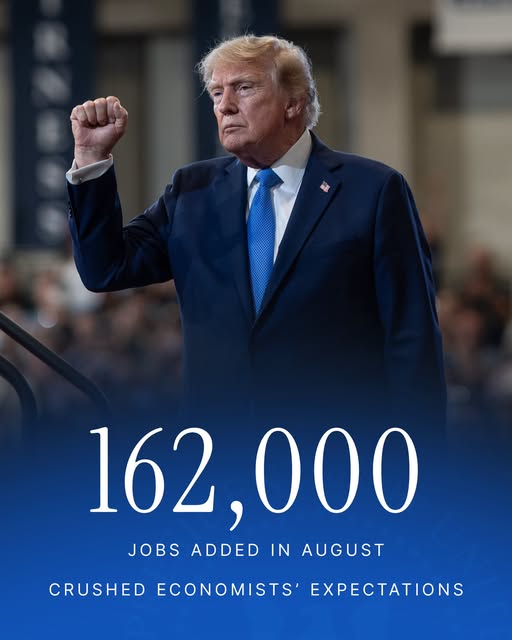
The U.S. labor market delivered a surprisingly strong performance in August, with employers adding 162,000 nonfarm jobs, far above the roughly 53,000–65,000 jobs economists had expected.
The unemployment rate remained at 4.1%, while the labor-force participation rate improved to 61.6%. Even more importantly, the government revised June and July employment upward by a combined 55,000 jobs, meaning the labor market was stronger over the summer than earlier reports had suggested.
The graphic is therefore correct about its central number: 162,000 jobs were added in August.
But calling the report simply a sign of an economic boom would miss several important details—particularly the composition of the hiring, slowing wage growth, long-term unemployment and what the numbers mean for Federal Reserve interest rates.
162,000 Jobs Was a Huge Upside Surprise
The August figure was more than three times the forecast from some economists.
Reuters' economist survey had put expectations at approximately 56,000 jobs, while other forecasts were around 53,000–65,000. The actual increase of 162,000 therefore represented a major upside surprise.
It was also the largest monthly increase in five months, according to Reuters.
The significance becomes clearer when August is compared with the recent trend.
The average monthly payroll gain over the preceding 12 months was only 31,000.
August therefore produced more than five times that recent average.
That is a substantial acceleration.
The earlier numbers were also revised upward
The government didn't simply report a strong August. It also determined that the previous two months had been stronger than initially reported.
| Month | Earlier estimate | Revised estimate |
|---|---|---|
| June | +20,000 | +31,000 |
| July | -23,000 | +21,000 |
| August | — | +162,000 |
The revisions added 55,000 jobs to the combined June-July total.
That is particularly important because July had initially looked like a negative month. After revision, July was no longer a job-loss month at all.
Where Did the 162,000 Jobs Come From?
This is one of the most important details that the graphic doesn't show.
The hiring wasn't evenly distributed throughout the economy.
Restaurants and bars led the way
Food services and drinking places added 59,000 jobs in August.
That's almost 36% of the entire monthly payroll increase.
The sector had been averaging only about 12,000 additional jobs per month during the previous year, making August's increase particularly large.
Local government education added 42,000
Local government education added another 42,000 positions, largely reversing a decline recorded previously.
Together, food services and local-government education accounted for roughly 101,000 of the 162,000 jobs added during August.
That means these two categories alone represented about 62% of the headline gain.
Manufacturing also improved
Manufacturing employment increased by 16,000, according to the Washington Post's analysis of the report. Some of those gains occurred in industries benefiting from tariffs and changes in domestic production.
Construction continued to expand
Construction employment also increased, with demand tied in part to the continuing build-out of infrastructure and data centers associated with artificial intelligence.
Health care remained a source of growth
Health care continued adding jobs, although its pace was weaker than during periods when the sector was responsible for a large share of U.S. job creation.
Not Every Sector Was Strong
This is where the "economic boom" interpretation becomes less straightforward.
Some important white-collar industries actually lost employment.
The information sector lost about 23,000 jobs, while the finance sector lost about 11,000, according to the Washington Post.
The information sector includes portions of the technology and media industries.
The weakness is particularly notable because businesses have been rapidly adopting artificial intelligence and other automation technologies.
That doesn't mean AI caused every job loss in these sectors. But the broader labor market is increasingly experiencing a divergence:
Some industries are aggressively hiring, while others are reducing headcount or becoming much more cautious about adding workers.
The Unemployment Rate Stayed at 4.1%
At first glance, it might seem strange that 162,000 jobs were added but unemployment didn't fall.
The reason is that the unemployment rate isn't simply a count of payroll jobs.
The household survey also measures whether people are working, looking for work or outside the labor force.
And in August, more Americans entered or returned to the labor force.
The labor-force participation rate increased from 61.4% to 61.6%. The labor force expanded by approximately 683,000 people.
That is actually an encouraging development.
It means the 4.1% unemployment rate wasn't being maintained simply because people were giving up looking for jobs.
More people were participating.
A Particularly Important Number: 300,000 People Returned Directly to Jobs
Reuters reported that the increase in labor-force participation was driven partly by roughly 300,000 people moving directly from outside the labor force into employment.
That's significant.
A healthy labor market isn't just one where employers hire people already working or already searching for work.
It's also one where people who had stopped looking believe the market is attractive enough to return.
That August movement suggests at least some workers became more confident about finding employment.
But Long-Term Unemployment Is Still a Warning Sign
The report wasn't uniformly positive.
Reuters noted that the median duration of unemployment rose to about 11.4 weeks, close to a 4½-year high.
That creates an important distinction:
Finding a job remains relatively easy for many workers, but some unemployed Americans are taking longer to find one.
The labor market can therefore be simultaneously:
- strong in total payroll growth,
- strong in unemployment rate,
- weak for certain industries,
- difficult for some job seekers,
- and increasingly challenging for long-term unemployed workers.
That's why economists don't generally judge the entire labor market from the payroll number alone.
Wages Rose — But Not as Fast as Prices
Average hourly earnings increased by 10 cents, or 0.3%, in August to $37.75.
Over the previous 12 months, wages increased 3.1%.
That is an important number for consumers.
A strong labor market is most beneficial when workers aren't merely employed but are also seeing their purchasing power increase.
Recent inflation, however, has been running somewhat faster than wage growth. The Washington Post noted that consumer prices were rising around 3.4%, compared with 3.1% annual wage growth.
So while Americans are earning more dollars per hour, their real purchasing power can still be under pressure.
This is one reason the jobs report isn't an unqualified victory for household finances.
Why Good Jobs News Could Actually Be Bad News for Interest Rates
This is the biggest economic consequence of the report.
Normally, adding 162,000 jobs would simply be good news.
But the Federal Reserve has two competing objectives:
- Maintain a healthy labor market.
- Keep inflation under control.
The labor market had been showing signs of weakness earlier in the summer.
That gave investors more reason to expect the Fed to reduce rates or at least avoid tightening monetary policy.
August changed that calculation.
A labor market that is suddenly producing jobs at a much faster rate gives the Fed more room to worry about inflation.
Reuters reported that futures markets moved toward a greater probability of a September rate hike following the report.
Wall Street's Reaction Was Almost the Opposite of What You Might Expect
The jobs report was excellent news for employment.
Yet stocks fell.
On Friday:
- S&P 500: -0.4%
- Dow Jones: -0.5%
- Nasdaq: -0.3%
At the same time, Treasury yields rose. The two-year Treasury yield, which is particularly sensitive to expectations about Federal Reserve policy, moved higher.
Why?
Because investors were essentially thinking:
Stronger economy → less urgency for rate cuts → greater possibility of higher rates.
Higher interest rates make borrowing more expensive for businesses and consumers and can put pressure on stock valuations.
So good economic news became bad market news.
The Fed Is Now Facing a More Difficult Decision
The Federal Reserve's next policy meeting is scheduled for September 15–16.
Before the jobs report, investors were debating whether policymakers needed to support a weakening labor market.
After the report, another possibility came back into focus:
Could the Fed actually raise rates?
Reuters reported that market pricing moved toward roughly a 59% probability of a September hike after the employment numbers.
But the jobs report alone won't determine the decision.
The Fed will also receive important inflation information immediately before its meeting.
The Bureau of Labor Statistics is scheduled to release:
- PPI: September 10
- CPI: September 11
The Fed meeting follows the following week.
That means the next inflation reports could be just as important as the jobs report.
Trump Has a Political Reason to Celebrate the Number
The graphic prominently features President Donald Trump alongside the 162,000 figure.
Trump himself celebrated the report on Truth Social, calling it a number that "breaking all estimates" and arguing that stronger economic conditions should support lower interest rates.
That puts the president at odds with the interpretation many investors took from the report.
Trump's argument is essentially:
The economy is strong → America is a better credit → interest rates should be lower.
The market's immediate reaction was closer to:
The economy is strong → the Fed has less reason to cut rates and more reason to fight inflation.
Those are two very different conclusions from the same data.
Does This Prove Trump's Economic Policies Are Working?
No—not by itself.
This is an important distinction.
The BLS report measures employment. It doesn't assign credit for individual jobs to the president, Congress or a particular economic policy.
There are many forces affecting employment simultaneously:
- consumer spending,
- interest rates,
- government hiring,
- immigration and labor supply,
- energy prices,
- tariffs,
- business investment,
- artificial intelligence,
- global economic conditions,
- seasonal patterns,
- and ordinary fluctuations in hiring.
The report therefore establishes that employment improved substantially in August.
It does not establish that Trump's policies caused all—or even most—of those jobs.
That would require a much more sophisticated economic analysis.
The Political Timing Matters
The report arrives just before the November 3 midterm elections.
That makes the 162,000 figure politically valuable for the Trump administration and Republicans, who can point to:
162,000 jobs
4.1% unemployment
55,000 upward revision
as evidence that the economy remains resilient.
But Democrats can point to different numbers:
3.1% annual wage growth
long-term unemployment increasing
weak information-sector employment
inflation still above the Fed's target
Both sides can therefore use the same report to tell very different stories.
What About the Claim "Crushed Economists' Expectations"?
That part of the graphic is fair.
The actual number was dramatically above expectations.
Using the Reuters consensus of 56,000 jobs:
Expected: 56,000
Actual: 162,000
Surprise: +106,000 jobs
In percentage terms, the actual gain was nearly three times the forecast.
Using the 65,000 estimate cited by AP, the actual gain was about 2.5 times expectations.
So "crushed expectations" is obviously promotional language, but the underlying claim is accurate.
What the Graphic Gets Right — and What It Leaves Out
✅ Correct
162,000 jobs were added in August.
The number was dramatically higher than economists expected.
Unemployment remained at 4.1%.
June and July were revised upward by a combined 55,000 jobs.
The August increase was the strongest in five months.
⚠️ Missing context
The majority of August's gains were concentrated in a relatively small number of areas, especially restaurants and local-government education.
Information and finance lost jobs.
Wage growth slowed to 3.1% year over year.
Long-term unemployment remains elevated.
And perhaps most importantly, the strong report increased the possibility of higher interest rates, which is why financial markets initially reacted negatively.
The Bigger Picture: Is the U.S. Labor Market Actually Strong?
The answer is yes—but with significant qualifications.
The August data substantially reduced fears that the U.S. labor market was sliding rapidly toward recession.
A 162,000 monthly payroll increase, a 4.1% unemployment rate and upward revisions to the previous two months are difficult to characterize as a collapsing labor market. Axios described the report as easing the earlier "jobs scare."
But the longer-term picture is less spectacular.
The average monthly payroll increase over the previous year was only 31,000, meaning the August number is unusually strong compared with the recent trend.
And the labor market still has structural challenges:
- fewer workers are available as the population ages;
- immigration restrictions can reduce labor supply;
- some white-collar occupations are experiencing AI-related restructuring;
- long-term unemployment has increased;
- and wage growth isn't currently keeping pace comfortably with inflation.
So the best description is probably:
A strong August rebound, not proof that every part of the economy is booming.
What Happens Next?
The next few economic releases will determine whether August was the beginning of a sustained labor-market acceleration or simply an unusually strong month.
The immediate sequence is:
September 10: Producer Price Index
September 11: Consumer Price Index
September 15–16: Federal Reserve policy meeting
September 29: August Job Openings and Labor Turnover Survey
October 2: September employment report
The Fed will be watching all of them.
If inflation remains stubbornly high while employment stays strong, the case for keeping rates higher—or even raising them—will strengthen.
If inflation falls sharply, policymakers could potentially interpret the strong August employment report as compatible with maintaining or eventually lowering rates.
Bottom Line
The 162,000 jobs figure is real, and it was a major upside surprise.
The most important positive signals are:
162,000 new jobs
4.1% unemployment
61.6% labor-force participation
55,000 upward revision to June and July
3.1% annual wage growth
59,000 restaurant and drinking-place jobs
42,000 local-government education jobs
But the report is not as simple as the graphic suggests.
It shows a labor market that rebounded sharply in August, not necessarily one that has entered an economic boom. The composition of hiring is uneven, long-term unemployment remains a concern, and wage growth is still trailing inflation.
Most importantly, the report has potentially changed the Federal Reserve debate.
For workers, 162,000 jobs is good news.
For Trump politically, it is good news.
For inflation fighters at the Fed, it may be a reason to stay tough.
For Wall Street, that is why good jobs news produced a bad day for stocks.
That tension is likely to dominate the U.S. economic debate through September.
Comments (0)
Loading comments...
May You Like

OBAMA STUNS ON INSTAGRAM: MESSAGE MARKING 34-YEAR MILESTONE SPARKS A BUZZ

TRUMP’S OHIO WARNING UNDER THE SPOTLIGHT

OBAMA STUNS ON INSTAGRAM: MESSAGE MARKING 34-YEAR MILESTONE SPARKS A BUZZ












