U.S. Economy Adds 162,000 Jobs in August, Far Beating Expectations
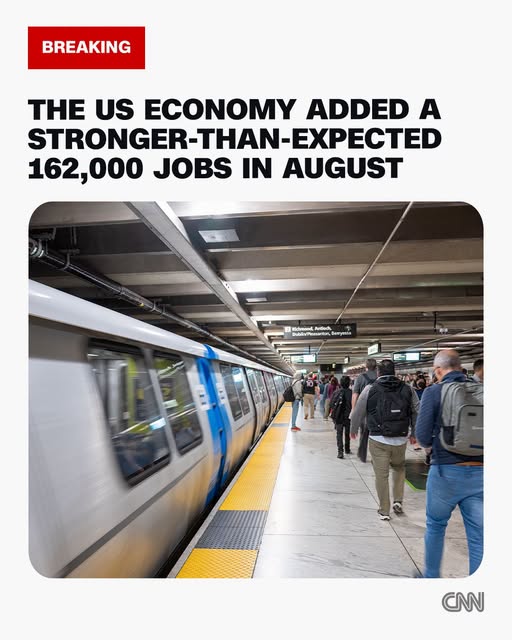
The U.S. labor market delivered a stronger-than-expected performance in August, with employers adding 162,000 jobs, according to the latest report from the Bureau of Labor Statistics (BLS).
The result was a sharp rebound from the weak hiring reported earlier in the summer and substantially exceeded economists' expectations. The unemployment rate, however, remained unchanged at 4.1%.
The graphic accurately highlights the headline figure and the better-than-expected result.
August Hiring Rebounded Sharply
Total nonfarm payroll employment increased by 162,000 in August, compared with an average monthly gain of just 31,000 over the previous 12 months, according to the BLS.
Economists had expected a much smaller increase—roughly 55,000 to 65,000 jobs, depending on the survey—making the 162,000 gain considerably stronger than forecasts.
August's increase was also the largest monthly gain in five months, according to Reuters.
The improvement followed a particularly weak stretch for hiring. The BLS revised June's gain upward from 20,000 to 31,000, while July was revised from an initial 23,000-job decline to a 21,000-job increase. Together, those revisions added 55,000 jobs to the previously reported June-July total.
Where the Jobs Came From
The biggest gains were concentrated in several areas:
- Food services and drinking places: +59,000
- Local government education: +42,000
- Nonresidential specialty trade contractors: +8,000
The information industry, meanwhile, lost jobs. Employment was little changed in several other major sectors, including retail, transportation and warehousing, financial activities, professional and business services, and social assistance.
The concentration of hiring in restaurants and local education means the headline number does not necessarily indicate that every part of the economy is accelerating.
Unemployment Stayed at 4.1%
Despite the strong payroll number, the unemployment rate did not fall.
It remained at 4.1%, the same level recorded in July. At the same time, the civilian labor force grew by approximately 683,000 people, while the labor-force participation rate increased from 61.4% to 61.6%.
That combination helps explain why the unemployment rate stayed unchanged despite strong payroll growth: more people entered or returned to the labor force and were looking for work.
Wages Continue to Rise, but More Slowly
Average hourly earnings for private-sector workers increased by 10 cents, or 0.3%, in August, reaching $37.75.
Over the previous 12 months, wages were up 3.1%.
The moderation in annual wage growth is significant for the Federal Reserve because wage pressures can contribute to inflation. At the same time, the economy is still dealing with elevated price pressures, meaning a strong jobs report could complicate the Fed's next decision on interest rates.
A Strong Jobs Report Creates a New Fed Question
The report arrived just ahead of the Federal Reserve's September policy meeting.
Before the data, markets had been focused heavily on whether weakening employment would justify interest-rate cuts. The unexpectedly strong August numbers shifted some expectations in the opposite direction, with financial markets increasing the probability of a potential Fed rate hike.
Citigroup, for example, moved its forecast for the next Fed rate cut from October 2026 to June 2027, arguing that the stronger labor market gives policymakers more reason to concentrate on inflation.
That doesn't mean a rate hike is certain. The Fed will also have the upcoming inflation reports to consider before making its decision.
Is the Labor Market Actually Getting Stronger?
The August report is clearly positive, but economists caution against reading the 162,000 figure in isolation.
The unemployment rate remains above the levels seen during some of the strongest periods of the post-pandemic recovery, while long-term unemployment has increased. Reuters also noted that the median duration of unemployment rose to 11.4 weeks, close to a four-and-a-half-year high.
In other words, the latest data suggest a labor market that has rebounded rather than returned to an unambiguously booming state.
Hiring is stronger, but workers looking for jobs may still face a very different environment from the headline payroll number.
What the Graphic Gets Right — and What It Leaves Out
What it gets right:
- The U.S. added 162,000 nonfarm jobs in August.
- The figure was substantially above economists' expectations.
- The unemployment rate remained at 4.1%.
- The report represented a significant improvement from the weak June-July hiring picture.
What it leaves out:
- The unemployment rate did not decline.
- Most of the job growth was concentrated in food services and local government education.
- June and July figures were revised substantially higher.
- Wage growth was 3.1% year over year.
- Long-term unemployment remains a concern.
- The unexpectedly strong report could make it harder for the Fed to justify near-term rate cuts.
Bottom Line
The 162,000 August jobs gain is genuinely stronger than expected and represents a welcome rebound for the U.S. labor market.
But the broader picture is more nuanced: unemployment remains at 4.1%, wage growth is moderating, long-term unemployment has risen, and the strength of the report could influence the Federal Reserve toward a more cautious approach to cutting interest rates.
For now, the latest numbers give the U.S. economy a stronger employment headline—but not necessarily a clean bill of health for the labor market.
Comments (0)
Loading comments...
May You Like

South Korea–Ukraine Rift Deepens Over North Korean POW Transfer as PURL Draws New Scrutiny

South Korea–Ukraine Rift Deepens Over North Korean POW Transfer as PURL Draws New Scrutiny