U.S. Intelligence Warns Iran Has Emerged From Six Months of War More Confident — and May Be Ready to Escalate
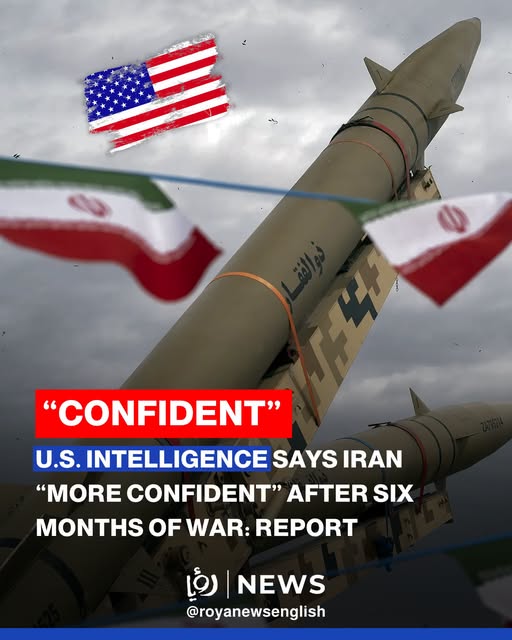
A political graphic circulating online claims that U.S. intelligence has become “more confident” that Iran is emerging from six months of war with greater confidence in its own military capabilities. The wording is awkward, but the underlying report is real.
A Sept. 4 New York Times report, citing current and former U.S. officials briefed on intelligence assessments, says Iran has become more confident in its ability to attack targets across the Middle East and appears prepared to keep fighting for months.
The development is significant because it challenges the assumption that months of U.S.-Israeli military strikes have forced Tehran into a position where it must quickly seek a settlement.
What U.S. intelligence is reportedly seeing
According to the intelligence assessments described by The New York Times, Iran has emerged from months of intermittent fighting with a better understanding of both its own military strengths and the limits of U.S. power.
Officials cited in the report believe Tehran may now have greater confidence in:
- Its remaining missile and drone capabilities
- Its ability to strike American and regional targets
- Its leverage over shipping through the Strait of Hormuz
- The political and economic costs that continued fighting can impose on Washington
- The limits on how much additional force the United States can deploy or sustain
The assessments reportedly warn that Iran's hard-line leadership may be contemplating a significant escalation.
That does not mean U.S. intelligence has concluded that a major escalation is inevitable. Rather, it means analysts see a heightened possibility and believe Tehran has reasons to keep testing Washington.
The war is entering its seventh month
The conflict began on Feb. 28, 2026, when the United States and Israel launched the opening attacks against Iran.
Six months later, the fighting remains unresolved.
The latest intelligence assessment comes after a renewed series of confrontations involving the Strait of Hormuz, American forces and Iranian military targets. The New York Times reported that Iran recently targeted ships and U.S. troops while American forces struck inside Iran.
U.S. Central Command confirmed that American forces conducted another wave of strikes on Sept. 1, targeting Islamic Revolutionary Guard Corps facilities, including air-defense sites, radar systems, maritime assets, mine-laying capabilities and communications facilities. CENTCOM said the strikes followed Iranian attempts to attack commercial shipping in the Strait of Hormuz and American personnel.
More than 50,000 U.S. service members are currently operating across the Middle East, according to CENTCOM.
Iran may believe it has more leverage than it did at the start
One of the most important elements of the intelligence reporting concerns the Strait of Hormuz.
The waterway is a critical global energy chokepoint, and Iran has repeatedly demonstrated its ability to threaten shipping there.
The Times reported that U.S. officials believe Iran now has a more precise understanding of how to use control and disruption around the strait as leverage.
That creates a difficult strategic calculation for Washington.
Iran does not necessarily have to defeat the U.S. military conventionally to impose costs. Disrupting shipping, launching missiles or drones, threatening American bases and sustaining pressure on energy markets can create economic and political consequences even if American forces remain vastly more powerful militarily.
U.S. officials still say Iran has suffered enormous damage
The intelligence assessment should not be interpreted as saying Iran has won the war or that its military remains intact.
The Trump administration has repeatedly argued that American strikes have severely damaged Iran's military and nuclear capabilities.
The White House said in August that U.S. operations had significantly dismantled Iran's military capabilities and weakened its nuclear program.
CENTCOM likewise continues to describe Operation Epic Fury as an effort to dismantle the Iranian regime's security apparatus and eliminate threats to the United States.
The intelligence assessment instead raises a different question:
How much military capability does Iran need to retain in order to continue fighting and impose costs on the United States?
The answer appears to be more than Washington initially expected.
Iran may be willing to wait out Washington
The New York Times report says U.S. officials believe Iran may be prepared to prolong the conflict for months.
One reason is political.
The war has already created economic pressure through energy-market disruptions and the Strait of Hormuz. Intelligence officials cited by the Times believe Tehran understands that the conflict could become increasingly politically damaging for President Donald Trump and Republicans as the November midterm elections approach.
That could encourage Iran to adopt a strategy of survival and attrition rather than immediate confrontation.
In other words, Tehran may calculate that it does not have to destroy American forces. It only has to survive, continue imposing costs and wait for political pressure in the United States to grow.
The administration's position remains very different
The Trump administration continues to present the campaign as a demonstration of overwhelming American military power.
The White House has said that U.S. objectives include eliminating Iran's missile capabilities, destroying its ability to produce new missiles, neutralizing its navy, preventing Iran from obtaining a nuclear weapon and cutting its support for terrorist proxies.
That creates an obvious strategic tension with the latest intelligence assessment.
Washington says Iran has been badly degraded.
The intelligence reporting says Tehran nevertheless believes it has learned how to survive, retaliate and exploit America's vulnerabilities.
Both statements can be true at the same time.
What the graphic gets right — and what it leaves out
The core claim is real. The New York Times reported Sept. 4 that recent U.S. intelligence assessments conclude Iran has become more confident in its military capabilities after roughly six months of conflict.
But the graphic oversimplifies the finding. Intelligence officials aren't saying Iran has become militarily stronger than the United States. The assessment is that Tehran has gained confidence in its ability to survive, retaliate and exploit areas where American power has limits.
The threat of escalation is not a prediction of certain escalation. The assessments reportedly say Iran may be contemplating a significant escalation.
And the war is still active. CENTCOM's Sept. 1 strikes and its statement that more than 50,000 U.S. personnel remain in the region demonstrate that this is not simply a retrospective assessment of a conflict that has ended.
Bottom line
The most consequential part of the report isn't simply that Iran feels “confident.”
It is that, after six months of a war in which the United States has employed overwhelming air and missile power, U.S. intelligence reportedly believes Tehran has learned enough about American capabilities and constraints to believe it can keep fighting — and potentially increase the pressure.
That suggests the conflict may be entering a more dangerous phase rather than moving inevitably toward a conclusion.
Comments (0)
Loading comments...
May You Like

Barack Obama Draws Attention With New Literary Podcast

OBAMA STEPS BACK INTO THE POLITICAL SPOTLIGHT