U.S.-Iran Conflict Escalates as China Pushes Toward a New Era of Military Robotics
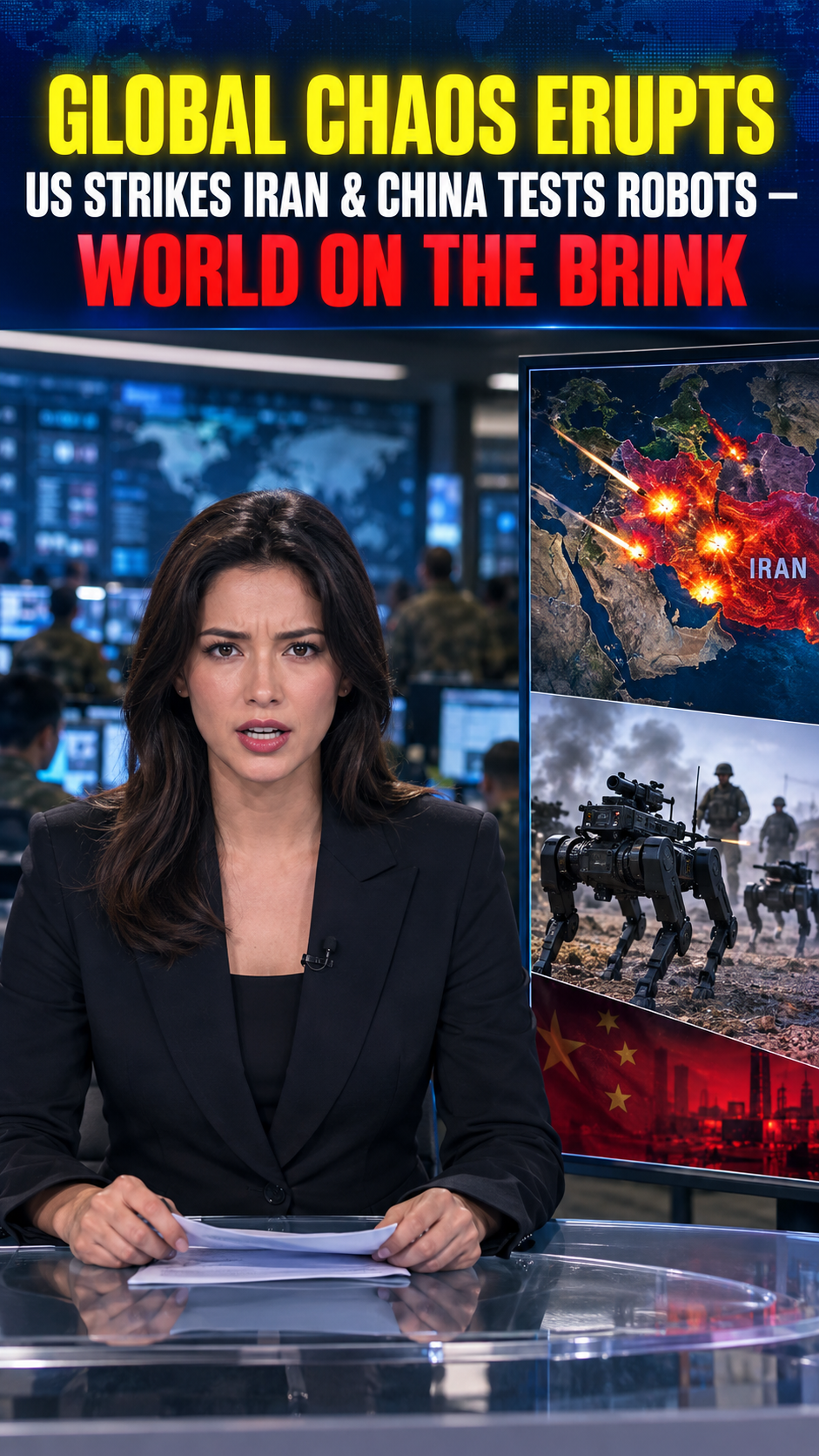
A sharp military escalation between the United States and Iran, rapid advances in Chinese humanoid robotics, and the capture of a U.S.-linked underwater drone are highlighting how quickly modern warfare is changing.
The Middle East has entered another dangerous phase of escalation after U.S. forces destroyed five additional Iranian oil tankers following missile attacks targeting an American Navy warship.
U.S. Central Command said the strikes came after Iran’s Islamic Revolutionary Guard Corps launched ballistic missiles at a U.S. Navy vessel on two occasions over two consecutive days. The American ship was not hit, and U.S. officials reported no American casualties.
Before the tankers were struck, their crews were warned to abandon the vessels.
The latest operation brought the number of Iranian tankers reportedly destroyed or disabled by U.S. forces in recent attacks to approximately 10, according to recent reporting.
But the confrontation did not end there.
Iran responded with a new wave of missile activity across the region, including ballistic missile strikes targeting a military facility in Jordan used by U.S. forces. Jordanian authorities said their air defenses intercepted the overwhelming majority of missiles launched toward the country.
The exchange marked one of the sharpest escalations in months in the continuing U.S.-Iran conflict.
For American policymakers, military planners and energy markets, the concern is increasingly clear: each new exchange raises the possibility that a regional conflict could spread further across the Middle East.
The Strait of Hormuz remains at the center of those concerns.
The narrow waterway is one of the world's most strategically important shipping routes, and disruptions there can quickly affect global energy markets. Oil prices have already surged as traders assess the possibility of prolonged disruptions to crude shipments and commercial shipping in the Gulf.
The latest confrontation also comes as U.S. naval forces face the prospect of maintaining an extended military presence in the region.
What began as a series of exchanges is increasingly looking like a conflict with the potential to become a long-term military commitment.
China’s Humanoid Robots Are Moving From the Lab Toward Real-World Competition
While the United States and Iran exchange missiles and naval strikes, another military competition is developing far from the Middle East.
China is accelerating its investment in autonomous systems, artificial intelligence and robotics — technologies that could reshape future battlefields.
At military and technology demonstrations, Chinese developers have showcased drone swarms, robotic dogs and unmanned ground vehicles capable of operating in complex environments.
The basic military logic behind these systems is straightforward.
Machines can be sent into dangerous areas before human soldiers.
Robots and autonomous vehicles could potentially scout urban terrain, identify obstacles, detect mines, carry supplies or perform other high-risk missions without immediately exposing troops to enemy fire.
China's rapid progress in humanoid robotics has attracted particular attention.
At the World Humanoid Robot Games in Beijing, Chinese robots demonstrated abilities ranging from dancing and soccer to industrial tasks and high-speed athletics.
One of the biggest headlines came when China's Tiangong Ultra humanoid robot completed the 100-meter sprint in under nine seconds, faster than Usain Bolt's famous human world record.
The achievement does not mean robots are ready to replace elite human athletes — or soldiers — tomorrow.
Humanoid robots still face major technical challenges, including energy consumption, reliability, balance and the ability to operate independently in unpredictable environments.
A robot may perform extremely well in a controlled demonstration but struggle when confronted with damaged terrain, poor weather, communication failures or unexpected obstacles.
Still, the speed of progress is difficult to ignore.
China has identified humanoid robotics and artificial intelligence as strategic technologies, and both Chinese companies and government-backed organizations are investing heavily in developing more capable machines.
For the Pentagon, the implications extend beyond China itself.
The question is no longer simply whether humanoid robots can walk, run or perform demonstrations.
The bigger question is whether autonomous machines will eventually take on meaningful roles in military logistics, reconnaissance, engineering and other battlefield operations.
The United States is also investing heavily in autonomous military technology.
American defense planners and technology companies are increasingly exploring how artificial intelligence and robotics could reduce risks to human personnel while expanding the military's ability to operate in dangerous environments.
The competition between Washington and Beijing may eventually become as important in robotics and autonomous warfare as previous geopolitical competitions were in nuclear weapons, space exploration and cyber technology.
Iran’s Capture of an Underwater Drone Reveals Another Side of Modern Warfare
The growing importance of autonomous systems was also demonstrated this week in the Strait of Hormuz.
Iran announced that it had captured a U.S. underwater drone, describing the incident as a significant intelligence and military achievement.
The underwater vehicle was identified as a Dive-LD, a large autonomous underwater system produced by the American defense technology company Anduril.
But U.S. officials presented a very different version of the incident.
According to U.S. reporting, the underwater vehicle was an older model that malfunctioned and was no longer operating properly when it was recovered.
American officials said the system did not contain classified equipment or sensitive intelligence data.
The Dive-LD is designed for missions that can include seabed mapping, mine countermeasures, underwater infrastructure inspection and other operations that would otherwise require personnel to operate in potentially dangerous environments.
Its loss highlights one of the central realities of modern autonomous warfare.
Unmanned systems are increasingly designed to operate where commanders may consider the risk to human personnel too high.
That also means some systems may be lost.
For Iran, displaying the captured vehicle offers a propaganda victory and an opportunity to demonstrate that American technology can be recovered.
For the United States, however, the incident appears to carry less strategic significance if the Pentagon's assessment is correct that the malfunctioning vehicle did not contain sensitive data or classified systems.
The broader story may be more important than the individual drone.
Above the water, the United States and Iran are exchanging missile attacks and strikes on oil tankers.
On land, militaries are preparing for a future in which robots, autonomous vehicles and artificial intelligence could become increasingly important.
And beneath the water, unmanned systems are quietly mapping the seabed, searching for mines and monitoring critical infrastructure.
The battlefield is expanding in every direction.
And increasingly, it is becoming a battlefield where machines may arrive before soldiers do.
For Americans watching the latest crisis unfold, the U.S.-Iran escalation and China's robotics push may appear to be separate stories.
They are not.
Together, they offer a glimpse into the changing nature of global conflict — where missile strikes can disrupt global oil markets overnight, autonomous underwater vehicles operate in some of the world's most sensitive waterways, and humanoid robots are advancing faster than many people expected.
The future of warfare may not arrive all at once.
But it is already beginning to take shape.
Comments (0)
Loading comments...
May You Like

Obama Steps Back Into the Political Spotlight as Democrats Target Trump’s