
Trump Says U.S. Is Working on ‘Massive’ Belarus Potash Deal to Undercut Canadian Prices
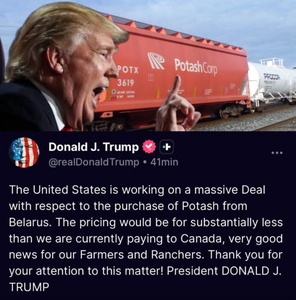
President Donald Trump says Washington is negotiating to buy cheaper potash from Belarus, potentially reducing U.S. reliance on Canadian fertilizer, but major questions remain over price, supply availability, sanctions and transportation costs.


President Donald Trump said Monday that the United States is working on a “massive” agreement to buy potash from Belarus at prices he claims would be substantially below Canadian supplies.
Trump presented the potential agreement as good news for American farmers and ranchers, but his Truth Social post provided no purchase volume, contract value, delivery schedule, or confirmed Belarusian counterpart.
Potash is a potassium-rich mineral used primarily in fertilizer, helping crops withstand disease, improve quality and increase yields, which makes reliable access important for American grain and food production.
The United States is heavily dependent on imported potash, and Canada has long been its dominant supplier because Saskatchewan’s enormous deposits sit close to major American agricultural regions and rail networks.
Natural Resources Canada says Canada exported about 22.9 million tonnes of potash in 2024, representing nearly 39 percent of world exports, with the United States receiving 53 percent.
Canadian reporting says the United States imported about C$4.2 billion worth of Canadian potash in 2025, amounting to nearly half of Canada’s potash exports that year.
Despite the broader U.S.-Canada trade confrontation, Canadian potash has remained exempt from recent American tariffs, making Trump’s proposed Belarus purchase less about avoiding a tariff than changing suppliers.
Belarus is nevertheless a major global producer. Canada, Russia and Belarus together dominate international potash supply, giving Minsk the capacity to matter significantly in fertilizer markets if trade barriers ease.
Washington has recently eased some Belarus-related sanctions after negotiations that included releases of political prisoners, although the Treasury Department still maintains an active Belarus sanctions program with other restrictions.
The European Union continues restricting Belarusian potash, creating a major logistical obstacle because landlocked Belarus cannot simply ship large volumes westward through EU ports under the current sanctions environment.
The Washington Post reported that additional Belarusian exports to the United States would likely have to move through Russian ports, adding distance, handling costs and geopolitical complications to the proposed supply route.
Industry analysts in Canada questioned whether Belarus has enough uncommitted product to replace large Canadian volumes and whether any headline discount could survive freight, insurance, port and rail expenses.
Saskatchewan Premier Scott Moe strongly opposed Trump’s proposal, calling Belarusian fertilizer “blood potash” and arguing that purchases routed through Russia would indirectly support a government closely aligned with Moscow.
Fertilizer Canada responded that Canadian potash has supplied North American farmers reliably for decades, pointing to geography and integrated rail infrastructure as advantages for timely and predictable fertilizer deliveries.
Markets reacted immediately to Trump’s announcement, with shares of Canadian fertilizer producer Nutrien and several other potash-related companies falling as investors considered the possibility of greater Belarusian competition.
For American farmers, the practical benefit would depend on the delivered price at farms and distribution terminals, not simply the price negotiated at a Belarusian mine or export point.
There is also a supply-security argument for diversification. USGS has highlighted potash as a critical mineral partly because roughly 90 percent of U.S. net imports recently came from Canada alone.
The United States does produce potash domestically, mainly in New Mexico and Utah, but domestic output is far smaller than national demand, leaving American agriculture structurally dependent on foreign supply.
The Belarus initiative also carries geopolitical implications because President Alexander Lukashenko remains closely aligned with Russia, and Belarus allowed Russian forces to use its territory during the 2022 invasion of Ukraine.
The viral image therefore reflects a real Trump announcement, but no completed “massive deal” has been disclosed, and the claimed Canadian price advantage remains an assertion rather than a demonstrated final delivered cost.
Comments (0)
Loading comments...
May You Like

FIGHT OVER OBAMA’S IRAN POLICY

South Korea–Ukraine Rift Deepens Over North Korean POW Transfer as PURL Draws New Scrutiny













