
U.S. Markets Under Pressure as Trump Challenges Inflation and Interest-Rate Concerns
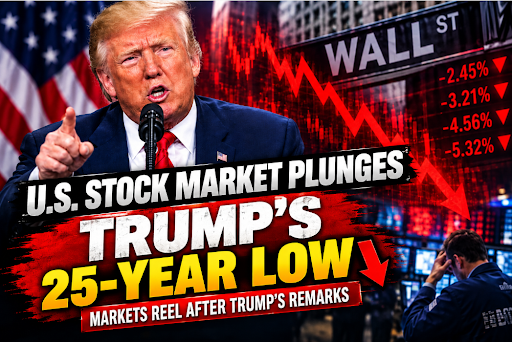


President Donald Trump has challenged the economic logic behind recent market declines, arguing that strong employment should support stocks rather than trigger concerns about inflation and higher interest rates.
The comments followed the release of August employment data showing 162,000 jobs added, significantly exceeding economists’ expectations while the unemployment rate remained unchanged at 4.1%.
Instead of interpreting the report as an uncomplicated positive, investors focused on whether stronger employment could encourage the Federal Reserve to maintain or increase borrowing costs.
On September 4, major U.S. stock indexes declined after the employment report pushed Treasury yields higher, with the S&P 500 falling 0.4% and the Nasdaq losing 0.3%.
Trump subsequently argued that markets were reacting to an outdated fear that economic growth automatically creates inflation, describing the market decline as inconsistent with stronger employment and economic conditions.
His remarks also criticized the broader approach to monetary policy, as Trump has repeatedly called for lower interest rates while the Federal Reserve considers inflation and other economic indicators.
The economic debate centers on a fundamental tension: stronger employment can support household incomes and spending, while excessive demand under constrained supply can contribute to inflationary pressure.
August’s employment figures showed renewed strength after several weaker months. However, Reuters reported that long-term unemployment remained elevated, suggesting the labor market still contained important areas of weakness.
Wage growth also moderated, with average hourly earnings increasing 3.1% from a year earlier in August, according to Reuters, reducing some concerns about a wage-driven inflation spiral.
Nevertheless, financial markets responded cautiously because stronger employment could give policymakers less reason to reduce borrowing costs, particularly while inflation remains above the Federal Reserve’s long-term target.
That pressure has intensified in September as energy prices climbed sharply. Rising crude prices have increased inflation expectations and strengthened market expectations for tighter monetary policy.
By September 15, Wall Street faced several simultaneous pressures, including higher oil prices, rising Treasury yields, concerns about federal debt and uncertainty surrounding technology investment.
The Dow Jones Industrial Average fell 0.63% that day, while the S&P 500 declined 0.45% and the Nasdaq Composite dropped 0.78%, according to Reuters market data.
The benchmark 10-year Treasury yield also moved above 5%, reaching its highest level since 2007 and increasing borrowing costs for companies, households and the federal government.
Higher yields can make government bonds comparatively attractive while raising financing costs for businesses, potentially placing additional pressure on stock valuations and investment decisions.
Oil prices have become another major concern. Reuters reported that crude prices jumped sharply as geopolitical tensions disrupted energy markets, adding another potential source of inflationary pressure.
The Federal Reserve entered its September policy meeting facing conflicting signals: employment remained relatively resilient, while inflation and energy costs were creating pressure in the opposite direction.
Trump’s argument that economic growth should not automatically be treated as an inflation threat contrasts with conventional concerns that policymakers must balance employment, prices and financial stability.
At the same time, current market declines cannot be attributed solely to Trump’s remarks. Recent trading has reflected oil prices, Treasury yields, monetary-policy expectations, geopolitical risks and technology-sector concerns.
The U.S. economy therefore enters the autumn facing a complicated combination of relatively resilient employment, persistent inflation pressures, expensive borrowing and financial-market uncertainty as policymakers assess their next moves.
Image note: The uploaded image is used as an illustrative editorial visual. Its headline and graphics should not be treated as independent evidence that Trump’s remarks directly caused the market decline or represented a “25-year low.”
Comments (0)
Loading comments...
May You Like

South Korea–Ukraine Rift Deepens Over North Korean POW Transfer as PURL Draws New Scrutiny
TRUMP HIT WITH 26 ARTICLES OF IMPEACHMENT














