
U.S. Measles Cases Surge Past 3,100, Reaching Highest Level in More Than 35 Years
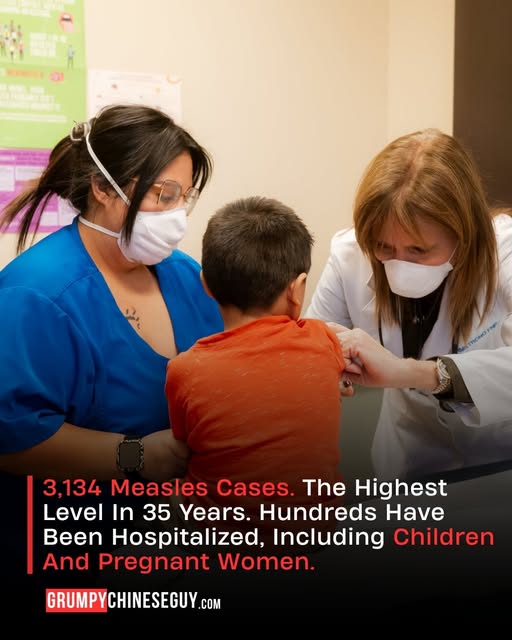
A major measles resurgence is unfolding across the United States, with 3,134 confirmed cases reported so far in 2026 — the highest annual total in more than 35 years, according to the latest CDC figures reported Sept. 4. The outbreak has also resulted in 248 hospitalizations, or about 8% of reported cases.
The graphic you shared is therefore based on a real and serious public-health development, although one detail needs correcting: it says the total is the highest level in 33 years, while current reporting puts it at more than 35 years.
More than 3,100 cases across the country
As of Sept. 3, the CDC count stood at 3,134 confirmed measles cases, with 3,118 reported among residents of 47 U.S. jurisdictions and 16 cases involving international visitors.
The number has risen rapidly over the summer. The CDC had reported:
- 2,777 cases as of Aug. 20
- 2,903 cases as of Aug. 27
- 3,134 cases by Sept. 3.
That makes 2026 the worst U.S. measles year since the major resurgence of 1989–1991, when more than 55,000 infections were recorded.
Hundreds have been hospitalized
The CDC's latest tally cited by Reuters shows 248 people hospitalized with measles this year, equivalent to roughly 8% of reported cases.
Children have been particularly affected. As of the late-August CDC data, 19% of cases were in children younger than 5 and 47% were among those ages 5–19. About 94% of cases involved people who were unvaccinated or whose vaccination status was unknown.
This is important context behind the photograph in the viral graphic: measles is not simply a childhood rash. Severe cases can result in pneumonia, dehydration, encephalitis and other complications.
Pregnant women face particular risks
The graphic specifically mentions pregnant women. That concern is medically legitimate, although the image does not provide evidence that a large number of the 248 hospitalized patients in 2026 were pregnant.
CDC guidance identifies pregnant women as a group at higher risk of serious complications from measles. Infection during pregnancy can be associated with pneumonia and other severe outcomes, as well as pregnancy loss, premature delivery and low birth weight.
There is also a particularly striking example from the 2025 West Texas outbreak. Among five hospitalized adults aged 18–44 whose records were reviewed, four were pregnant women, all in their third trimester. Two subsequently delivered infants who were diagnosed with active measles infection shortly after birth.
So the image's reference to pregnant women reflects a genuine medical concern, but it should not be interpreted as saying that hundreds of pregnant women have been hospitalized in the current 2026 outbreak.
Why is measles coming back?
The resurgence is closely associated with declining vaccination coverage.
The CDC says two doses of the measles, mumps and rubella (MMR) vaccine are about 97% effective at preventing measles, while one dose is about 93% effective.
For communities to maintain strong population-level protection, vaccination coverage generally needs to remain above about 95%. Yet U.S. kindergarten MMR coverage has fallen below that threshold. The CDC reported coverage of 92.4% during the 2025–26 school year, leaving an estimated 280,000 kindergartners vulnerable.
Once vaccination coverage drops, measles can spread extremely quickly because the virus is exceptionally contagious.
The disease is far from harmless
Measles spreads through the air when an infected person coughs, sneezes or breathes. A person can become infected simply by being in a room where someone with measles was present, including for a period after the infected person has left.
CDC clinical guidance lists young children, adults over 20, pregnant women and people with weakened immune systems among those at greater risk of complications.
The consequences can be severe. In a CDC analysis of hospitalized patients from the 2025 West Texas outbreak, 72% developed pneumonia, 68.5% experienced hypoxia and four patients required intensive-care treatment. One hospitalized child died.
What the viral graphic gets right — and what it gets wrong
Correct: The United States has recorded 3,134 confirmed measles cases in 2026 as of early September.
Correct: The total is the highest annual U.S. measles count in more than 35 years, not merely 33 years.
Correct: Hundreds of patients have been hospitalized — the latest figure is 248.
Correct: Children and pregnant women are among groups that can face serious complications from measles.
Needs clarification: There is no evidence in the latest national figures that “hundreds” of hospitalized patients are pregnant women. The prominent pregnancy data often cited comes from the 2025 West Texas outbreak, where four of five hospitalized adults aged 18–44 were pregnant.
A warning sign for U.S. public health
The significance of the 2026 outbreak extends beyond the raw case count.
The United States had made enormous progress against measles through widespread vaccination. The current resurgence demonstrates how quickly that protection can weaken when vaccination coverage falls and outbreaks encounter communities with pockets of unvaccinated people.
With cases continuing to rise into September, the 3,134 figure should not be viewed as a final total. CDC surveillance data are provisional and can be revised as jurisdictions report additional cases.
The central public-health concern now is whether the country can restore sufficiently high vaccination coverage to stop the outbreak from producing another sustained cycle of transmission.
Comments (0)
Loading comments...
May You Like


gfnhgmnghnmfgnbvvvvvvvvv

Jack Smith Defends His Integrity as Trump Investigations Face Renewed Political Firestorm













