
U.S. PUBLIC DEBT SURPASSES $40 TRILLION — WHAT OTHER WOES AWAIT THE AMERICAN PEOPLE?
AMERICA’S $40 TRILLION DEBT WARNING: U.S. COULD HIT ITS BORROWING LIMIT IN 2027 — WHAT HAPPENS TO YOUR MONEY?
WASHINGTON, D.C., UNITED STATES — NOVEMBER 20, 2026

America's national debt has crossed an unprecedented $40 trillion. Now, a new warning suggests Washington could face another confrontation over its ability to borrow money — with potentially serious consequences for American households.
A November 18 analysis from the Bipartisan Policy Center projects that the federal government could reach its statutory debt ceiling as early as February or March 2027.
The Treasury Department could then rely on emergency accounting measures and available cash to continue meeting government obligations.
But if Congress fails to act before those resources run out, the United States could face the possibility of missing payments.
Could this become a historic financial crisis? And what would it mean for your mortgage, retirement savings, Social Security benefits and everyday expenses?
The answer depends on a crucial distinction: reaching the debt ceiling is not the same as defaulting.
Bipartisan Policy Center+1
America's National Debt Has Surpassed $40 Trillion

In August 2026, America's gross national debt surpassed $40 trillion for the first time.
By September 3, the total had reached approximately $40.10 trillion, according to the U.S. Congress Joint Economic Committee.
Reuters+1
THE U.S. DEBT PICTURE
$40+ trillion
Gross federal debt, which includes debt held by investors and obligations within government accounts.
Statutory debt ceiling
$41.1T
Borrowing room remaining
$764B
November 18 estimate
Bipartisan Policy Center
The growing debt reflects decades of federal spending, tax decisions, economic crises, healthcare obligations and rising interest costs.
Both Republican and Democratic administrations have presided over increases in the national debt.
March 2027: Washington's Next Financial Deadline

According to the Bipartisan Policy Center, the federal government will most likely reach its borrowing limit in February or March 2027 unless Congress raises or suspends it.
The current $41.1 trillion ceiling was established after Congress approved a $5 trillion increase in July 2025.
The center estimates that debt subject to the limit has since risen by approximately $4.2 trillion.
Bipartisan Policy Center
Once the ceiling is reached, Treasury cannot simply continue borrowing as usual.
Instead, officials can use existing cash balances and legally authorized extraordinary measures to temporarily continue paying federal obligations.
Those measures provide additional time for lawmakers to negotiate.
But they cannot permanently solve the underlying problem.
Could America Default as Early as August 2027?
How the debt ceiling crisis could unfold
-
February–March 2027
Projected period when federal borrowing could reach the $41.1 trillion limit.
Following months
Treasury may use cash reserves and extraordinary measures to continue meeting obligations.
Second half of 2027
The government could reach the so-called X-date, when available resources are insufficient to pay every obligation on time.
If Congress acts
Raising or suspending the debt ceiling would avert a debt-limit-driven payment crisis.
The Bipartisan Policy Center estimates that extraordinary measures and cash reserves could provide roughly six to nine additional months after the debt ceiling is reached.
That makes an August 2027 payment crisis a possible early scenario, not a confirmed default date.
Other projections place the X-date later. The National Taxpayers Union, for example, estimates that the critical deadline could arrive around December 2027.
Bipartisan Policy Center+1
These forecasts are uncertain because federal tax collections, spending decisions, economic conditions and Treasury cash management can all change the timeline.
What Could a U.S. Default Mean for Your Wallet?

A federal payment crisis could affect Americans even if they do not personally own Treasury bonds.
The consequences would depend on the duration of the disruption and how financial markets respond.
|
Your finances |
Potential consequences
Mortgage
Higher borrowing costs could make homeownership more expensive
Credit cards
Financial instability could contribute to tighter credit conditions
Retirement savings
Stocks and bonds could experience substantial volatility
Social Security
Payment delays could become a risk if Treasury lacks sufficient resources
Employment
Reduced confidence and spending could weaken business activity
Everyday expenses
Market disruptions could create additional financial uncertainty
These are risks associated with a severe debt-limit crisis, not outcomes that have already occurred.
The U.S. Treasury market plays a central role in global finance. Even concerns about delayed government payments can affect investor confidence and borrowing conditions.
Social Security and Medicare: Are Americans' Benefits at Risk?

Millions of Americans depend on Social Security, Medicare and other federal programs.
Reaching the debt ceiling would not automatically terminate those benefits.
However, if Treasury eventually lacked sufficient funds to meet all obligations on time, delays in some government payments could become possible.
The precise effects would depend on the legal, operational and financial circumstances at that time.
There is currently no established August 2027 suspension of Social Security or Medicare payments.
The Hidden Cost: America's Growing Interest Bill

America's debt challenge extends beyond the next borrowing deadline.
As federal debt increases and older bonds are refinanced at higher interest rates, the government can face growing interest expenses.
The Bipartisan Policy Center reported that net interest spending in fiscal year 2026 was $81 billion higher than in fiscal year 2025, an increase of approximately 8%.
Bipartisan Policy Center
Year-over-year increase in federal net interest spending
+$81 billion
Fiscal year 2026 compared with fiscal year 2025, according to the Bipartisan Policy Center.
Interest payments compete with other priorities for federal resources, including infrastructure, healthcare, defense and education.
They can also make future budget decisions more difficult.
Is America's Debt the Biggest Crisis in Its History?
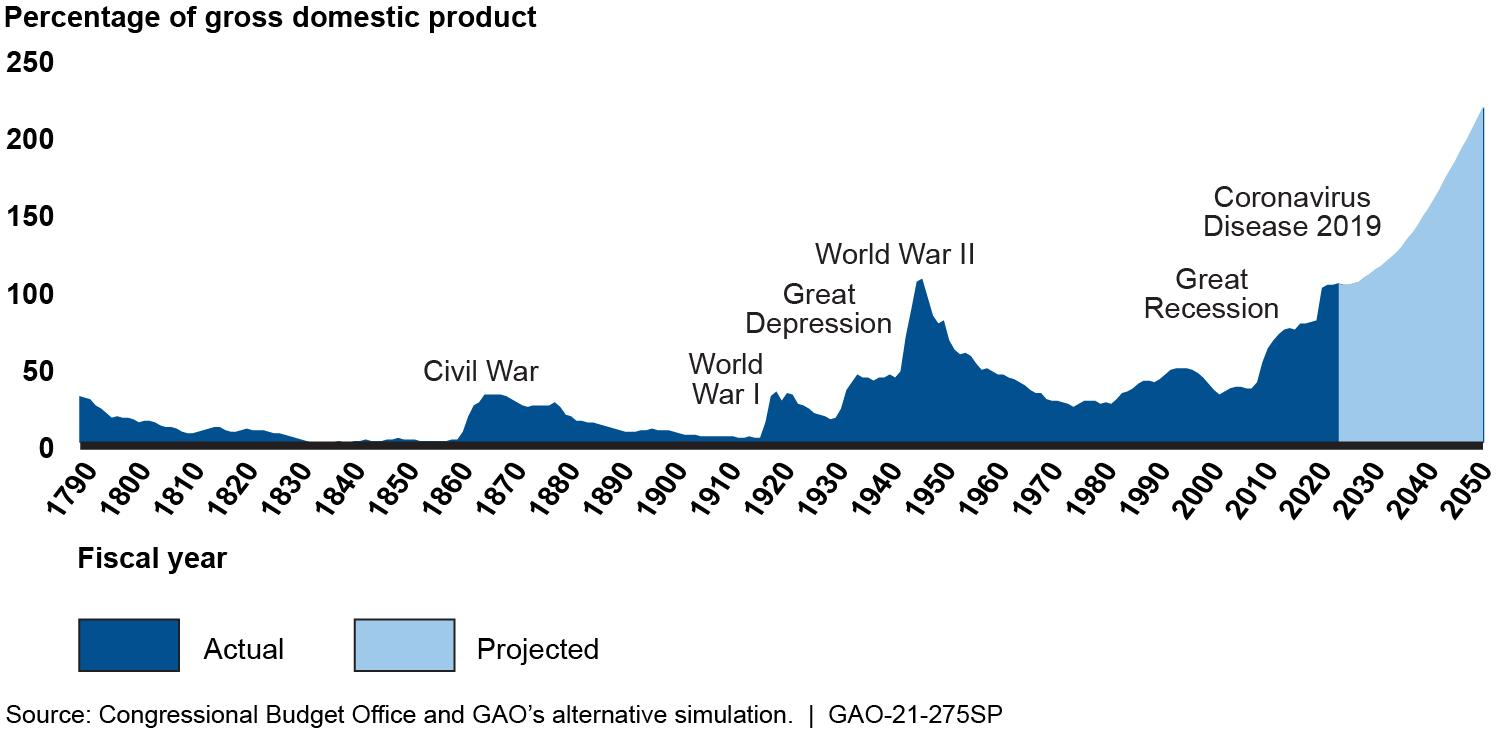
The debt has reached a record in nominal dollar terms.
But that alone does not establish that America is experiencing its most severe debt crisis in history.
Economists also consider debt relative to the size of the economy, interest costs, economic growth and the government's ability to finance its obligations.
For perspective, the Congressional Research Service reports that federal debt subject to the limit reached approximately 118% of GDP in 1946, before falling substantially in subsequent decades.
Every CRS Report
Today's fiscal position raises serious long-term sustainability questions, but a record dollar amount is not the same thing as an imminent national bankruptcy.
What Can Congress Do to Prevent a Default?

Congress has several policy choices.
Lawmakers can raise or suspend the borrowing limit to prevent a debt-limit-driven payment crisis.
Separately, they can negotiate measures to address the government's long-term fiscal outlook, including changes to spending, taxation and budget procedures.
The political disagreement concerns how to balance competing objectives.
Supporters of spending reductions emphasize controlling deficits and limiting future borrowing.
Supporters of additional revenue measures argue that tax policy must also be considered, particularly when lawmakers seek to protect major public programs.
Economists and fiscal analysts generally distinguish the immediate need to avoid missed payments from the longer-term challenge of making federal finances sustainable.
What Should American Families Watch in 2027?
For households, the most useful signals will be whether Congress reaches an agreement, how Treasury updates its X-date estimates and whether financial markets begin demanding higher yields on government debt.
Families may also want to review emergency savings, upcoming borrowing needs and the risks associated with their investments.
Major financial decisions should be based on individual circumstances rather than predictions that a default is inevitable.
America's $40 Trillion Question: Can Washington Avoid Another Debt Showdown?

America's national debt has crossed $40 trillion.
The federal borrowing limit could become binding in early 2027.
And unless Congress acts, Treasury could eventually face a deadline when it can no longer meet every government obligation on time.
Yet the United States has not defaulted, and the projected deadline remains uncertain.
The next several months will test whether lawmakers can resolve the borrowing limit while confronting the larger challenge of rising federal debt and interest costs.
The question is not simply how much America owes. It is how Washington manages that debt without putting the financial stability of American households at risk.
Should Congress prioritize raising the debt ceiling to prevent a payment crisis, or link the decision to broader changes in federal spending and taxation?
AMERICA, WHAT DO YOU THINK? SHARE YOUR OPINION IN THE COMMENTS BELOW!
Comments (0)
Loading comments...
May You Like

IOWA MILITARY EMERGENCY: 51 TONS OF UNSTABLE SUSPECTED BIOWEAPON WASTE FOUND AFTER 5-TON BLAST!

AMERICA'S LUCAS DRONE — A POTENTIAL GAME CHANGER IN THE SOUTH CHINA SEA?

IOWA EMERGENCY: TOXIC AIR, POLLUTED WATER, 3,000 FAMILIES FORCED OUT AFTER 5-TON WASTE BLAST!









Popular Posts




