
US Stands Alone as UN Overwhelmingly Backs Resolution to Correct Africa's Size on World Maps
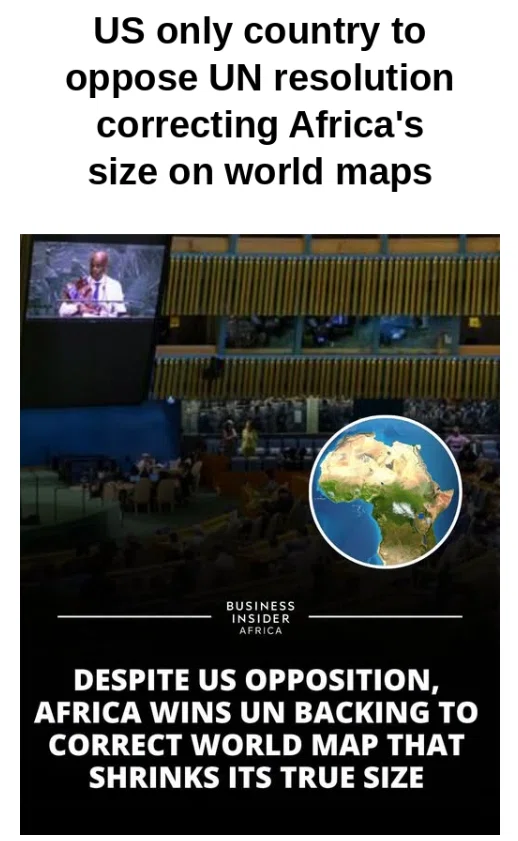
The United Nations General Assembly has passed a landmark resolution urging the world to adopt maps that more accurately reflect Africa's true size, ending centuries of cartographic distortion that made the continent appear far smaller than it actually is. The United States was the sole nation to vote against the measure, dismissing it as a "radical ideological project."
UNITED NATIONS – In a historic vote on September 4, 2026, the UN General Assembly adopted the "Correct the Map" resolution by a resounding margin of 164 votes in favor, one against, and six abstentions .
The resolution, spearheaded by Togo and backed by the 54-member African Union, encourages governments, schools, and international institutions to adopt equal-area map projections, such as the Equal Earth projection, which more accurately depict the relative size of continents . The widely used Mercator projection, developed in 1569 for maritime navigation, significantly distorts landmasses farther from the equator, making Africa appear roughly the same size as Greenland — when in fact Africa is 14 times larger .
The six abstaining nations were: Estonia, Georgia, Lithuania, Moldova, Serbia, and Ukraine .
Africa's True Scale: A Matter of 'Cognitive Justice'
Togo's Foreign Minister Robert Dussey, who introduced the resolution, framed the issue as far more than a technical cartographic correction.
"Maps shape our understanding of the world," Dussey told the General Assembly. "They guide education, nourish the imagination, and influence collective perceptions" .
"It has to do with cognitive justice, with access to precise geographical knowledge, the dignity of peoples, historic memory" .
The resolution does not ban the Mercator projection or mandate a replacement. Instead, it encourages the use of equal-area maps like Equal Earth, developed in 2018, which preserve proportional size at the cost of some shape distortion .
France welcomed the move, with Foreign Minister Jean-Noël Barrot stating: "Changing the map obviously doesn't change the world. But correcting a representation that distorts it is already an act of truth" .
Why the US Voted No
The United States stood completely isolated in its opposition. Speaking on behalf of the U.S., Deputy Representative Yaryna Ferencevych dismissed the resolution as part of a "radical ideological project" linked to reparations and "cognitive justice."
"Instead of focusing on genuine problems of international peace, prosperity, or good relations, this body is debating map projects from the 16th century, and their role in promoting reparations and 'cognitive justice,'" Ferencevych said .
"Resolutions like this and the ideological agenda they promote, are barnacles on our work here, and the reason this institution is losing its credibility" .
The U.S. argued that the resolution was a distraction from more pressing global challenges, a position that was firmly rejected by the vast majority of member states .
What the Resolution Means
| Key Detail | Explanation |
|---|---|
| Vote Result | 164 in favor, 1 against (U.S.), 6 abstentions |
| Resolution | "Correct the Map" — encourages use of equal-area projections |
| Target | Mercator projection (1569), which shrinks Africa's perceived size |
| Alternative | Equal Earth projection (2018), showing Africa 14x larger than Greenland |
| Binding? | No — non-binding; encourages, does not mandate change |
| U.S. Argument | Resolution is an "ideological" distraction |
The African Union Commission celebrated the vote as a historic moment. "For centuries, the Mercator projection distorted global geography, shrinking Africa to the size of Greenland when our continent is actually 14 times larger," the group wrote on social media .
"Today's resolution promotes equal-area maps like Equal Earth across classrooms, media, and international institutions ensuring the world map finally reflects Africa's true scale, weight, and place in the world"
Comments (0)
Loading comments...
May You Like

TRUMP’S OHIO WARNING UNDER THE SPOTLIGHT
OBAMA STEPS BACK INTO THE POLITICAL SPOTLIGHT

Russian Drone Strikes Kyiv Bridge as German Chancellor Arrives in Ukraine













