US Used More Than Half Its Patriot Missiles to Intercept Iranian Attacks; Panetta Calls It a 'Dangerous Moment'
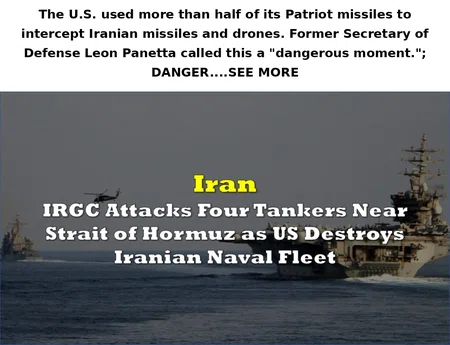
WASHINGTON — The United States has expended more than half of its Patriot missile interceptors to counter Iranian missile and drone attacks, according to newly disclosed figures, prompting former Defense Secretary Leon Panetta to warn that the situation represents a "dangerous moment" for American military readiness.
The disclosure comes as Iran's Islamic Revolutionary Guard Corps (IRGC) launched a fresh wave of attacks on four tankers near the Strait of Hormuz, while U.S. forces struck back by destroying an Iranian naval fleet.
The Patriot Missile Drain
According to officials familiar with the matter, U.S. forces in the Gulf region have fired more than 50% of their available Patriot Advanced Capability-3 (PAC-3) interceptors since hostilities began. The interceptors are designed to shoot down incoming ballistic missiles and are among the most sophisticated — and expensive — air defense weapons in the U.S. arsenal.
The rate of expenditure has alarmed military planners, who note that each Patriot interceptor costs approximately $4 million and that production capacity is limited. Replenishing the stockpile could take years.
"It's a dangerous moment," Panetta said in an interview Thursday. "We are using up our most critical defensive systems at an alarming rate, and we don't have a clear strategy for how this ends."
Panetta, who served as CIA director and secretary of defense under President Barack Obama, has been a frequent critic of the Trump administration's Iran policy.
The IRGC Attacks
On Thursday, the IRGC Navy announced it had targeted four oil tankers near the Strait of Hormuz, accusing them of using "unauthorized routes." The IRGC also warned commercial vessels to avoid the waterway.
The attacks came in retaliation for U.S. strikes that destroyed an Iranian naval fleet earlier in the week. U.S. Central Command said its forces had "rendered inoperable" multiple Iranian vessels, including the M/T Kaviz, M/T Charminar, M/T Horizon 1, and M/T Riesco.
The exchange marked the latest in a series of tit-for-tat strikes that have transformed the Strait of Hormuz — through which approximately 20% of the world's oil passes — into a live-fire zone.
The Strategic Implications
The expenditure of Patriot missiles has broader implications for U.S. global readiness. The interceptors are deployed not only in the Middle East but also in Europe, the Indo-Pacific, and on U.S. soil. Diverting them to the Iran conflict leaves other theaters potentially vulnerable.
"If we're using half our Patriots to shoot down Iranian drones, what do we have left for a potential crisis in Taiwan?" asked one former Pentagon official, speaking on condition of anonymity. "This is a zero-sum equation."
The Pentagon has not publicly commented on the specific figures.
The Bottom Line
| Key Development | Details |
|---|---|
| Patriot Missile Usage | More than 50% of interceptors expended |
| Cost Per Interceptor | ~$4 million |
| Panetta's Warning | "Dangerous moment" for U.S. readiness |
| IRGC Attacks | Four tankers targeted near Strait of Hormuz |
| U.S. Response | Destroyed Iranian naval fleet |
| Strategic Concern | Depletion of air defense stocks across theaters |
As the Iran war enters its seventh month, the strain on U.S. military resources is becoming increasingly difficult to ignore. For the Trump administration, which has promised a swift end to the conflict, the question now is whether American forces can sustain the current pace — or whether the war is quietly hollowing out the arsenal meant to deter the next one.
Comments (0)
Loading comments...
May You Like

Obama Steps Back Into the Political Spotlight as Democrats Target Trump’s Senate Majority
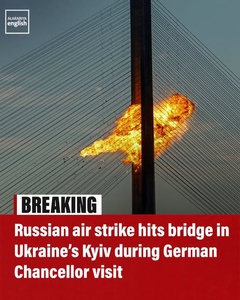
Russian Drone Strikes Kyiv Bridge as German Chancellor Arrives in Ukraine
Russian Drone Strikes Kyiv Bridge as German Chancellor Arrives in Ukraine