
Valerie Foushee Says ICE Is “Not Compatible With
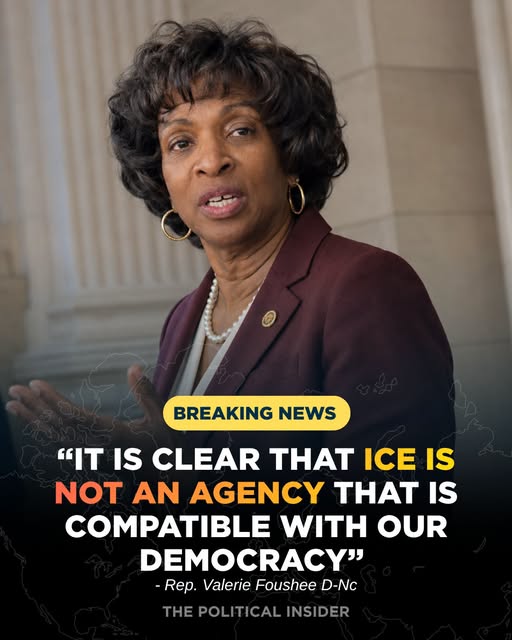
WASHINGTON — Rep. Valerie Foushee, a North Carolina Democrat, is escalating her criticism of U.S. Immigration and Customs Enforcement, arguing that the federal agency has become incompatible with democratic principles and calling for sweeping changes to its role and funding.
Foushee’s comments have drawn renewed attention as congressional Democrats intensify their opposition to the Trump administration’s immigration-enforcement policies and ICE operations across the country.
In a statement released by her congressional office earlier this year, Foushee described ICE as a “rogue, lawless agency” and said it was “incompatible with our democracy.” She has also backed legislation seeking to defund and dismantle the agency.
The remarks have since circulated widely online, turning a long-running policy dispute over immigration enforcement into another flashpoint in the broader political battle between Democrats and the Trump administration.
Foushee Calls for ICE to Be Defunded
Foushee has made opposition to ICE a central part of her criticism of the administration.
In February, her office announced that she had cosponsored legislation aimed at dismantling ICE and redirecting some of its funding toward community-based services.
She accused the agency of targeting immigrant communities and argued that the federal government should pursue a fundamentally different approach to immigration enforcement.
At a town hall in Morrisville, North Carolina, Foushee went even further, saying that the conduct of the administration and ICE demonstrated what she described as a disregard for democratic principles.
Her position puts her firmly on the progressive side of one of the Democratic Party’s most contentious issues heading into the 2026 midterm elections.
The Dispute Is No Longer Just About Immigration Policy
The conflict between Foushee and ICE has increasingly moved beyond the question of immigration enforcement itself.
In August, Foushee joined Democratic lawmakers Pramila Jayapal, Hank Johnson, Nikema Williams and Deborah Ross in an oversight visit to the Stewart Detention Center in Georgia.
The lawmakers later accused ICE of making false statements about the timing and circumstances of their inspection. They said they had provided advance notice and disputed ICE's account of when the lawmakers arrived and departed.
The lawmakers said they would continue congressional oversight despite the confrontation.
ICE and its supporters have a fundamentally different view of the agency's role, arguing that immigration enforcement is a legitimate federal responsibility and that agents are carrying out laws passed by Congress.
That disagreement is at the heart of the political battle.
Foushee's Opposition Comes as Democrats Debate How Far to Go
Foushee is not alone in demanding a stronger Democratic response to ICE.
Immigration enforcement has emerged as a major dividing line within the Democratic Party during the 2026 election cycle. ABC News reported earlier this year that Democratic primaries were exposing disagreements over whether ICE should be abolished or fundamentally restructured.
For progressive Democrats, the issue is increasingly connected to civil rights, government accountability and the limits of federal immigration power.
For Republicans and immigration-enforcement supporters, however, proposals to dismantle ICE represent an attempt to weaken the government's ability to enforce immigration law.
That ideological divide is likely to remain politically potent well beyond the current election cycle.
Foushee Has Made “Democracy” a Central Theme
Foushee's criticism of ICE is also part of a much broader argument about the Trump administration.
In her 2026 campaign platform, Foushee identified preserving democracy as one of her primary concerns. She has accused the administration of abusing government power and has supported legal challenges to several Trump policies.
That framing helps explain why she describes ICE not merely as an immigration agency she opposes, but as an institution she believes has become incompatible with democratic governance.
The distinction is politically important.
Rather than arguing only that individual ICE policies are too aggressive, Foushee is questioning the agency's broader structure, authority and conduct.
A Growing Battle Over Congressional Oversight
The confrontation over the Stewart Detention Center has added another dimension to the dispute.
Members of Congress have a constitutional oversight role, and Foushee and her colleagues argue that federal agencies must cooperate with legitimate congressional inspections.
After the Georgia visit, the lawmakers said ICE had attempted to interfere with their oversight and refused to provide basic information about detainees. They vowed not to be deterred from future inspections.
The dispute illustrates how immigration enforcement has become intertwined with a larger fight over executive power.
Democrats argue that congressional oversight is necessary to prevent abuses.
The administration and its supporters argue that ICE must be allowed to carry out its enforcement responsibilities without political interference.
The Political Stakes for Foushee
Foushee's position also carries electoral consequences.
She represents North Carolina's 4th Congressional District and faced a competitive Democratic primary in 2026 against Durham County Commissioner Nida Allam, who positioned herself as a more outspoken progressive alternative. The contest attracted national attention as part of a broader struggle over the future direction of the Democratic Party.
Foushee ultimately won that primary by a razor-thin margin, with Allam conceding after the race entered recount territory.
The result underscored just how competitive the ideological debate has become even inside heavily Democratic districts.
What Foushee's Statement Really Means
The viral wording — that ICE is “not compatible with our democracy” — is striking, but it should be understood as Foushee's political judgment, not an established legal finding that ICE is itself unconstitutional or unlawful.
ICE remains a federal agency operating within the Department of Homeland Security and carrying out immigration laws enacted by Congress.
Foushee is arguing that the agency's conduct and current role have crossed a democratic line. Her Republican opponents and ICE supporters reject that characterization.
That distinction is important because the political rhetoric surrounding ICE has become increasingly heated.
A Larger Fight Over the Future of Immigration Enforcement
The confrontation between Foushee and ICE reflects a much larger national debate.
The Trump administration has made aggressive immigration enforcement one of its defining priorities. Democrats, meanwhile, are increasingly divided over whether to seek reforms, sharply restrict ICE's authority or advocate for dismantling the agency altogether.
Foushee has clearly chosen the most confrontational position.
Her message is that the question is no longer simply how ICE should enforce immigration law.
She argues that Americans should instead be asking whether the agency's current methods are consistent with the democratic principles the government is supposed to protect.
As the 2026 political battle continues, that argument is likely to become one of the most contentious fault lines between the two parties — and one of the clearest tests of how far Democrats are prepared to go in challenging the Trump administration's immigration agenda.
Comments (0)
Loading comments...
May You Like

Shocking news from Ohio: an unexpected development ahead of Trump's rally
Jack Smith Defends His Integrity as Trump Investigations Face Renewed Political Firestorm

Russian Drone Strikes Kyiv Bridge as German Chancellor Arrives in Ukraine













