Viral Claim Links Trump’s Iran War to Epstein Files, but Polling Tells a More Complicated Story
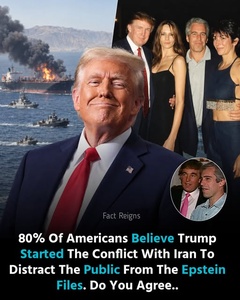
WASHINGTON — A viral social-media graphic claims that 80% of Americans believe President Donald Trump started the conflict with Iran to distract the public from the release of the Jeffrey Epstein files. However, available polling and reporting do not support the claim that 80% of Americans hold that view.
The graphic appears to combine images of Trump, Jeffrey Epstein and the Iran conflict with a sweeping statement about public opinion. A review of recent polling shows that Americans are divided over both the war in Iran and the controversy surrounding the Epstein files.
A More in Common survey conducted from March 30 to April 6, 2026, found that 51% of U.S. adults said Trump went to war with Iran to distract attention from the Epstein files, while 30% said there was no connection and 19% were unsure. The survey included 1,469 U.S. adults. Among Trump’s 2024 voters, however, only 19% attributed the decision to the Epstein files.
That distinction is important. While the survey provides evidence that a substantial share of Americans see a connection between the two issues, it does not support the viral graphic’s specific figure of 80%.
The timeline
The timing of the two events has fueled speculation online.
The U.S. Department of Justice published more than 3 million additional pages related to the Epstein investigation on January 30, 2026, bringing the total released material to nearly 3.5 million pages under the Epstein Files Transparency Act. The department said the material included documents, videos and images collected from several investigations.
One month later, on February 28, 2026, Trump announced major U.S. military operations against Iran. The White House identifies that date as the beginning of Operation Epic Fury.
The proximity of the two events has become a major subject of online debate. But a chronological overlap by itself does not establish that one event was deliberately undertaken to distract from the other.
Epstein controversy remains politically significant
Public concern over the Epstein investigation has nevertheless been substantial. An Economist/YouGov poll conducted in February 2026 found that large majorities of Americans were aware of the government's release of Epstein-related documents. The survey also found significant disagreement over Trump's handling of the investigation and whether he was attempting to conceal information.
The Justice Department has maintained an online Epstein Library containing documents released under the transparency law, while warning that some material may contain inaccurate or falsely submitted information.
Online misinformation adds another layer
The controversy has also become intertwined with misinformation campaigns. The Washington Post reported in March 2026 that a network of pro-Iran accounts circulated fabricated or AI-generated material linking Trump, Epstein and the Iran conflict. Researchers cited by the newspaper said some of the material was designed to promote the narrative that the Iran operation was intended to delay or divert attention from Epstein-related revelations.
This does not prove that every discussion of a possible connection is false. It does mean that claims circulating on social media should be separated from independently verified evidence.
What can be established?
There is clear evidence that the Epstein files were being released shortly before the U.S. military campaign against Iran began, and polling shows that many Americans believe the two events were connected. But the viral claim that “80% of Americans” believe Trump started the conflict for that reason is not supported by the available polling cited above.
Whether the timing represents a deliberate political strategy is a matter of interpretation and requires evidence beyond the sequence of events or public opinion surveys.
For now, the most defensible conclusion is narrower: the alleged connection is a significant topic of public debate, but the viral graphic substantially overstates the level of agreement among Americans and presents a disputed interpretation as though it were an established fact
Comments (0)
Loading comments...
May You Like
OBAMA STUNS ON INSTAGRAM: MESSAGE MARKING 34-YEAR MILESTONE SPARKS A BUZZ
South Korea–Ukraine Rift Deepens Over North Korean POW Transfer as PURL Draws New Scrutiny