
Viral Graphic Misquotes Trump: He Called Canada Tougher to Deal With Than China — Not a Greater Threat Than Russia
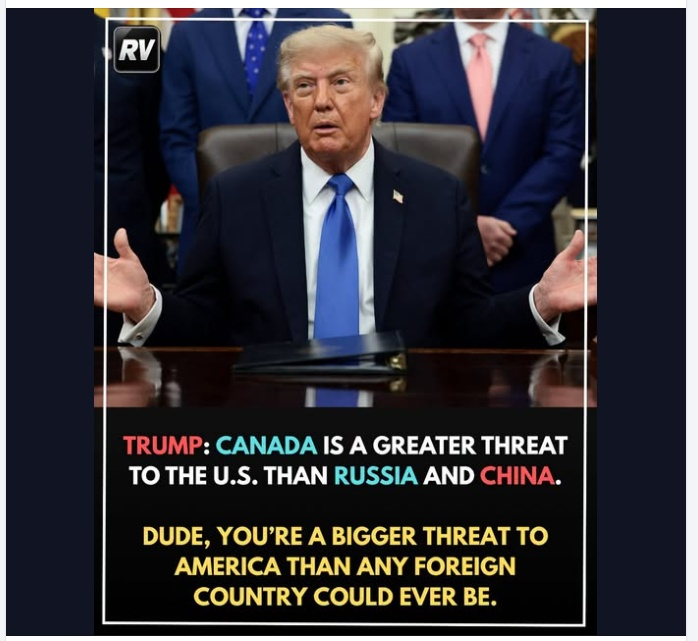
A viral graphic circulating online claims that President Donald Trump said “Canada is a greater threat to the U.S. than Russia and China.” The wording is striking, but the available transcript of Trump’s recent remarks does not support that quotation.
The image shows Trump at the White House with the claim presented as a direct quote, followed by a sarcastic caption: “Dude, you’re a bigger threat to America than any foreign country could ever be.”
The underlying story, however, is real: Trump did recently single out Canada as more difficult to deal with than China in the context of trade negotiations.
What Trump actually said
On September 2, 2026, Trump was speaking with reporters in the Oval Office about the deteriorating U.S.-Canada trade relationship.
He was asked about countries that are difficult for the United States to negotiate with. Trump responded that people might expect China or Vietnam to be the toughest, but said:
“No, actually, it’s Canada.”
He then complained that Canada had taken advantage of the United States economically and argued that previous U.S. presidents had failed to protect American industries.
Trump went on to argue that the United States did not need many Canadian products and said Washington could respond with still higher tariffs if necessary.
That is a significant statement—but it is not the same as saying Canada is a greater national-security threat than Russia and China.
The key distinction
The viral graphic transforms:
“Canada is the toughest country to deal with”
into:
“Canada is a greater threat to the U.S. than Russia and China.”
Those are materially different claims.
The first concerns trade negotiations and economic disputes. The second describes Canada as a greater strategic or national-security threat than two major U.S. geopolitical rivals.
I found no credible transcript or contemporaneous report showing Trump making the exact “greater threat than Russia and China” statement shown in the graphic. The documented September 2 remarks instead repeatedly frame Canada as a particularly difficult trade counterpart.
Why the graphic appeared now
The meme appears to have been inspired by Trump's September 2 comments, which quickly circulated online.
A social-media post subsequently presented the shortened formulation “Trump: Canada is a greater threat to the U.S. than Russia and China”, effectively converting Trump's “toughest one to deal with” remark into a broader geopolitical claim. That wording was then reproduced by other accounts.
In other words, the graphic appears to be commentary built around a real Trump statement, rather than a faithful quotation of one.
That distinction matters because the image visually presents the sentence as though Trump himself said it.
Trump and Canada: Why relations have deteriorated
The dispute is not new.
Since returning to office, Trump has repeatedly attacked Canada's trade policies and has also revived his provocative suggestion that Canada could become the 51st U.S. state.
Trump's pressure campaign has included tariff threats, complaints about the U.S. trade deficit and criticism of Canadian economic policy. His rhetoric has generated a strong nationalist reaction in Canada.
The relationship has deteriorated further under Prime Minister Mark Carney.
In January 2026, Trump even threatened a 100% tariff on Canadian goods if Canada pursued a trade agreement with China, arguing that Canada could become a conduit for Chinese goods entering the United States.
More recently, Washington and Ottawa have struggled to revive trade negotiations. Carney said on September 3 that Canada remained prepared to negotiate an agreement beneficial to both countries, while Trump warned that Canada could suffer economically if the dispute continued.
Trump is escalating the rhetoric—but the context is economic
Trump's September 2 remarks went well beyond simply saying Canada was difficult to negotiate with.
He argued that Canada had benefited at America's expense and complained about Canadian automobile production. He also asserted that the United States had little need for Canadian resources and said Washington could increase tariffs if necessary.
That helps explain why the remark generated headlines.
But it is important not to turn Trump's rhetoric into something he did not actually say.
Canada being described as a tougher trading partner than China is not equivalent to Canada being declared a greater military, intelligence or national-security threat than Russia and China.
Those are different categories.
The broader irony: Canada is America's closest neighbor and a major economic partner
The intensity of the dispute is particularly striking because the United States and Canada have one of the world's most deeply integrated economic relationships.
The two countries are heavily interconnected through energy, automobiles, manufacturing, agriculture and supply chains. Analysts have warned that prolonged confrontation could damage businesses and consumers on both sides of the border.
The political consequences are already visible.
A 2025 Pew Research Center survey found that Canadian views of the United States and Trump had fallen to near historic lows. A majority of Canadians surveyed said the U.S. posed the greatest threat to their country, a dramatic shift from earlier years when China was more commonly identified.
More recent polling has shown how deeply the relationship has deteriorated: a February 2026 poll found a plurality of Canadians no longer considered the United States an ally, with nearly half viewing the U.S. as a greater threat to world peace than Russia.
That does not validate the meme's claim about Trump's assessment of Canada. Instead, it demonstrates how Trump's policies and rhetoric have dramatically changed perceptions of the bilateral relationship.
What the viral graphic gets right — and what it leaves out
What it gets right:
- Trump really did say Canada was the toughest country for him to deal with in the context of current negotiations.
- He has become increasingly hostile toward Canada's trade policies.
- His administration has imposed substantial tariffs and repeatedly threatened additional economic pressure.
- U.S.-Canada relations are currently under significant strain.
What it gets wrong or exaggerates:
- There is no evidence in the available transcript that Trump said “Canada is a greater threat to the U.S. than Russia and China.”
- His September 2 comment was about who was toughest to deal with, particularly in the trade context.
- The graphic presents a paraphrase or reinterpretation as a direct quotation.
- It therefore gives readers the impression that Trump ranked Canada above Russia and China as a national-security threat, which the documented remarks do not establish.
The real significance of Trump's comment
Even without the meme's embellishment, Trump's statement is politically consequential.
China is widely treated in U.S. national-security strategy as America's principal long-term strategic competitor, while Russia remains a major military and geopolitical adversary. Pew's 2025 survey, for example, found that 42% of Americans named China as the greatest threat to the United States and 25% named Russia.
Trump's decision to describe Canada as tougher to deal with than China therefore stands out—not because he formally ranked Canada as America's greatest enemy, but because it illustrates how heavily his administration's current confrontation with Ottawa has come to dominate his rhetoric.
And the dispute is still evolving. Canada says it wants a mutually beneficial trade agreement, while Trump continues to argue that the United States has been disadvantaged by the relationship.
Bottom line
The viral graphic is misleading.
Trump did say that Canada was tougher to deal with than China, but there is no reliable evidence that he said Canada was a greater threat to the United States than Russia and China. The latter wording appears to be a social-media transformation of his actual remarks.
The underlying conflict with Canada is very real. The quotation presented in the meme is not.
Comments (0)
Loading comments...
May You Like

Obama Steps Back Into the Political Spotlight as Democrats Target Trump’s

Shocking news from Ohio: an unexpected development ahead of Trump's rally













