Viral “Types of Headaches” Meme Takes Aim at Celebrity Politics — But the Medical Chart Isn’t What It Seems
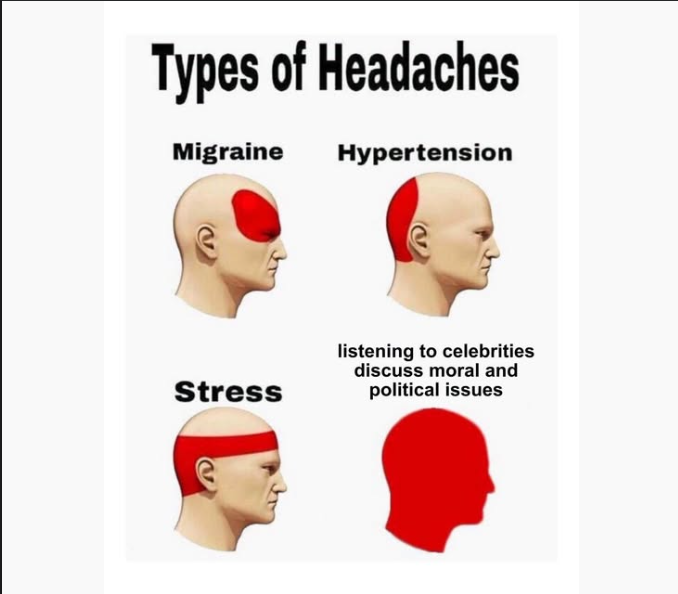
A tongue-in-cheek image circulating online has turned a familiar medical-style infographic into a political joke, labeling “listening to celebrities discuss moral and political issues” as its own supposed type of headache.
The meme displays four illustrated heads under the heading “Types of Headaches.” Three are labeled migraine, hypertension and stress, while a fourth, depicted entirely in red, is assigned the humorous diagnosis of irritation caused by celebrities weighing in on politics and morality.
The joke is obvious: the image is not offering a medical diagnosis. It is expressing frustration with the increasingly common practice of entertainers and other public figures commenting on political and social issues.
But there is an interesting real-world question behind the meme: Do celebrity political statements actually influence people, and are audiences increasingly tired of politics entering entertainment?
Celebrity Politics Has Become a Major Part of Public Discourse
Celebrities have long endorsed candidates and spoken publicly about political causes. Social media, however, has made it far easier for entertainers to address millions of followers directly.
A 2026 academic study published in Celebrity Studies examined how audiences perceive celebrities who enter political debates. The research found that people tend to regard celebrities as less credible when their political views conflict with their own, while people are more receptive when the celebrity's views align with theirs. Stronger parasocial relationships with celebrities can also increase perceived credibility.
That finding helps explain why celebrity political commentary can be so polarizing.
A fan may view an actor, musician or athlete as an influential voice worth hearing. Someone who disagrees may instead wonder why an entertainer's political opinion should carry any special authority.
Americans Are Also Feeling Politics Everywhere
The frustration captured by the meme isn't entirely imaginary.
Research from the Pew Research Center published in July 2026 found that Americans who are more engaged with public life tend to be more interested in politics and news. The study also found significant differences in how groups engage with and trust news and political information.
Meanwhile, the broader decline in trust toward traditional news organizations and the growth of social media have created an environment in which political commentary can come from almost anywhere — including celebrities, athletes, influencers and entertainers.
That means audiences increasingly encounter political opinions in spaces that were once viewed primarily as entertainment.
Celebrities Can Influence Political Conversations — But Not Everyone Listens
The idea that celebrities automatically persuade voters is also too simplistic.
An Ipsos survey of Britons published in 2025 found that 60% said they had not paid attention to celebrities expressing political views, while only 5% said they trusted celebrities most when seeking opinions on political issues. Friends and family were considerably more trusted.
The research suggests that celebrity influence depends heavily on the audience.
People who already admire a particular celebrity may be receptive to that person's political message. Those who dislike the celebrity's views may experience the opposite reaction — becoming even more skeptical of the speaker.
In other words, a celebrity endorsement can mobilize supporters without necessarily persuading opponents.
And What About the “Headache” Claim?
This is where the meme should not be taken literally.
The medical terminology in the graphic is simplified. The World Health Organization identifies migraine, tension-type headache and cluster headache among the major primary headache disorders.
“Listening to celebrities discuss moral and political issues” is obviously not a recognized medical headache disorder.
The graphic's use of “hypertension” is also an oversimplification. High blood pressure usually causes no symptoms, according to the American Heart Association, although extremely high blood pressure can become a medical emergency and may be associated with serious symptoms.
Similarly, stress can contribute to tension-type headaches. MedlinePlus describes tension headaches as the most common type and says they can be associated with stress, anxiety and muscle tension.
So the first three categories in the meme borrow recognizable medical concepts, while the fourth is purely comedic.
Why the Joke Resonates
The meme works because it combines two things that are increasingly difficult to separate online: entertainment and politics.
When a celebrity discusses an issue that agrees with a person's political beliefs, the same statement may be viewed as courageous or socially responsible. When the celebrity takes the opposite position, the reaction can be dramatically different.
That phenomenon is consistent with the 2026 research on celebrity credibility: audiences tend to judge celebrity political speech partly through the lens of whether they already agree with the speaker.
The result is a political environment in which even a movie premiere, awards show, sporting event or late-night television appearance can become part of a larger political conversation.
For some viewers, that is engagement.
For others, it is the headache depicted in the meme.
What the Viral Image Gets Right — and What It Doesn't
What the meme gets right:
- Celebrities increasingly participate in political and moral debates.
- Celebrity political speech can affect how audiences perceive the speaker.
- Political opinions can increasingly appear in entertainment and social-media spaces.
- Some people are clearly frustrated by the politicization of entertainment.
What the meme gets wrong if interpreted literally:
- There is no recognized medical condition called “celebrity political commentary headache.”
- Hypertension is not simply a standard “type of headache.”
- Headache disorders have specific medical classifications and causes.
- The image provides no evidence that celebrity political commentary causes a medical disorder.
Bottom Line
The viral “Types of Headaches” image is best understood as political satire, not medical information.
Its joke nevertheless reflects a genuine cultural tension. Celebrities have enormous platforms, and research suggests their political messages can influence how audiences perceive both the issues and the celebrities themselves. At the same time, many people prefer to keep politics out of entertainment.
Whether celebrity activism is valuable civic engagement or simply another source of political fatigue ultimately depends on the audience.
For the person who wants politics everywhere, the celebrity may be an important voice.
For everyone else, apparently, there is always one more headache.
Comments (0)
Loading comments...
May You Like

OBAMA STUNS ON INSTAGRAM: MESSAGE MARKING 34-YEAR MILESTONE SPARKS A BUZZ
TRUMP HIT WITH 26 ARTICLES OF IMPEACHMENT

Barack Obama Draws Attention With New Literary Podcast