
Virginia Early Voting Tops 1.1 Million as Midterm Stakes Rise — What the Numbers Really Reveal
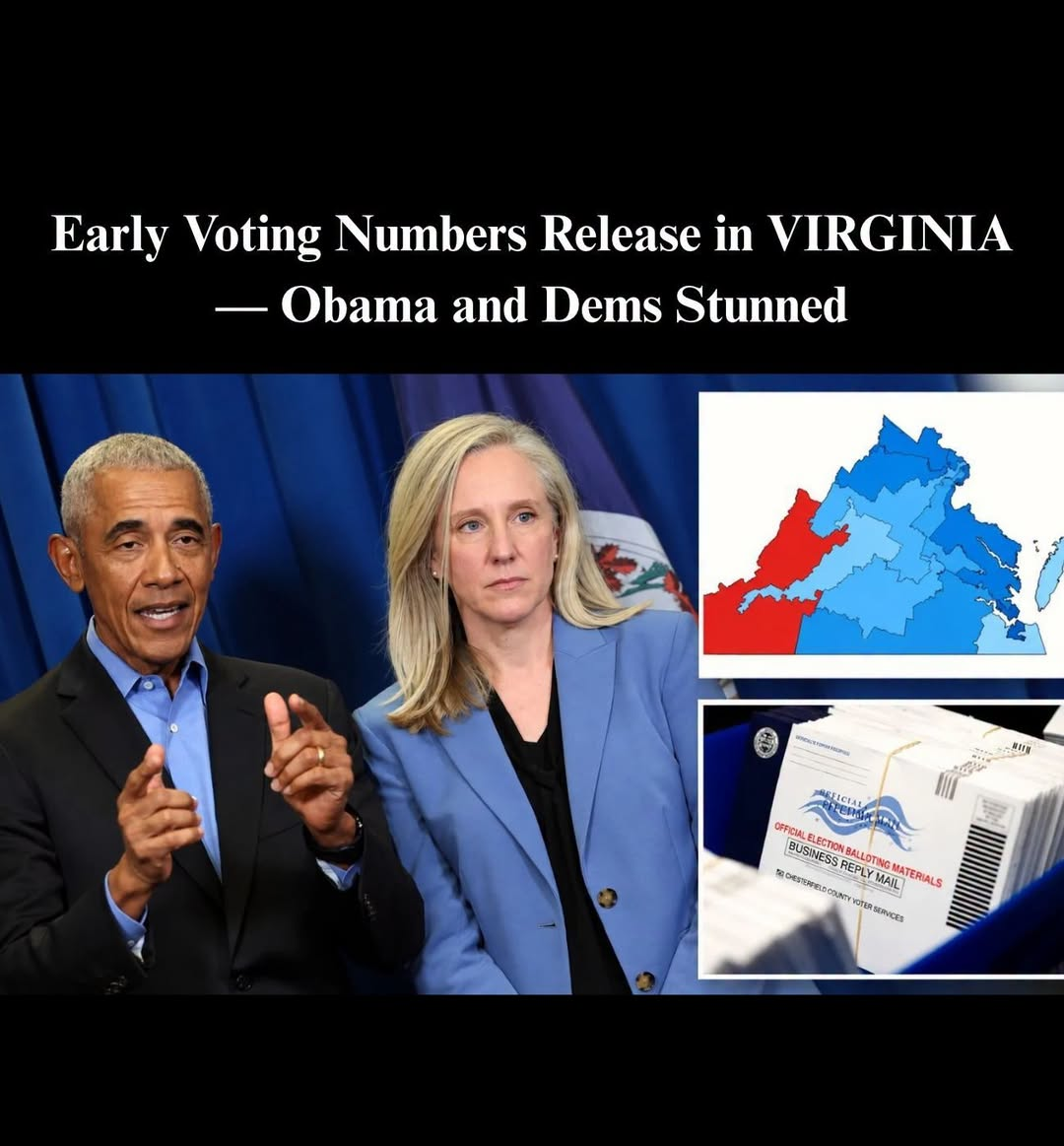
Virginia’s 2026 midterm election is entering its final stretch with early voting already exceeding 1.1 million ballots, drawing attention to turnout, the state’s congressional contests and three proposed constitutional amendments. The latest figure, reported by Virginia’s public television station WTVR using data from the Virginia Public Access Project (VPAP), puts participation well above the total early vote recorded during the 2022 midterm election—even though voting remains open through October 31. Election Day is November 3.
The numbers are significant, but their meaning requires care. A high early-voting total shows that many Virginians have already participated; it does not, by itself, establish which party will benefit or which congressional districts are likely to change hands. The viral image’s claim that Barack Obama and Democrats have been “stunned” is not substantiated by the turnout figure itself.
The contest is unfolding amid concerns about living costs, debates over constitutional rights and competition for control of Congress. Virginia voters are choosing representatives for every U.S. House seat, deciding a U.S. Senate race and considering three proposed amendments to the state constitution. In some localities, ballots also include a proposed sales tax to finance school construction or major renovations.
More than 1.1 million ballots — a striking turnout milestone
According to WTVR’s October 27 report, more than 1.1 million Virginians had cast early ballots. That was already about 200,000 more than the total number of people who voted early in the entire 2022 midterm cycle, the report said. The increase is a notable sign of participation, although comparisons must account for differences in the elections, the issues on the ballot and the amount of time voters have had to cast their ballots.
A separate October 25 analysis published by Blue Virginia, citing VPAP and State Navigate figures, put the early-vote total at approximately 1.072 million. It reported that this was about 1.8 times the early-voting figure at a comparable point in 2022 and already above the 977,000 early votes recorded during that earlier midterm cycle. The slight difference between the October 25 and October 27 totals reflects the fact that voting continued and the figures were published on different dates.
The last day for early voting is October 31, meaning additional ballots may still be cast before Election Day. The final participation total will depend on turnout during the remaining early-voting period and on voters who choose to cast ballots on November 3.
High turnout can reflect several factors at once: competitive races, extensive campaigning, concern about national politics, local issues and the convenience of early voting. Without more detailed evidence, it would be premature to attribute the increase to one party, one candidate or one political event.
Why Virginia’s congressional map is drawing attention
Virginia’s congressional races are one reason election analysts are watching the state closely. The districts differ considerably: Northern Virginia includes densely populated suburban communities, while central and western parts of the state include more rural areas with different political histories. Statewide turnout can therefore conceal substantial differences between individual districts.
The October 25 analysis published by Blue Virginia highlighted early-voting activity in several congressional districts, including the 1st, 2nd and 5th, which it described as competitive. It also reported that the 9th District remained strongly Republican in its early-voting pattern, although its projected early-vote margin was narrower than recent Republican election margins there. These figures are an analysis of early-vote patterns, not official predictions of the final results.
The distinction is important when interpreting the map in the viral image. A district colored blue or red may indicate a particular data measure, historical voting pattern or model estimate. It does not automatically mean that a seat is about to change parties. To assess whether a district is genuinely competitive, analysts need to consider the candidates, previous election results, polling, campaign spending, turnout patterns and the number of votes still to be cast.
VPAP is a useful resource for examining Virginia election data, but a map should always be read alongside its legend, methodology and publication date. The image supplied with the claim does not include enough information to establish that any specific congressional seat is about to flip.
Are Democrats benefiting from the surge?
Some Democratic-leaning analysts have interpreted the early-voting figures as encouraging for their party. Blue Virginia’s October 25 analysis reported an estimated Democratic advantage in its modeled early-vote margins across much of the state. It also highlighted a shift toward Democrats compared with the previous year’s early-voting pattern. Those estimates should be treated as the publication’s analysis rather than a final count of votes for Democratic candidates.
There is a fundamental limitation to early-voting data: a ballot cast is not the same thing as a vote publicly identified for a particular candidate. Where voter-registration information is available, party registration can provide clues about participation, but it does not prove how an individual voted. Virginia’s turnout total alone cannot establish that Democrats are gaining votes at Republicans’ expense.
Nor does a surge necessarily favor one party. Higher participation can benefit a candidate whose supporters are especially motivated, but it can also reflect mobilization by opponents. Campaigns may interpret the same turnout figures differently depending on their internal models and the districts they are trying to win.
Obama’s presence in the supplied graphic adds political symbolism, but the turnout data cited in the reports do not establish that he has reacted with surprise or alarm. The image’s headline is therefore best understood as commentary, not a verified account of his response.
Cost of living and constitutional amendments add to the stakes
The congressional races are only part of the election. Virginia voters are also being asked to decide three proposed constitutional amendments concerning reproductive healthcare, including abortion; protections for same-sex marriage; and automatic restoration of voting rights for people who have completed their felony sentences. These proposals give the election significance beyond the competition between Democrats and Republicans.
Economic concerns are also influencing voters’ accounts of why they are participating. WTVR reported that some Virginians cited rising household expenses and the difficulty of making ends meet, while others emphasized constitutional rights and public services. Those interviews illustrate a range of motivations, though they should not be treated as a representative survey of the entire electorate.
In some localities, voters will also decide whether to approve a 1% sales tax intended to fund school construction or major renovation projects. That means the same ballot may involve national political questions, state constitutional issues and practical local decisions about schools and public spending.
These overlapping issues help explain why turnout deserves attention. But they also make it difficult to reduce the election to a single explanation, such as enthusiasm for Obama, opposition to Trump or dissatisfaction with the economy.
What the numbers can—and cannot—tell us
The most reliable conclusions at this stage are straightforward:
-
Participation is high: More than 1.1 million Virginians had voted early by the time of WTVR’s October 27 report.
The 2022 comparison is notable: The early-vote total had already exceeded the entire early-vote count from that midterm cycle.
The election involves several distinct issues: Congressional contests, a Senate race, three proposed constitutional amendments and some local school-funding measures are all on the ballot.
The partisan outcome remains uncertain: Aggregate turnout figures and early-vote models do not establish who will win a particular district or the statewide contests.
The next meaningful benchmark will be the final early-voting total on October 31, followed by the full results after polls close on November 3. Analysts will then be able to compare actual results with early-voting estimates and determine whether turnout translated into unexpected gains for either party.
The bigger picture: a closely watched test of voter engagement
Virginia’s early-voting surge is a real development, and the numbers deserve attention. They show that a substantial number of voters have already chosen to participate before Election Day, at a time when the economy, constitutional rights and control of Congress are prominent political concerns.
But claims that the figures have stunned Democrats or prove that Republican-held congressional seats are about to turn blue go beyond what the available evidence establishes. Early-voting totals are an important indicator of participation, not a substitute for election results.
With early voting continuing through October 31 and Election Day approaching on November 3, Virginia offers an important case study in how turnout, local issues and national political debates intersect. The decisive question is not simply how many people have voted early, but how those ballots—and the votes still to come—translate into actual results.
Comments (0)
Loading comments...
May You Like

EAST COAST MEGASTORM—2 MILLION HOUSES DAMAGED, 5 MILLION AT RISK OF BLACKOUTS, WATER FAILURES!

COASTAL DISASTER — 112 KM/H WINDS, SEAWATER FLOODING, 79,000 NEW JERSEY HOMES AT RISK!

WWE BRONSON REED DEAD AT 38, STIMULANTS DETECTED, $10M INSURANCE PAYOUT FROZEN!
MINNESOTA EMERGENCY — HOUSE EXPLOSION PUTS 2 HUNDRED FAMILIES AT RISK OF FIRE AND WINTER EVACUATION!









Popular Posts





