Voters Are Fed Up With Data Centers. Both Parties Are Trying to Cash In for Midterms
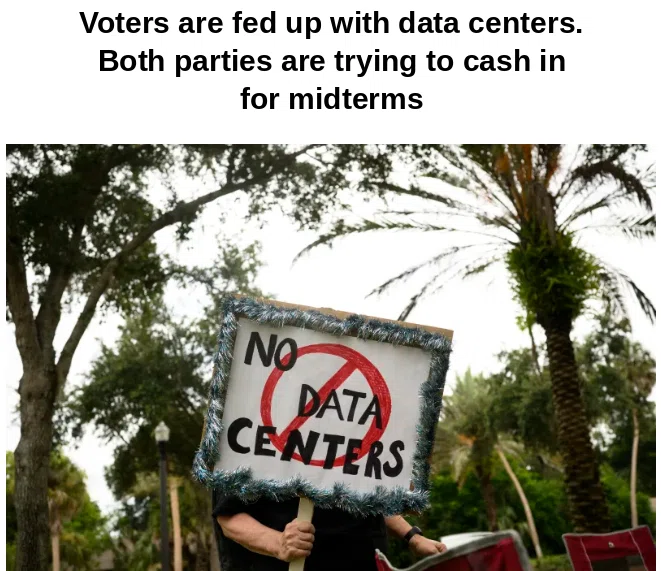
A bipartisan backlash against the sprawling facilities powering the artificial intelligence boom has turned data centers into an unlikely fault line in the 2026 midterm elections. With voters furious over rising electricity bills and environmental concerns, candidates from both parties are racing to position themselves as opponents of the industry — even as President Donald Trump continues to champion data centers as essential to beating China.
WASHINGTON – In campaign ads airing everywhere from Georgia to Iowa, Republicans and Democrats are confronting the same enemy: data centers powering the artificial intelligence boom .
An NPR analysis of political advertising data from the firm AdImpact found that since January, campaigns and outside groups have spent more than $45 million on ads mentioning data centers in this year's gubernatorial, House and Senate races . The two major parties driving that spending are largely making the same argument: the sprawling facilities get too many tax breaks, drive up electricity bills and need reining in .
From January to August, spending was nearly identical: over $22 million** supported Republican candidates and more than **$21 million for Democratic candidates, with independents driving the rest . Still, Democrats ran almost twice as many ads as Republicans — 127 compared to 67 — and spread their messaging across more states and races . The ads are clustered in states with competitive races, like Wisconsin and Michigan .
The Numbers Driving the Backlash
The voter anger is backed by stark polling data. A June Reuters/Ipsos poll found that 77% of Americans are concerned about data centers raising electricity costs and two-thirds of Democrats and half of Republicans said they'd oppose a data center in their community .
The opposition has only grown over time. The Annenberg Public Policy Center of the University of Pennsylvania, in a survey released on August 11, found a sharp uptick in data center opposition over just four months this year. Sixty-one percent of Americans opposed the projects as of mid-July, up from 49% in March — with majorities opposing across party lines: 69% of Democrats, 54% of Republicans and 53% of independents .
An Emerson College Poll released in July also found a surge in opposition, with 63% of voters not wanting them built in or near their communities, while 27% supported them and 10% were neutral . Gallup in May found that 7 in 10 Americans don't want data centers built in their communities, citing local impacts on energy prices, water consumption and the environment .
On the grid serving Senate battleground Ohio, as well as 12 other states, demand from data centers drove up capacity costs by $9.3 billion in a single year — a 174% increase, according to an independent market monitor .
A Rare Bipartisan Consensus — With a Twist
Data centers are a unique issue where "MAGA Republicans and liberal Democrats" land in the same place, said Michael Franz, co-director of the Wesleyan Media Project, which tracks political advertising .
Apart from a chance to talk about affordability, "Democrats can latch on to environmental concerns," Franz said, adding that for Republicans, criticizing data centers is a way "to go in opposition to big corporations, in opposition to a system that doesn't care about you" .
But there's a catch: President Donald Trump is out of step with his own party's candidates.
Trump has remained a full-throated cheerleader for data centers, calling them essential to winning the AI race with China . On August 31, he posted on social media: "The only reason that communities throughout the U.S.A. should not want data centers is if they want to end up being backwards and poor" . He has also said communities that don't accept data centers are "making a mistake" and urged them to surrender to projects, declaring, "You can't fight it. You have to go with it" .
Those comments have landed with a thud among Republicans on the ballot. U.S. Rep. Tim Burchett, a Tennessee Republican and Trump ally, seized the opportunity to call himself "backwards and poor" while recommending that data centers be built on military bases and blaming tech companies for doing a poor job on community outreach .
Vice President JD Vance has tried to smooth things over with nuance. On August 31, he suggested that data center owners should build their own power plants, so communities where they are located are not impacted by energy costs .
The Battlefields: Georgia, Ohio and Beyond
According to data from AdImpact, more than half of the GOP's spending on ads mentioning data centers has been in Georgia, and the state has captured about 30% of total spending on data center ads . Georgia's contest for governor is the race that has spent the most on ads mentioning data centers — $12.8 million across nine ads .
Six ads discouraged voters from backing Republican Lt. Gov. Burt Jones, using data centers as a bogeyman for his alleged corruption .
In Ohio's U.S. Senate race, supporters of Democratic nominee Sherrod Brown have spent millions to describe his opponent, Republican Sen. Jon Husted, as "the face of data centers," and accuse him of "giving corporations over $2.5 billion in out of control tax breaks and causing electric bills to spike by thousands of dollars" .
The issue has alarmed Republican strategists. In an internal memo obtained by NPR and first reported by Axios, the National Republican Senatorial Committee singled out the Ohio race and called data centers a "sleeper issue" . The memo warned that data center politics was endangering Husted, arguing that "more than any other thing in this race, data centers are the anchor hanging around Husted's neck" .
In Michigan, the issue toppled two better-connected Democrats in a primary won by a leftist who said opposition had united committed Republicans, Trump voters, independents and Democrats .
Republicans Scrambling to Distance Themselves
A growing number of Republican candidates have scrambled to shield themselves from any fallout, voicing skepticism about data centers despite Trump's cheerleading .
Mike Rogers, the Republican running for Senate in Michigan, recently said he supports a one-year moratorium on data center construction . Former Rep. Mike Rogers, who previously welcomed data center expansion in Michigan, argued that "Michigan needs stronger guardrails to protect community control, prevent utility price hikes, protect our water, and stop pay-to-play schemes" .
In Florida, Rep. Byron Donalds, the Republican nominee for governor, spent more than $2 million on one ad in his primary, vowing to "protect" the state from data centers that "jack up utility rates" . He introduced legislation this summer that would require large AI data centers to generate their own power and water rather than draw from public utilities .
Texas Gov. Greg Abbott, a Republican running for a fourth term, halted new data center connections to the state's power grid pending a comprehensive regulatory audit . Trump called Abbott's decision a "mistake" .
Ohio Republican gubernatorial nominee Vivek Ramaswamy pledged to issue a first-day-in-office executive order halting approval of all new data center projects until his proposed safeguards are enacted .
Wisconsin Republican gubernatorial nominee Tom Tiffany has highlighted that he opposes new data centers unless strict conditions are met, and has taken to calling his Democratic opponent "Data Center David Crowley" .
Democrats Seize the Opportunity
Democrats have been racing to harness voter anger about data centers over rising electricity prices, water use and mistrust of the tech sector, aiming to punish Republicans for cozying up to industry by approving many of these projects .
A Believe in Wisconsin PAC ad for Wisconsin's Democratic gubernatorial nominee David Crowley promises that Crowley "will lower costs, make housing affordable, stop AI data centers from making your energy bills skyrocket" .
In Pennsylvania's gubernatorial race, Democrats have also hit the issue hard . Pennsylvania now requires developers to cover infrastructure costs and meet tougher standards on water use, hiring and community consultation .
New York has imposed a year-long moratorium on new hyperscale facilities .
Zac McCrary, a Democratic pollster, said that opposing data centers offered Democrats a rare chance to make inroads in rural areas and small towns that are resisting the developments. "It absolutely shakes up the snow globe on the partisan coalitions in a part of the world where Republicans have been dominant," he said . "It's one of the few issues today that does not immediately code as red or blue, left or right" .
Legislative Action and Grassroots Opposition
The backlash has translated into legislative action. In June 2026, Rep. Alexandria Ocasio-Cortez introduced the Artificial Intelligence Data Center Moratorium Act (H.R. 9442), which would impose a moratorium on the construction of new data centers until legislation is enacted that safeguards the public from the dangers of artificial intelligence . The bill has 13 Democratic cosponsors .
In South Carolina, a joint resolution was introduced in February 2026 to prohibit governmental entities from granting final approval for new data centers until January 1, 2028 . In Pennsylvania, a bipartisan bill — co-sponsored by Democratic Sen. Carolyn Comitta and Republican Sen. Rosemary Brown — was introduced in June 2026 to impose a statewide moratorium on hyperscale data center development .
Grassroots opposition has been fierce. In Virginia, local groups like "Protect Warren County – No Data Centers" have organized community outreach efforts, urging residents to attend public hearings and voice opposition . The group says its mission is to preserve the area's rural character, scenic views, and natural resources .
In June 2026, a data center project in Virginia was canceled largely in response to local community legal action and protest . The "Human First" protests against data center development were staged nationwide in July 2026 .
Trump Stands Firm — For Now
Despite the political backlash, Trump has not moved with his party's candidates. He has made data centers a key ingredient in winning the AI race with China . His administration has signed up Google, Microsoft, Meta, Oracle, xAI, OpenAI and Amazon to a voluntary "Ratepayer Protection Pledge," under which the companies undertake not to leave consumers paying for the power plants and grid upgrades their facilities require .
But Trump, at least for now, seems to be giving Republicans some wiggle room. "If a Republican's against a data center, that's OK with me," Trump said .
Veteran Republican strategist Matt Gorman told Fox News Digital that "Trump is smartly taking the long view of this," adding that "Republicans on the ballot this year are being responsive to the very real concerns people have" .
The AI industry is responding to the political backlash. Build American AI, an industry-aligned group powered by top AI leaders, this week launched a multimillion-dollar public engagement campaign to build support for "clear, strong, and commonsense policies governing the development of the data centers and energy infrastructure" .
The Bottom Line
| What's Happening | The Numbers |
|---|---|
| Ads mentioning data centers since January | $45 million+ |
| Americans concerned about rising electricity costs | 77% |
| Americans opposing data centers in their communities (July) | 61% (up from 49% in March) |
| Voters opposing data centers in/near their communities | 63% |
| Data center capacity cost increase on Ohio grid | 174% ($9.3 billion) |
| Republicans backing away from Trump's position | Growing number in battleground states |
As the midterm elections draw nearer, data centers have become a political minefield — an issue where the president and his party's candidates find themselves on opposite sides. For voters fed up with rising bills and environmental impacts, both parties are eager to claim the mantle of reform. But with Trump standing firm, the debate is far from over.
Comments (0)
Loading comments...
May You Like

gfnhgmnghnmfgnbvvvvvvvvv

Obama Steps Back Into the Political Spotlight as Democrats Target Trump’s