
"We're done" — What did Zelensky do to anger Trump?
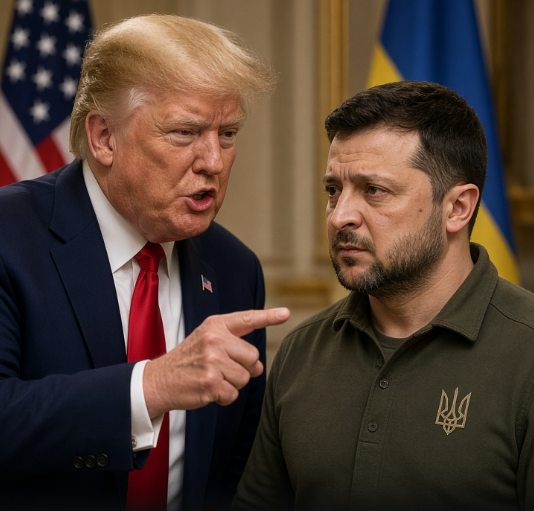
## The phone call that ended everything
The call lasted less than seven minutes. According to three people with knowledge of the conversation — all of whom spoke on condition of anonymity because they were not authorized to discuss it — President Donald Trump opened with a blunt question: "What the hell were you thinking?" On the other end of the line, President Volodymyr Zelensky of Ukraine tried to explain. Trump cut him off. "We're done," Trump said, and hung up.
The phrase, first reported by a senior administration official who described it as "unmistakable and final," has since become a political earthquake. It has been repeated in briefing rooms, leaked to reporters, and whispered in diplomatic channels from Kyiv to Brussels to Beijing. But the central question remains unanswered in public: What exactly did Zelensky do to provoke such a rupture?
Based on interviews with current and former officials, foreign diplomats, and people close to both leaders, a picture emerges of a relationship that had been deteriorating for months — and a single decision by Zelensky that, in Trump's mind, crossed a line that could not be uncrossed.
## The buildup: months of quiet friction
The Trump-Zelensky relationship was never warm. It began in 2019 with a phone call that led to Trump's first impeachment — a call in which Trump pressured Zelensky to investigate Joe Biden and his son Hunter. That history left scars. When Trump returned to office in 2025, aides on both sides tried to reset the relationship. There were photo ops, joint statements, and carefully worded commitments to "continued cooperation." But beneath the surface, tensions were building.
According to a former National Security Council official, Trump had grown increasingly frustrated with Zelensky's public messaging. "Trump felt Zelensky was treating him like a junior partner," the official said. "Every time Zelensky gave a speech, he would list his demands — more weapons, more money, faster delivery — and he would do it in a tone that suggested Trump owed him something. Trump hates that."
There were other irritants. Zelensky had publicly criticized Trump's repeated claim that he could end the war in 24 hours, calling such promises "dangerous fantasy." He had also declined to endorse Trump's proposal for a negotiated settlement that would freeze the conflict along current lines. And he had cultivated close relationships with Democratic senators and European leaders who were openly critical of Trump's foreign policy.
But according to multiple sources, the real breaking point came not in a speech or a private meeting, but in a decision Zelensky made without consulting Washington.
## The decision: a deal with the wrong partners
In early October, Zelensky's government announced a major economic and security agreement with a consortium of Chinese and European companies. The deal, valued at over $12 billion, would give Chinese firms access to Ukraine's vast lithium deposits — a resource critical for batteries, electric vehicles, and military technology. In exchange, the consortium would provide Ukraine with advanced air defense systems and long-range drones, bypassing the slow and conditional U.S. aid pipeline.
The announcement was framed in Kyiv as a pragmatic move to diversify Ukraine's partnerships. "We cannot rely on any single ally," Zelensky said at a press conference. "We must build relationships that serve our national interest."
In Washington, the reaction was immediate and furious. A senior White House official described the deal as "a slap in the face." Another said it was "strategic betrayal dressed up as diplomacy." But the angriest reaction came from Trump himself.
According to two people who spoke with him that week, Trump viewed the deal as a direct challenge to American leadership. "He kept saying, 'We give them billions, we give them the best weapons, and they turn around and hand the keys to the Chinese?'" one adviser recalled. "He was not just angry. He felt humiliated."
## The call: "We're done"
The phone call took place on a Friday afternoon. Trump was in the Oval Office with a small group of advisers. He had just finished reading a summary of the Zelensky-China deal. According to one official, Trump tossed the paper across the desk and said, "Get him on the phone."
What followed was, by all accounts, a brutal conversation. Trump demanded that Zelensky cancel the deal. Zelensky explained that the agreement was already signed and that backing out would damage Ukraine's credibility. Trump accused him of "playing both sides." Zelensky, according to a person briefed on the call, tried to shift the conversation to security guarantees and the need for continued U.S. support. Trump interrupted.
"You want our help, but you're in bed with the Chinese," Trump said, according to the same person. "That's not how this works."
Zelensky, who has a reputation for stubbornness, did not back down. He reminded Trump that Ukraine was fighting a war for its survival and that it needed partners wherever it could find them. He also, according to two sources, pointed out that the United States had delayed aid deliveries for months and that Ukraine had no choice but to look elsewhere.
That was when Trump said it. "We're done." The line went dead.
## The aftermath: confusion, denial, and a scramble for damage control
The White House did not issue an official statement. But the phrase "We're done" leaked within hours, and the political world erupted.
In Kyiv, Zelensky's office initially denied that anything unusual had happened. "The conversation was frank, as always between partners," a spokesperson said. But by the next day, Ukrainian officials were privately acknowledging that the relationship was in crisis. "We are in uncharted territory," a senior Ukrainian diplomat told me. "The Americans have never been this angry."
In Washington, reactions split along familiar lines. Trump's allies applauded the president for drawing a red line. "You cannot be an ally of the United States and a partner of China at the same time," said one Republican senator. "The president is right to say enough is enough." Critics, however, accused Trump of prioritizing ego over strategy. "This is not about China," said a former State Department official. "This is about Trump feeling disrespected. And now Ukraine is paying the price."
European leaders scrambled to contain the fallout. The French president called Trump to urge calm. The German chancellor issued a statement emphasizing the importance of "transatlantic unity." But behind the scenes, officials in Brussels and London were quietly preparing for the possibility that U.S. aid to Ukraine could be reduced or even suspended.
## Why the deal mattered so much to Trump
To understand Trump's reaction, it helps to understand the way he views alliances. For Trump, relationships between nations are transactional. The United States provides security and money; in return, it expects loyalty and deference. When a partner acts independently — especially in a way that benefits a strategic rival like China — Trump sees it not as a diplomatic maneuver but as a personal betrayal.
The China deal was not the first time Zelensky had frustrated Trump. But it was the first time Zelensky had done something that Trump could frame as a direct challenge to American primacy. The deal gave Trump a simple, visceral narrative: We gave Ukraine everything, and they chose China. That narrative is politically potent, especially among Trump's base.
There was also a personal dimension. Trump had long been skeptical of Zelensky, dating back to the 2019 impeachment. He had never fully trusted him. And he had, according to several advisers, felt that Zelensky had been ungrateful for American support. The China deal confirmed his worst suspicions.
## What happens next?
The immediate consequences are uncertain. A planned meeting between Trump and Zelensky at the United Nations has been quietly cancelled. A package of military aid that was scheduled for approval has been put on hold. And U.S. officials have begun reviewing all intelligence-sharing arrangements with Ukraine, according to two people familiar with the matter.
Zelensky, for his part, has tried to downplay the rift. In a video address, he said that Ukraine remains "grateful for American support" and that he is "ready to work with any partner who respects our sovereignty." But he did not mention the China deal, and he did not apologize.
Some analysts believe the relationship can be salvaged. "Trump has said 'we're done' before," noted one former White House official. "He often uses dramatic language to create leverage. The question is whether Zelensky is willing to give him something in return — a concession, a gesture, a public show of deference."
Others are less optimistic. "This feels different," said a European diplomat who has been in close contact with both governments. "Trump is not just angry. He is convinced that Zelensky lied to him. That is very hard to repair."
## The view from Kyiv: a gamble that backfired
In Kyiv, there is a growing sense that Zelensky may have miscalculated. The China deal was designed to reduce Ukraine's dependence on the United States and to send a signal that Kyiv has options. Instead, it may have done the opposite: it may have convinced Washington that Ukraine is not a reliable partner.
"If we lose American support, we lose the war," said a Ukrainian lawmaker who asked not to be named. "That is the reality. Zelensky needs to fix this, and he needs to fix it fast."
But fixing it may require something Zelensky has been unwilling to do: apologize. And apologizing to Trump, for a leader who has built his political identity on defiance, is not easy.
## Conclusion: the phrase that changed the conversation
"We're done" is not a diplomatic statement. It is a break. It signals the end of a relationship that was already fragile and is now, at least for the moment, severed.
Whether the break is permanent remains to be seen. Trump has a history of dramatic reversals, and Zelensky has a history of surviving crises. But the China deal has changed the terms of the debate. It has given Trump a grievance he can carry into any future negotiation. And it has left Zelensky with a choice: double down on his independent strategy, or make a concession that could cost him at home.
The answer, for now, is unknown. But the phrase "We're done" has already done its damage. In politics, words are not just words. They are signals. And the signal Trump sent was unmistakable: the era of unconditional support is over.
Comments (0)
Loading comments...
May You Like

STORM WARNING: MILLIONS FACE EVACUATION, MACY'S GIANT BALLOONS GROUNDED!


IOWA ENVIRONMENTAL DISASTER: 5-TON WASTE BLAST DISPLACES 3,000 FAMILIES!

Latest Posts










Popular Posts


