
"We're Going to Make a Decision": Inside Trump's Urgent Security Talks—and the Narrowing Window for War with Iran
"We're Going to Make a Decision": Inside Trump's Urgent Security Talks—and the Narrowing Window for War with Iran
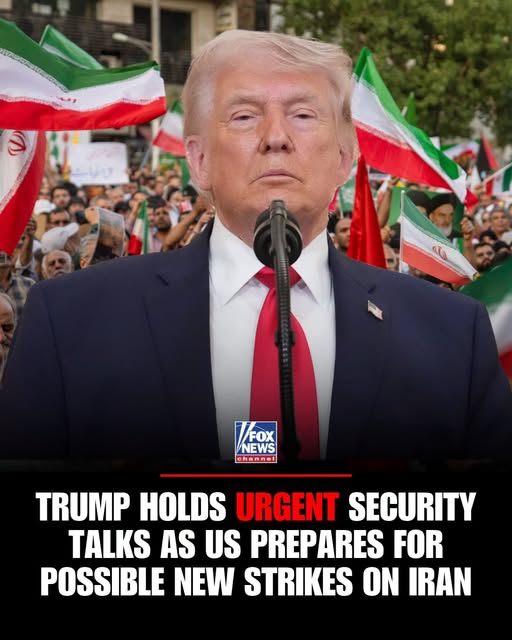
The image is designed to project resolve in a moment of acute political vulnerability: Donald Trump stands at a podium, his expression grave, the Fox News chyron cutting to the heart of the matter: "TRUMP HOLDS URGENT SECURITY TALKS AS US PREPARES FOR POSSIBLE NEW STRIKES ON IRAN."
The post, which has circulated widely across social media in the days following the 2026 midterm elections, captures a moment of extraordinary geopolitical and political gravity. This was not a routine briefing or a scripted campaign event. It was a series of emergency meetings at the White House, convened just days after Republicans suffered a devastating defeat at the polls, to decide whether to launch a new wave of military strikes on Iran—or to pursue a last-ditch diplomatic deal that could end the conflict without further bloodshed.
This is the story behind the urgent talks, the three options on the table, the narrowing window of opportunity, and the high-stakes gamble that could define the final months of Trump's presidency.
The Verdict: A Real Moment of Decision, Not Just a Headline
Unlike many viral political headlines, this one is grounded in verifiable reporting from multiple credible sources. On November 5, 2026—two days after the midterm elections—Trump convened a meeting with his top national security advisers to discuss the next steps on Iran . The meeting was the first of its kind since the elections, and it was followed by another session the next day .
According to Fox News, which first reported the meetings, Trump discussed whether to resume military strikes on Iran. Officials also noted that November 9 would be a favorable date for a military operation, because a new moon over the Middle East would mean almost no moonlight—conditions that are advantageous for a surprise air campaign .
The White House has not announced a final decision. But Trump himself told reporters in the Oval Office: "Now we're going to make a decision. We'll see if we have to do further air strikes to make sure the nuclear program is completely dismantled and 'never comes back.' If I can, I'd rather not destroy the rest of Iran, but maybe I'll have to. You'll know soon" .
The Three Options: War, Pressure, or a Deal
According to Axios and other outlets, Trump is weighing three distinct paths forward :
-
A new round of military strikes: A large-scale air campaign targeting Iran's remaining nuclear facilities, energy infrastructure, and military sites.
Sustained economic pressure: Continuing to tighten the economic stranglehold on Tehran without a new military escalation.
A diplomatic agreement: A deal that would include concessions to Iran in exchange for verifiable guarantees that it will not pursue a nuclear weapon.
The choice is not an easy one. Trump's advisers have reportedly warned him that the "time window" for a major military operation is narrowing. The reason is practical: the U.S. has deployed more than 50,000 troops, 20 ships, and 200 aircraft to the Middle East—a massive force that is difficult to sustain indefinitely. Some advisers have recommended acting before the new Democratic-controlled Congress is seated in January 2027, which could constrain his options .
The Military Reality: A Force Built for War
The United States has not been idle in the months since the conflict with Iran began. According to CNN, U.S. forces in the Middle East are fully prepared to launch a new, potentially major military operation within 96 hours of receiving an order from the President . Officials have described the planned operation as "a big effort"—not a limited "mow the lawn" strike, but a campaign that could significantly expand the scope of the war .
A third aircraft carrier strike group, led by the USS Theodore Roosevelt, is expected to arrive in the Middle East by mid-November, which would give the U.S. an unprecedented three-carrier presence in the region . The Pentagon has drawn up a wide-ranging target list that includes Iranian energy infrastructure, military bases, and nuclear facilities .
The risk of retaliation is high. U.S. intelligence assessments indicate that Iran and its Houthi allies are taking the possibility of renewed attacks "very seriously" and would likely retaliate immediately if struck, targeting American personnel and facilities across the Middle East . The U.S. has already begun quietly drawing down personnel from its embassies in the region in anticipation of a potential crisis .
The Diplomatic Track: A Two-Day Window for Peace
Even as the military prepares for war, a parallel diplomatic effort is underway. On November 5—the same day as Trump's security meeting—Iranian Foreign Minister Abbas Araghchi held a series of intensive calls with officials from Qatar, Saudi Arabia, Turkey, the UAE, Oman, and Egypt .
According to regional sources, Qatari mediators are working with both Iran and the White House on a draft proposal that would implement a series of confidence-building measures within two days, laying the groundwork for a comprehensive agreement . The plan is specific:
-
Day One: The U.S. would lift its naval blockade and unfreeze some Iranian assets. Iran would formally invite the IAEA to inspect its damaged nuclear facilities.
Day Two: Both sides would reopen the Strait of Hormuz, followed by the resumption of nuclear negotiations focused on Iran's stockpile of highly enriched uranium .
Trump has acknowledged that diplomacy is still on the table. "We're doing very well with Iran," he told reporters on November 6. "We're talking to Iran, and we have been talking" . But he has not set a deadline, and he has made clear that the military option remains fully available.
The Political Context: A Post-Election Reckoning
The timing of these urgent talks is impossible to separate from the political earthquake that preceded them. Republicans suffered a crushing defeat in the midterm elections on November 3, losing control of Congress in what many analysts have described as a repudiation of Trump's leadership .
The war with Iran was a central issue in the campaign. It has cost the United States at least $47.1 billion, driven up oil prices, and contributed to the inflation that squeezed American families. Polls showed that a majority of Americans opposed the conflict and wanted it to end .
For Trump, the political calculus is fraught. Escalating the war could further alienate an electorate that has already turned against him. But ending it without a clear victory could be seen as a surrender—a perception that would be devastating for a president who has built his entire political identity on the promise of strength and winning. As one analysis put it, Trump is now in a "dilemma": he must choose between a war that is unpopular and a peace that may look like defeat .
The Bottom Line
The viral graphic is right about one thing: Donald Trump did hold urgent security talks as the United States prepared for possible new strikes on Iran. But the story is not just about a single meeting or a single decision. It is a story about a president who is trapped between a war he cannot easily win and a peace he cannot easily sell. It is a story about a military that is poised for action and a diplomatic track that is racing against the clock. And it is a story about a political system that is demanding an end to a conflict that has already cost too much.
The next few days will be decisive. The moon over the Middle East will be dark on November 9. The mediators are still talking. The President is still deciding. And the world is watching, waiting to see whether the United States will choose the path of diplomacy or the path of war.
📸 Suggested Images
-
The Meeting: A photo of the White House Situation Room or the Oval Office, with a caption noting that Trump convened his national security team on November 5-6, 2026.
The Decision: A photo of Trump speaking to reporters in the Oval Office, with a quote overlay of "Now we're going to make a decision."
The Force: A photo of a U.S. aircraft carrier strike group in the Middle East, with a caption noting the 50,000 troops, 20 ships, and 200 aircraft deployed to the region.
The Diplomacy: A photo of Qatari mediators or Iranian Foreign Minister Abbas Araghchi, with a caption noting the two-day proposal to reopen the Strait of Hormuz and resume nuclear talks.
The Stakes: A map of the Middle East highlighting Iran, the Strait of Hormuz, and the U.S. military bases in the region, illustrating the scope of the potential conflict.
Comments (0)
Loading comments...
May You Like

NYC EMERGENCY—MILLIONS FACE EVACUATION RISKS, MACY'S GIANT BALLOONS REMOVED FOR SAFETY!

BANGCHAK REFINERY DISASTER IN THAILAND—120,000 BARRELS A DAY SHUT DOWN, U.S. OIL PRICES SURGE 10%!

TRUMP CALLS GDP FIGURE “FAKE” AFTER GOVERNMENT’S SCHEDULED REVISION

Latest Posts








Popular Posts




