
"We’ve Already Agreed": Inside Trump’s Election-Day Bombshell to End $4 Billion in Aid to Israel—and the Legal Firestorm It Ignited
"We’ve Already Agreed": Inside Trump’s Election-Day Bombshell to End $4 Billion in Aid to Israel—and the Legal Firestorm It Ignited
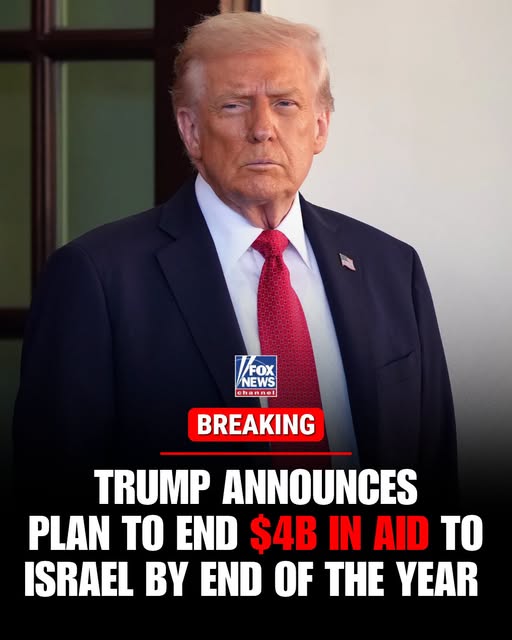
The image is designed to feel like a political earthquake: a Fox News chyron blaring a headline about a "BREAKING" plan to end $4 billion in aid to Israel by the end of the year, paired with a stern-faced Donald Trump.
On its face, the claim seems to upend decades of U.S. foreign policy and the bedrock of the U.S.-Israel alliance. And in a way, it does. But the full story is far more complex than a single headline. President Donald Trump did indeed make this announcement on Fox News on the morning of Election Day, November 3, 2026. However, the declaration was not a finalized policy but a political bombshell dropped just as voters headed to the polls—one that immediately created confusion, sparked a political firestorm in Jerusalem, and raised serious constitutional questions about whether he can actually follow through.
This is the story behind the announcement, the shockwaves it sent through the Middle East, and the legal reality that stands in its way.
The Verdict: A Real Announcement, But a Highly Contested Policy
Unlike many viral political headlines, this one is grounded in verifiable reporting. Trump did, in fact, announce his intention to end the annual military aid package to Israel. He did, in fact, claim it was a pre-arranged agreement with Israeli Prime Minister Benjamin Netanyahu. And he did, in fact, frame it as a political maneuver on the day Americans were voting.
But the story is not as simple as a done deal. The move puts Trump on a collision course with Congress, contradicts the terms of a binding 10-year agreement, and appears to have caught the Israeli government entirely off guard.
The Announcement: "We've Already Agreed"
In a wide-ranging telephone interview with Fox & Friends, Trump dropped the bombshell. For decades, the United States has provided Israel with roughly $3.8 billion to $4 billion in annual military aid under a Memorandum of Understanding (MOU) signed in 2016, which is set to expire in 2028.
Trump told Fox News that the United States would stop providing that aid by the end of the year. He framed the decision not as a rupture, but as a pre-arranged agreement with Netanyahu.
"Bibi Netanyahu and I have made a deal that we give Israel $4 billion a year, and we made a deal months ago that we're stopping," Trump said. "We've already agreed that by the end of this year we won't be paying Israel."
Trump offered two primary justifications for the move. First, he argued that Israel "doesn't need it" . He claimed that Israel is a successful country that can now afford to purchase its own weapons. Second, and perhaps more revealingly, he framed the decision as a political calculation, calling the aid a "bad talking point" for Democrats. He questioned why Republicans should "suffer the slings" from Democratic candidates who criticize the aid while the U.S. continues to write the checks.
The Fallout in Israel: "Surprise" and Anxiety
The announcement, made without prior notice to Congress or apparently to the Israeli government, triggered immediate and contrasting reactions in Israel.
Israeli officials were reportedly caught completely off guard. A security source told Israel's Channel 12, "We did not expect this announcement, and certainly not today." Another starkly warned of the practical consequences: "When the Air Force commander hears something like this, he might consider suicide... Where will the 15 billion shekels come from every year?"
The announcement immediately became a political cudgel in Israeli domestic politics. Former IDF Chief of Staff Gadi Eisenkot declared that the fact the defense establishment learned of this through the media showed Netanyahu "can no longer be trusted, and he must be replaced." Opposition leader Yair Golan called it "another massive failure" from the Prime Minister, accusing him of destroying the U.S.-Israel relationship for his own political survival.
The White House’s claim that this was a pre-agreed deal was met with deep skepticism in Jerusalem, where officials scrambled to clarify whether Trump was speaking literally or merely floating a trial balloon.
The Legal Reality: Can a President Do That?
The most significant obstacle to Trump's announcement is the U.S. Constitution. He may not have the legal authority to unilaterally cancel the aid.
The current aid is governed by a 10-year MOU signed in 2016, which was designed to provide stability and predictability to Israel's military planning. Under the U.S. Constitution, Congress controls federal spending. Lawmakers had already approved the funding, and the current agreement is legally binding until September 2028.
Trump's plan is a classic political "impoundment"—the president refusing to spend money that Congress has appropriated. While the administration has pushed the limits of executive authority on spending before, a move to unilaterally terminate a major security agreement without congressional approval would almost certainly face immediate legal challenges from lawmakers from both parties. As one analysis noted, Trump's plan is a "political play" that would face a legal wall, as he cannot simply refuse to spend money Congress has appropriated.
The Political Calculus: An Election-Day Gamble
The timing of the interview was not accidental. Trump was calling into Fox & Friends on the morning of the midterm elections to make a final pitch to voters. The elections would determine control of Congress, with Democrats needing to gain just a handful of seats to seize the House and Senate.
By announcing the end of aid to Israel, Trump was trying to do several things at once:
-
Neutralize a Democratic talking point: He explicitly admitted this was to stop Democrats from attacking Republicans over the issue.
Appeal to the "America First" base: A growing faction of the Republican base, particularly among younger voters and those influenced by figures like Tucker Carlson, is deeply skeptical of foreign aid. By announcing an end to the $4 billion package, Trump was throwing a bone to this isolationist wing of his party.
Project strength: He framed the cut as proof that he is a dealmaker who forces allies to pay their own way.
However, the move risks alienating pro-Israel donors and evangelical Christian voters, two crucial pillars of the Republican coalition, just as they were heading to the polls.
The Bottom Line
The viral graphic captures a real and seismic political moment, but it presents a simplified version of a much messier reality. President Trump did announce a plan to end $4 billion in aid to Israel by the end of the year, but it is far from a done deal.
The move was a calculated political gamble, dropped on Election Day to neutralize a Democratic talking point and fire up his base. It has created deep anxiety in Israel, fury among its supporters in Congress, and a significant constitutional question over whether a president can unilaterally undo a congressionally approved security commitment.
Whether the plan becomes a reality or collapses under legal and political pressure, the announcement itself has fundamentally shifted the debate over the U.S.-Israel relationship. For the first time in modern history, a U.S. president has publicly called for ending aid to Israel, acknowledging that support for the country has become a deeply polarizing political issue that is no longer a guaranteed bipartisan consensus.
📸 Suggested Images
-
The Interview: A photo of Trump speaking on the phone or at a desk, with a quote overlay of "We've already agreed that by the end of this year we won't be paying Israel."
The Ally: A photo of Israeli Prime Minister Benjamin Netanyahu, with a caption noting the Israeli government's surprise at the announcement.
The Funding: An infographic showing the $3.8 billion annual aid package and the 2016 MOU that runs through 2028, illustrating the legal stakes.
The Opposition: A photo of former IDF Chief of Staff Gadi Eisenkot or opposition leader Yair Golan, with a quote overlay of "Netanyahu can no longer be trusted."
The Capital: A photo of the U.S. Capitol, with a caption noting that Congress—not the President—holds the power of the purse.
Comments (0)
Loading comments...
May You Like

TOLEDO I-75 TRUCK CRASH — POTENTIAL BRIDGE COLLAPSE AND MILLIONS IN DAMAGE!

TRUMP CALLS GDP FIGURE “FAKE” AFTER GOVERNMENT’S SCHEDULED REVISION

I-75 THANKSGIVING NIGHTMARE — MAIL TRUCK CRASH RAISES OVERPASS COLLAPSE FEARS!

Latest Posts







Popular Posts




