
9/11 Changed America's Place in the World. What Did Russia and China Learn?
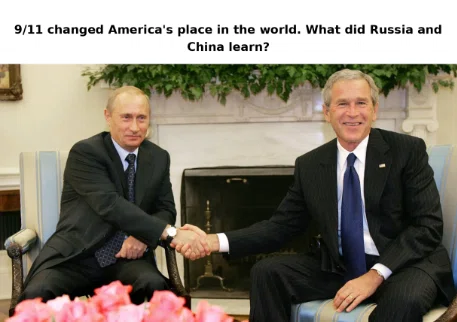
The 25th anniversary of 9/11 serves as a powerful historical milestone, prompting a re-evaluation of how the attacks reshaped not only the United States, but also the strategic calculations of its two chief rivals, Russia and China. For both Moscow and Beijing, the attacks and America's subsequent "War on Terror" provided a strategic "breathing space" and a clear lesson in great-power competition: never let a crisis go to waste.
The Immediate "Win-Win": A Strategic Pivot
Before September 11, 2001, the geopolitical landscape was fraught with tension. President George W. Bush had taken a hard line, viewing both Russia and China as strategic competitors and not partners . The U.S.-Russia relationship was strained, and the U.S.-China relationship was at a low point following the EP-3 spy plane collision just months earlier .
The 9/11 attacks changed everything overnight. In a remarkable turn, the U.S. suddenly needed the cooperation of Russia and China in its new "War on Terror" . This created a historic diplomatic opening.
Russia: A Tactical Realignment for Survival
For Russian President Vladimir Putin, the lesson was immediate and tactical: align with the West to stabilize a vulnerable position. Putin was the first foreign leader to call President Bush after the attacks . He offered crucial support, including:
-
Military Access: Acquiescing to a new U.S. military presence in the former Soviet republics of Central Asia and the Caucasus, a region Russia had long considered its traditional "sphere of influence" .
Strategic Alliance: Discarding the "China card" as a potential balance to U.S. power in Asia .
In return, Russia reaped significant benefits:
-
Reduced Pressure on NATO: The U.S. largely ceased its push to expand NATO into Ukraine and Georgia.
Legitimization of the Chechen War: Moscow’s brutal campaign in Chechnya was reframed as part of the global fight against terrorism, silencing Western criticism .
A Seat at the Table: Putin earned a higher profile in the G-8 group and established a cooperative, if temporary, "strategic framework" with Washington .
However, this honeymoon was short-lived. The 2003 U.S. invasion of Iraq, bypassing the UN, was a stark reminder for Russia of the dangers of U.S. unilateralism . Putin had learned that cooperation offered short-term tactical gains, but the U.S. remained a rival in the long run.
China: The "Decisive Decade" of Uninterrupted Rise
For China, the 9/11 attacks provided a much more profound lesson: the value of strategic patience. Beijing immediately understood that 9/11 had "removed a potential major headache" . The U.S. had been shifting its strategic focus to counter a rising China. The attacks, however, forced Washington to pivot its military resources to the Middle East and Central Asia .
China seized the moment, using the U.S. distraction to accelerate its development. The period following 9/11 is often cited as a "golden window" of opportunity that allowed China to grow largely unchallenged, becoming the world's second-largest economy and modernizing its military .
In many analyses, China is considered the single biggest beneficiary of the 9/11 attacks . It gained the U.S. as a tacit partner in the fight against Uyghur separatist groups (labeled as terrorists by the U.S. post-9/11) while quietly working to undermine U.S. strategic influence in its own backyards, particularly in Central Asia and the South China Sea .
Comments (0)
Loading comments...
May You Like

FIGHT OVER OBAMA’S IRAN POLICY

OBAMA STUNS ON INSTAGRAM: MESSAGE MARKING 34-YEAR MILESTONE SPARKS A BUZZ
Jack Smith Defends His Integrity as Trump Investigations Face Renewed Political Firestorm













