
What Exactly Is in Canada’s $20 Billion Retaliatory Tariff List — and Which U.S. Exports Are Affected?
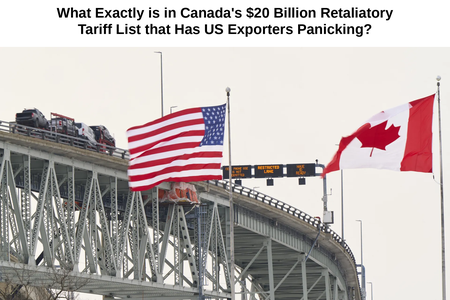
Canada has begun imposing a new round of retaliatory tariffs on U.S. goods worth about C$27.6 billion (roughly US$20 billion), escalating an already serious trade confrontation between Ottawa and Washington.
The measures took effect at 12:01 a.m. on September 8 and apply tariff rates of 15%, 25% or 50% to qualifying U.S.-origin products. Canada says the rates generally match the U.S. tariffs that triggered the response.
The list reaches far beyond steel and aluminum. It includes products ranging from dairy and appliances to agricultural equipment, pulp and paper, plastics and electronics.
The measures followed the collapse of U.S.-Canada trade negotiations and President Donald Trump's decision to impose new 50% tariffs on C$27.6 billion of Canadian goods beginning August 22.


Canada’s New Tariffs Are Now in Force
The latest Canadian measures were announced on August 25 after negotiations with the Trump administration failed to produce an agreement.
Canadian Finance Minister François-Philippe Champagne said the response would match the U.S. measures “dollar for dollar, rate for rate.” The government said the goal was to protect Canadian industries affected by U.S. tariffs while providing leverage in the trade dispute.
The Canadian government subsequently published the detailed tariff schedule.
The official list applies to U.S.-origin goods and distinguishes between products according to their tariff classification. Canada says the measures cover approximately C$27.6 billion in U.S. imports.
The Canada Border Services Agency is responsible for collecting the new surtaxes at the border.
What Products Are on the List?
The most important feature of Canada's retaliation is its breadth.
The federal government says the new measures concentrate on sectors most affected by the U.S. tariffs, including:
- Steel and aluminum
- Dairy products
- Appliances
- Agricultural equipment
- Pulp and paper
- Plastics
- Electronics
Other products on the detailed tariff schedule include food and consumer goods. Reporting by Reuters and the Associated Press identified items such as seafood, cheese, clothing, cosmetics and toilet paper among the products covered.
The official Canadian list contains individual tariff lines rather than simply naming broad industries, meaning the precise rate depends on the product's classification.


Steel and Aluminum Face Some of the Highest Rates
Steel and aluminum are among the most politically and economically significant categories.
Some affected products face tariffs of 50%, while other covered goods fall under the 25% or 15% rates depending on the tariff classification.
Canada's government said the new measures were designed to mirror the corresponding U.S. tariff rates rather than impose one uniform rate across all American exports.
The U.S. Department of Commerce's own summary of foreign retaliation says Canada's updated list contains 648 products, including 313 products that were already subject to earlier Canadian retaliatory tariffs.
That distinction matters because the headline figure of roughly $20 billion does not mean every product on the list suddenly receives a 50% tariff.
Instead, the Canadian response uses several tariff bands.
The three main rates
50%: Certain targeted products, including covered steel and aluminum items.
25%: A range of products including appliances, dairy and certain steel and aluminum derivatives.
15%: Other covered products receiving a lower matching tariff rate.
The exact rate depends on the specific tariff item.
Dairy and Cheese Are Among the Consumer Products Affected
Dairy is another significant part of Canada's response.
The official Canadian tariff schedule includes multiple categories of milk and cream products, with some receiving a 50% counter-tariff. Other dairy products, including certain cheeses, fall within the broader group facing additional tariffs.
That means the dispute is no longer confined to large industrial exporters.
American agricultural producers and food companies selling into Canada can also face additional costs when their products fall within the affected tariff classifications.
For consumers, the ultimate impact depends on whether importers absorb the additional expense, reduce orders, switch suppliers or pass some of the cost along through higher prices.
Appliances and Farm Equipment Are Also Targeted
Canada's list includes numerous manufactured goods.
The Canadian government specifically identifies appliances and agricultural equipment among the sectors covered by the new measures.
That creates potential exposure for U.S. manufacturers that rely on Canadian customers.
Agricultural machinery is particularly significant because the United States and Canada have highly integrated agricultural supply chains.
A tariff imposed at the border does not necessarily mean the American manufacturer pays the full amount directly. Typically, the Canadian importer is responsible for the tariff when the goods enter Canada, although the economic burden can be distributed among importers, exporters, retailers and consumers through pricing and purchasing decisions.
Pulp, Paper, Plastics and Electronics Expand the Reach
Canada's official announcement also identifies pulp and paper, plastics and electronics among the targeted sectors.
These categories illustrate why the retaliation could affect a wide range of American companies rather than a handful of large exporters.
Some products move through complicated North American supply chains several times before reaching their final customer.
For companies operating on both sides of the border, determining whether a particular shipment is subject to the Canadian counter-tariff therefore depends on the product's tariff classification and country-of-origin rules.
Canada explicitly states that the new measures apply to goods originating in the United States under its country-of-origin rules.
Not Every U.S. Product Entering Canada Is Suddenly Tariffed
One of the biggest potential misconceptions surrounding the $20 billion figure is that Canada has imposed a new tariff on everything Americans export north.
It has not.
The Canadian measures are targeted.
The government's official list specifies individual tariff items and rates, while goods outside those classifications are not automatically subject to this particular round of counter-tariffs.
The measures also do not replace every other Canadian trade measure already in place.
Canada says existing counter-tariffs on areas including automobiles remain in place, while separate remission mechanisms can provide relief in specific circumstances.
Why Canada Chose These Products
Ottawa says it focused on sectors that were directly affected by the latest U.S. tariffs.
The strategy is intended to mirror Washington's measures while limiting the retaliation to selected categories rather than imposing a blanket tariff on all American goods.
Reuters reported that Canadian officials also viewed some of the targeted industries as strategically important in politically significant U.S. states.
That has led some analysts to interpret the tariff list as having a political dimension as well as an economic one.
The Canadian government, however, describes the measures primarily as a response to U.S. tariffs and as protection for Canadian workers and businesses.
Canada Is Also Offering Billions in Support
Ottawa is not relying solely on tariffs.
The federal government announced a C$7.5 billion package of new and enhanced support measures for Canadian workers and businesses affected by the trade dispute. That comes on top of nearly C$25 billion in support measures introduced during the broader tariff conflict, according to the Canadian government.
The new package includes additional funding intended to help small and medium-sized businesses manage liquidity pressures and adjust to trade disruptions.
The government has also emphasized trade diversification as part of its longer-term response.
The strategy reflects Canada's concern that prolonged dependence on the U.S. market could leave Canadian businesses particularly vulnerable to sudden changes in American trade policy.
Washington Has Already Responded
The retaliation has triggered another response from the Trump administration.
On September 8, the White House announced additional actions against Canadian products, including import bans on certain Canadian goods and changes to the scope of existing tariffs.
The White House said the measures were intended to respond to Canada's latest retaliation and what it described as discriminatory treatment of American commerce.
That means the trade dispute has now moved through several rounds of tariffs and counter-tariffs.
Each government says its latest measures are a response to the other side's actions.


The Economic Relationship Is Too Large for the Dispute to Be Simple
The United States and Canada maintain one of the world's largest bilateral trading relationships.
That means even tariffs covering a relatively limited portion of total trade can have consequences for companies whose supply chains cross the border repeatedly.
The Associated Press reported that reciprocal tariffs worth about $20 billion per side are already creating difficulties for some small cross-border businesses, with companies dealing with higher costs, canceled orders and uncertainty.
At the same time, the overall effect on the two national economies is different from the impact on individual companies.
A manufacturer that depends heavily on Canadian customers can face a major disruption even if the affected trade represents only a small fraction of total U.S.-Canada commerce.
That is why the product-level list matters more to individual exporters than the headline $20 billion figure alone.
What U.S. Exporters Need to Know
For American companies selling into Canada, several questions are now particularly important:
Is the product on Canada's tariff schedule?
The official Canadian list identifies the affected tariff items.
What tariff rate applies?
Covered products can face 15%, 25% or 50%, depending on their classification.
Is the product actually U.S.-origin?
Canada says the counter-tariffs apply to goods originating in the United States under its country-of-origin rules.
When did the measure take effect?
The new counter-tariffs became effective at 12:01 a.m. on September 8, 2026. Goods already in transit to Canada on that date are treated separately under the Canadian rules.
The Canada Border Services Agency has published guidance for importers and travelers on how the new surtaxes are administered.
What the Viral Image Gets Right — and What It Leaves Out
The image asks:
“What Exactly Is in Canada's $20 Billion Retaliatory Tariff List That Has US Exporters Panicking?”
What is accurate:
✓ Canada imposed retaliatory tariffs on approximately US$20 billion worth of U.S. imports.
The Canadian government values the measures at about C$27.6 billion, roughly US$20 billion.
✓ The measures are now in force.
They took effect September 8, 2026.
✓ Tariff rates range from 15% to 50%.
The rate varies according to the affected product.
✓ The list includes far more than steel.
Dairy, appliances, agricultural equipment, pulp and paper, plastics and electronics are among the targeted sectors.
What requires context:
The phrase “US exporters panicking” is a characterization rather than a measurable description of every American exporter.
Some companies will face substantial exposure, while others will be unaffected because their products are outside the tariff schedule.
The headline also simplifies a complicated tariff system into a single $20 billion number. The actual impact depends on the specific product, tariff classification, country of origin and applicable rate.
The Bigger Question: How Long Can the Trade War Continue?
The latest Canadian measures represent another major escalation in the U.S.-Canada trade dispute.
For Ottawa, the objective is to match the economic pressure coming from Washington while protecting Canadian industries and giving affected businesses financial support.
For the Trump administration, the counter-tariffs are evidence that Canada has chosen confrontation rather than accepting U.S. trade demands.
Meanwhile, companies on both sides of the border are being forced to adjust to a rapidly changing tariff environment.
The immediate question is no longer whether Canada has retaliated.
It has.
The more important question now is whether the two governments can return to negotiations before repeated rounds of tariffs and counter-tariffs begin producing deeper disruptions across the highly integrated North American economy.
For American exporters, the first step is more concrete: identify exactly which tariff line applies to each product entering Canada.
The official Canadian list is the definitive reference, and it contains hundreds of individual tariff classifications rather than a simple list of industries.
Suggested SEO Setup
SEO Title:
Canada’s $20 Billion Tariff List: Which U.S. Products Face 15%, 25% or 50% Duties?
Alternative Headline:
Canada Hits $20 Billion of U.S. Goods With New Tariffs — Here’s What’s on the List
Meta Description:
Canada’s new retaliatory tariffs on roughly $20 billion of U.S. imports are now in force. Here are the major products and industries facing 15%, 25% and 50% duties.
Slug:canada-20-billion-retaliatory-tariffs-us-products-list
Category:
U.S. Politics / Canada / Trade & Economy
Tags:
Donald Trump, Canada, Mark Carney, Tariffs, Trade War, U.S. Exports, Canadian Tariffs, U.S.-Canada Relations, Steel, Dairy, Agriculture, Electronics
Comments (0)
Loading comments...
May You Like

Jack Smith Defends His Integrity as Trump Investigations Face Renewed Political Firestorm

TRUMP’S OHIO WARNING UNDER THE SPOTLIGHT

Barack Obama Draws Attention With New Literary Podcast













