Tariffs on Canada, China Trade and Russia Talks: What Is Really Driving Trump’s Shifting Foreign Policy?
President Donald Trump’s foreign policy toward Canada, China and Russia is increasingly being shaped by tariffs, trade negotiations and strategic bargaining — but the relationships are moving in very different directions.
The latest Canada-U.S. trade confrontation has pushed Ottawa to accelerate economic diversification, including deeper relationships with the European Union and China. At the same time, Washington is reopening channels with Moscow over the war in Ukraine while preparing for another high-level engagement with Beijing.
That combination can make the international picture look contradictory: tariffs against a traditional U.S. ally, negotiations with China, and renewed dialogue with Russia.
But the evidence points less toward a single, coherent “axis” and more toward a transactional foreign-policy approach in which trade, sanctions, security and diplomatic negotiations are being handled separately depending on the country involved.
Canada, meanwhile, is attempting to reduce its economic dependence on the United States without abandoning the U.S. relationship altogether.


Canada-U.S. Trade Relations Have Entered a New Phase
The immediate source of tension is tariffs.
On August 21, Prime Minister Mark Carney suspended Canada's trade negotiations with Washington after saying that last-minute U.S. demands had become unacceptable to Ottawa.
Canada said the United States planned a 50% tariff on roughly C$27.6 billion of Canadian goods, and Ottawa announced that it would match those tariffs on selected U.S. imports.
Those Canadian counter-tariffs took effect on September 8.
The Canadian government says the measures cover selected U.S.-origin products in sectors including:
- Steel and aluminum
- Dairy
- Appliances
- Agricultural equipment
- Pulp and paper
- Electronics
- Other manufactured goods
The tariff rates are generally 15%, 25% or 50%, depending on the corresponding U.S. tariff affecting the product.
Washington responded two days later with additional measures targeting certain Canadian imports, including dairy and other products, while also excluding Canadian-origin products from some U.S. government procurement programs. The White House said those actions were intended to counter what it described as discriminatory Canadian treatment of U.S. commerce.
The result is a trade relationship that remains highly integrated but is considerably more confrontational than it was before Trump's second term.
Carney Is Not Cutting Off the United States
The viral framing can make Canada's strategy look like a complete geopolitical break with Washington.
That is not what Ottawa is saying.
Carney has repeatedly argued that Canada should diversify its economy while maintaining the ability to negotiate with the United States.
On September 16, the Associated Press reported that Carney said Canada could wait for better conditions rather than rush into a new U.S. trade agreement.
More than 80% of U.S.-Canada trade remains tariff-free, according to the report, illustrating how extensive the two countries' economic integration remains.
Carney's broader argument is that Canada should have more alternatives.
Rather than relying overwhelmingly on one market, Ottawa wants to increase trade with Europe, Asia and other regions.
That distinction is important.
Diversification is not the same thing as abandoning the United States.
Europe Is Becoming a Bigger Part of Canada's Strategy
The most visible example is Canada's increasingly ambitious relationship with the European Union.
Carney is currently visiting Europe and is proposing what he calls a “unique alliance” between Canada and the EU.
On September 16, European Commission President Ursula von der Leyen went further, proposing that Canada become the EU's first “associate member.”
The concept would create a deeper framework for cooperation without making Canada a full EU member.
Potential areas include:
- Defense
- Artificial intelligence
- Critical minerals
- Energy
- Digital security
- Supply chains
- Trade
Reuters reported that the proposal would require approval from EU member states and that the precise legal meaning of “associate membership” remains unclear.
The next major test will be the Canada-EU summit scheduled for October in Montreal.


China Is Another Piece of the Puzzle
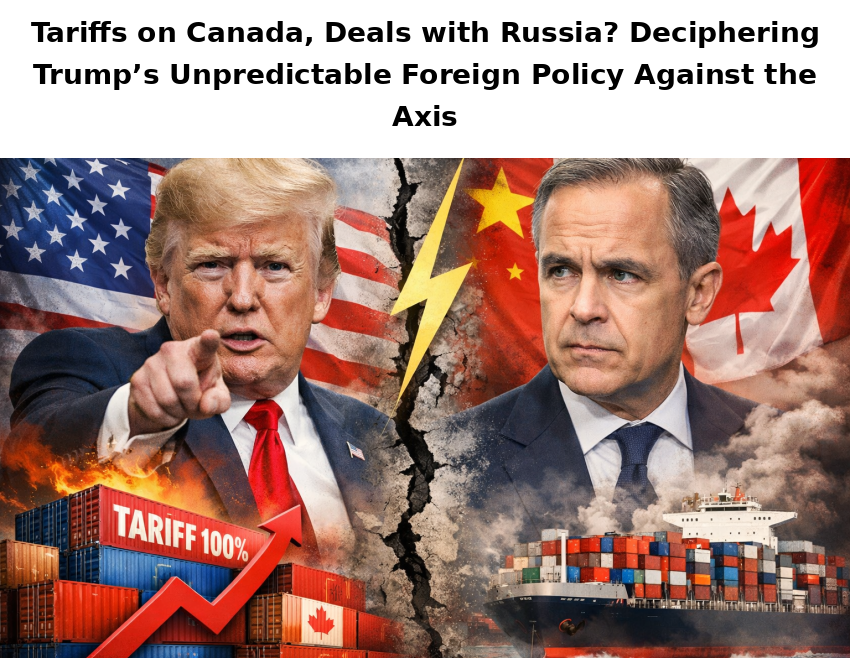
The image's reference to China's flag is also based on a real shift in Canadian policy — although the relationship is more complicated than a simple anti-American alignment.
In January, Carney traveled to Beijing for the first visit by a Canadian prime minister to China since 2017.
During the visit, Canada and China announced a new strategic partnership focused on trade, energy, agriculture, clean technology and investment.
Among the agreements announced were measures intended to reduce Chinese tariffs on Canadian canola and increase Canadian agricultural exports to China.
Canada also agreed to allow up to 49,000 Chinese electric vehicles into the Canadian market at a 6.1% most-favored-nation tariff rate.
The economic logic is straightforward: China is the world's second-largest economy and Canada's second-largest single-country trading partner.
But that does not mean Ottawa has discarded its security concerns about Beijing.
Canadian officials continue to face questions about Chinese foreign interference, technology security and strategic dependence.
A 2026 academic study on Canada-China relations similarly described Ottawa's challenge as a balancing act between economic engagement with China and security risks associated with Beijing.
So Canada's China strategy is better described as selective economic re-engagement rather than a geopolitical alliance.
What About Russia?
This is where the image's headline requires the most clarification.
There is no evidence that Canada is making a strategic deal with Russia comparable to its new economic relationship with China or its proposed partnership with Europe.
In fact, Canada's current policy toward Moscow remains strongly opposed to Russia's war in Ukraine.
During President Volodymyr Zelenskyy's September visit to Canada, Carney reaffirmed Ottawa's support for Ukraine.
The Canadian government says it has provided more than C$8.5 billion in military assistance to Ukraine and imposed more than 3,500 sanctions related to Russia's invasion. Canada has also extended its military training mission, Operation UNIFIER, through 2029.
Canada and Ukraine additionally signed a 100-Year Partnership Declaration on September 10, committing to deepen their strategic relationship.
Canada also recently announced a C$350 million air-defense package for Ukraine and plans to significantly expand drone production, with a portion intended for Ukrainian forces.
That is fundamentally different from pursuing a strategic rapprochement with Moscow.
Trump, However, Is Reopening Channels With Russia
The Russia part of the story applies much more directly to Washington.
Trump has been attempting to revive negotiations aimed at ending the war in Ukraine.
On September 8, Trump spoke by telephone with Russian President Vladimir Putin. According to the Kremlin, the two discussed the stalled peace process and the possibility of restoring U.S.-Russia relations after the war.
Trump subsequently said he believed Putin wanted to make a deal, according to CBS News.
The call followed meetings by Trump's envoys Steve Witkoff and Jared Kushner with Russian and Ukrainian officials.
At the same time, the United States has not abandoned economic pressure on Russia.
On September 16, the U.S. House moved toward a vote on legislation named for the late Senator Lindsey Graham that would impose additional sanctions on Russia and potentially authorize tariffs against countries that continue purchasing Russian energy.
That includes major economies such as China and India.
So Washington's current Russia policy contains two tracks:
Diplomatic engagement: attempt to negotiate an end to the Ukraine war.
Economic pressure: maintain or expand sanctions and potentially penalize countries helping Russia's energy economy.
Those approaches can coexist, even if they appear contradictory.
China and Russia Are Closer — But Canada Is Not Part of That Alignment
There is a real geopolitical development behind the image's “axis” language.
China and Russia have significantly deepened their strategic relationship.
The Council on Foreign Relations describes their relationship as one of the most consequential geopolitical developments of the past decade, while noting that the two countries still have competing interests and retain strategic autonomy.
At the 2026 BRICS summit in New Delhi, China and Russia joined other members in promoting expanded cooperation and criticizing protectionism and unilateral economic pressure.
But that does not mean Canada has joined a China-Russia bloc.
Canada is simultaneously:
- Supporting Ukraine against Russia
- Expanding defense cooperation with Europe
- Negotiating with China on trade and investment
- Maintaining deep economic ties with the United States
- Attempting to diversify into other markets
That is a very different strategy from joining a geopolitical bloc led by Beijing and Moscow.
Trump's China Policy Is Also More Complicated Than the Tariff Headlines Suggest
Washington's relationship with Beijing provides another example of the transactional nature of current diplomacy.
The Trump administration continues to impose restrictions and tariffs on Chinese products and is applying financial pressure to Chinese entities accused of supporting Iran.
At the same time, American and Chinese officials continue negotiating.
U.S. Treasury Secretary Scott Bessent is scheduled to meet Chinese Vice Premier He Lifeng this week, ahead of a possible Trump-Xi summit later in September.
Reuters reported that the two sides have continued discussions through an economic and trade consultation mechanism even while disputes remain over tariffs, technology and financial sanctions.
China has also recently purchased approximately 1 million metric tons of U.S. soybeans, according to traders cited by Reuters, illustrating how commercial trade continues despite strategic rivalry.
This is another reason the idea of a simple U.S.-China “cold war” does not fully explain the current situation.
The two governments can compete intensely in one area while negotiating in another.
Why Canada Is Becoming More Important to This Story
Canada's importance goes beyond tariffs.
The country has energy resources, critical minerals, agricultural production, Arctic territory, advanced industries and a long-standing military relationship with the United States and Europe.
That gives Ottawa multiple potential economic and strategic partners.
Carney's government has explicitly said it wants to double non-U.S. exports over the next decade. The January Canada-China initiative and September push toward a deeper EU relationship are two major components of that strategy.
But there are limits.
Europe cannot immediately replace the enormous U.S. market.
China brings its own geopolitical and security complications.
And Canada's economy remains deeply connected to American supply chains.
The Financial Times reported this week that some EU governments are also cautious about Carney's proposed “unique alliance,” citing concerns about trade concessions, Washington's reaction and unresolved issues surrounding the Canada-EU trade agreement.
The Trade War Is Changing Canada's Foreign-Policy Calculus
The clearest connection between Trump's policies and Canada's diplomatic diversification is economic.
Before the current dispute, Canada's dependence on the U.S. market was an established feature of its economy.
Now Ottawa is explicitly treating that dependence as a vulnerability.
Carney said in August that Canada had recognized that the United States had changed its approach to trade and that Ottawa could not simply expect the old relationship to return.
That has produced a new Canadian strategy:
Build at home.
Diversify abroad.
Keep negotiating with Washington.
Deepen relationships with Europe and Asia.
That is a much more accurate description of Canada's current direction than saying Ottawa has simply “joined an axis.”
What the Viral Image Gets Right — and What It Leaves Out
What is accurate:
✓ Trump has imposed major tariffs on Canadian goods.
Canada responded with matching tariffs on selected U.S. imports after negotiations broke down.
✓ Canada is actively diversifying its international partnerships.
Ottawa is pursuing deeper relationships with the EU and China while seeking broader export markets.
✓ Canada and China established a new strategic partnership in 2026.
It includes trade, energy, agriculture and clean technology.
✓ Trump is simultaneously pursuing renewed dialogue with Russia.
His administration is trying to revive Ukraine peace negotiations while Congress considers additional Russia sanctions.
What is misleading or unsupported:
⚠ There is no evidence that Canada is forming an alliance with Russia.
⚠ Canada's China strategy is not the same thing as joining a China-Russia geopolitical bloc.
⚠ Canada's push toward Europe did not begin solely because of Trump's latest tariff measures.
⚠ The word “axis” implies a coordinated political or military bloc that the available evidence does not establish.
⚠ Canada has not abandoned the United States. More than 80% of bilateral trade remains tariff-free, according to the AP's September 16 report, and Ottawa continues to leave room for future negotiations.
The Bigger Picture: A More Transactional World
The emerging pattern is less about countries choosing permanent sides and more about governments trying to maximize room for maneuver.
Trump is simultaneously:
- Pressuring Canada with tariffs
- Negotiating with China
- Talking directly with Putin
- Supporting pressure on Russia
- Using tariffs and sanctions as negotiating instruments
Canada is simultaneously:
- Fighting U.S. tariffs
- Keeping the door open to Washington
- Deepening trade with China
- Seeking a new strategic relationship with Europe
- Supporting Ukraine against Russia
China is simultaneously:
- Competing with Washington
- Negotiating with Trump
- Maintaining its partnership with Russia
- Expanding BRICS cooperation
- Continuing substantial trade with the United States
That complexity is what makes the current international system difficult to interpret through a simple “friend versus enemy” framework.
For Canada, the immediate question is whether diversification can give Ottawa enough economic leverage to reduce its vulnerability to future U.S. trade pressure.
For Trump, the challenge is whether tariffs, sanctions and direct negotiations can produce the economic and geopolitical concessions his administration is seeking.
And for the broader international system, the bigger story may be the growing willingness of middle powers to build multiple relationships rather than depend overwhelmingly on one major power.
The result is not necessarily a new “axis.” It is a more fragmented and transactional global order in which countries increasingly try to keep several doors open at the same time.


Suggested SEO Setup
SEO Title:
Trump’s Canada Tariffs, China Trade and Russia Talks: What Is Really Changing?
Alternative Headline:
Canada, China, Russia and Trump: The Foreign-Policy Moves Reshaping North America
Meta Description:
Trump is pressuring Canada with tariffs while reopening talks with Russia and negotiating with China. Here’s what the latest moves reveal about a changing global order.
Slug:trump-canada-tariffs-china-russia-foreign-policy
Category:
World News / U.S. Politics / Canada / International Affairs
Tags:
Donald Trump, Mark Carney, Canada, China, Russia, Vladimir Putin, Xi Jinping, Tariffs, Trade War, Canada-U.S. Relations, Canada-China Relations, Ukraine, European Union, Foreign Policy
Comments (0)
Loading comments...
May You Like
gfnhgmnghnmfgnbvvvvvvvvv
South Korea–Ukraine Rift Deepens Over North Korean POW Transfer as PURL Draws New Scrutiny