
“Code Red” at the White House? What the Viral Trump–Vance Graphic Actually Shows
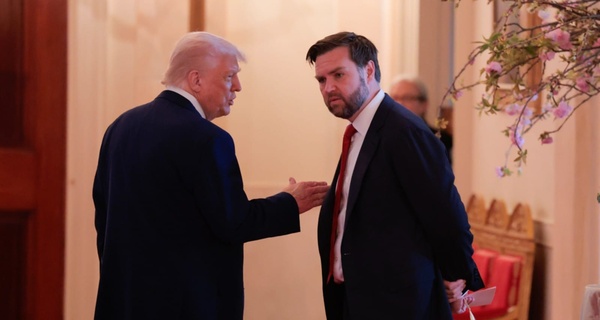
A dramatic graphic circulating online declares “BREAKING: ‘Code Red’ at White House” and shows President Donald Trump appearing to confront or privately warn Vice President JD Vance.
The implication is obvious: something serious has happened inside the Trump administration, perhaps a major rupture between the president and his vice president.
But there is no credible evidence of a White House “Code Red” or an emergency confrontation between Trump and Vance.
What is real is that Trump and Vance have faced increasing political tension over the Iran conflict and that Vance's emergence as a potential 2028 Republican presidential candidate has created a delicate succession dynamic.
Verdict: MISLEADING — real Trump–Vance tensions exist, but the “Code Red” framing is unsupported. The image also appears to be recycled rather than evidence of a new breaking event.
There is no official “Code Red” announcement
A search of recent White House releases, presidential schedules and major news coverage turns up no White House announcement declaring a “Code Red” involving Trump and Vance.
The White House's official gallery and presidential schedule show Trump and Vance continuing to appear as part of the administration's normal activities. Vance held a White House press briefing on September 3, while Trump continued holding policy meetings and signing events in the Oval Office.
That matters because the graphic gives the impression of a sudden emergency.
There is no evidence of one.
But there really are differences between Trump and Vance
The viral claim appears to be exploiting something real: Trump and Vance have not always been on exactly the same page over Iran.
In August, The Washington Post documented differences in how the two men described the administration's priorities in the Iran conflict.
Vance said the administration's first priority was keeping gasoline and oil prices low, followed by preventing Iran from obtaining a nuclear weapon.
Trump subsequently emphasized that preventing Iran from obtaining a nuclear weapon was the administration's overriding objective.
The White House, however, rejected the idea that this represented a serious rupture.
Vance himself also said that Trump makes the decisions and that the administration ultimately acts together once the president decides on a course.
So there is evidence of policy debate, but not evidence of an administration-threatening breakdown.
The Iran disagreement became more visible in September
The issue resurfaced dramatically on September 3.
During a White House briefing, Vance said:
“I wouldn’t call it a war.”
He argued that major U.S. combat operations had ended months earlier and characterized the current fighting as intermittent.
The next day, Trump was asked about Vance's characterization.
Rather than rebuking his vice president, Trump said there was “a lot of truth” to what Vance had said and described the conflict as a “military conflict” and “small potatoes” for the United States.
Whatever one thinks of that description, it does not support the graphic's suggestion that Trump and Vance were experiencing a secret emergency confrontation.
In fact, Trump publicly defended Vance.
The bigger issue may be 2028
There is, however, another reason the relationship is attracting increasing scrutiny.
Trump cannot constitutionally seek a third consecutive presidential term, meaning the Republican Party is already beginning to think about the post-Trump era.
Vance has increasingly emerged as one of the leading potential Republican candidates for 2028.
The Washington Post reported in August that Trump privately told donors:
“We need to elect JD.”
The comment suggested Trump is open to Vance succeeding him, although advisers cautioned that Trump had not necessarily made a final decision between Vance and other potential contenders such as Secretary of State Marco Rubio.
That dynamic has become even more visible this month.
At the Republican midterm convention in Dallas on September 10, Vance received chants of “28” and “48” from supporters, while delivering a major prime-time speech that positioned him as one of the central figures of the post-Trump Republican Party.
Reuters similarly described Vance as an emerging likely successor while noting that Republicans are already debating what Trumpism should look like after Trump.
That is a genuine political development.
It is not the same thing as a “Code Red.”
Trump still publicly backs Vance
The recent evidence actually points toward continued cooperation.
At the Republican convention, Trump and Vance appeared together and made a coordinated appeal for Republicans to retain control of Congress.
Vance continued to praise Trump's leadership, while Trump highlighted Vance's role in the administration. The two men were campaigning for the same midterm objective even as Vance's independent political profile continues to grow.
The picture of the two men together therefore shouldn't automatically be interpreted as evidence of a confrontation.
What about the photograph?
The photograph used by the graphic should also be treated cautiously.
The image shows Trump and Vance in a White House corridor, with Trump appearing to put a hand on Vance's chest or upper arm. But a still photograph cannot establish what was being said or whether the interaction was hostile.
More importantly, searches of documented Trump–Vance appearances show that similar White House photographs have been reused in political posts.
For example, official and wire-service photographs document numerous occasions during which Trump and Vance appeared together at White House events, including the March 16 signing of Trump's executive order establishing an anti-fraud task force led by Vance.
Other widely circulated Trump–Vance photographs come from earlier events and have subsequently been reused to illustrate new political narratives.
So the image itself is not proof of a September 2026 emergency.
There is a real political balancing act
The most interesting part of this story is actually more subtle.
Vance has two jobs at once.
First, he is Trump's vice president, meaning he is expected to defend and implement the president's policies.
Second, he is increasingly viewed as a potential 2028 presidential candidate, meaning he has a political future of his own to protect.
That creates an inherent tension.
The Iran war is particularly complicated because Vance had a longstanding reputation as a skeptic of foreign military intervention. Yet once Trump launched the conflict, Vance became one of its principal defenders and negotiators.
The Washington Post previously described Vance as the public face of Trump's Iran diplomacy and noted Trump's joking warning that if the effort succeeded, Trump would take the credit — and if it failed, he would blame Vance.
Now, with the conflict continuing into the fall and Republicans preparing for the midterms, Vance must defend the administration while simultaneously building his own political identity.
That is a genuine story.
So what does “Code Red” actually mean here?
If the graphic uses “Code Red” as a metaphor for political pressure inside the Trump administration, there is a kernel of truth.
There are:
- disagreements over the Iran war;
- questions about how long the conflict will continue;
- growing scrutiny of Trump's approval ratings;
- increasing attention to Vance's 2028 ambitions;
- competition between Vance and other potential Republican successors;
- and a Republican Party beginning to contemplate a future without Trump on the ballot.
But none of those facts establishes an emergency at the White House.
The latest reporting instead shows Trump and Vance continuing to work together publicly while navigating increasingly complicated political incentives.
Bottom Line
The viral graphic takes a real political undercurrent and turns it into a fake breaking-news emergency.
There is no verified “Code Red” at the White House involving Trump and Vance.
There are genuine differences between the two men, particularly over the Iran conflict. And Vance's increasingly obvious positioning as a possible 2028 Republican nominee adds another layer to their relationship.
But Trump has continued to publicly defend Vance, Vance continues to publicly support Trump, and both men appeared together at the Republican midterm convention only days ago.
VERDICT: MISLEADING.
The Trump–Vance relationship deserves scrutiny, but the graphic provides no evidence of the dramatic White House emergency it claims.
Comments (0)
Loading comments...
May You Like

Shocking news from Ohio: an unexpected development ahead of Trump's rally

Barack Obama Draws Attention With New Literary Podcast

South Korea–Ukraine Rift Deepens Over North Korean POW Transfer as PURL Draws New Scrutiny












