
“Whenever I Want It to End”: Inside Trump’s Defiant Iran War Ultimatum—and the $47 Billion Price Tag He Can’t Escape
“Whenever I Want It to End”: Inside Trump’s Defiant Iran War Ultimatum—and the $47 Billion Price Tag He Can’t Escape
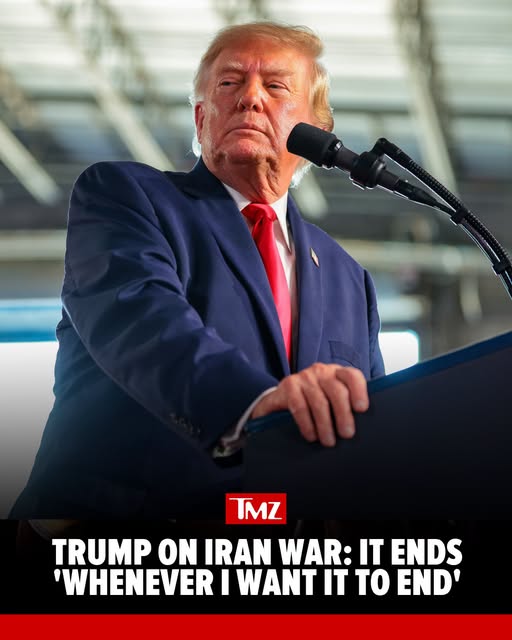
The image captures the essence of the moment: Donald Trump, standing before a microphone, his expression a mixture of defiance and fatigue. The TMZ headline is blunt and unmistakable: “TRUMP ON IRAN WAR: IT ENDS 'WHENEVER I WANT IT TO END'.”
The post, which has circulated widely across social media in the final days of the 2026 midterms, points to a very real and deeply consequential political moment. It is not a policy white paper or a diplomatic communiqué. It is a campaign rally declaration—a raw assertion of personal control over a war that has cost billions, reshaped the global economy, and become a political anchor around the neck of the Republican Party.
At the center of the storm is a single sentence, delivered to a crowd in Lubbock, Texas, that has crystallized the stakes of the 2026 election and the future of American foreign policy.
The Verdict: A Real Quote, A Real War, A Real Crisis
Unlike many viral political headlines, this one is grounded in verifiable reporting and direct quotes. On Tuesday, October 27, 2026, at a rally in Lubbock, Texas, Trump was asked about the timeline for ending the conflict with Iran. His response was characteristically blunt.
“Somebody asked me before, ‘When will the war in Iran end?’ and I said ‘Whenever I want it to end,’” Trump told the crowd . He then added a caveat: “It’d be very quick, but we have to have it end properly,” with a “total statement” that Iran would never have a nuclear weapon .
He also blamed past presidents for not taking military action sooner. “They didn’t have the courage to do so,” he said, referring to launching attacks on Iran eight months ago. “This should have been settled long before I came in” .
The Cost: $47 Billion and Counting
The quote landed with particular force because it came just as the financial toll of the conflict was becoming impossible to ignore. According to a U.S. Central Command estimate, the cost of the Iran war has climbed to at least **$47.1 billion** as of mid-October . The majority of that expense—roughly $29 billion—has gone toward replenishing used munitions .
But the cost is not just measured in federal dollars. Mark Zandi, chief economist at Moody’s Analytics, estimated that the war is costing American families an average of **$2,000** since it started, with $1,100 coming from higher energy costs, $540 from higher interest rates, and $360 from increased military spending . Diesel prices continue to hover near all-time peaks across the U.S., creating acute political difficulties for Republicans in historically red states like Iowa, Kansas, Ohio, and Texas .
The Political Context: A War That Was Supposed to Be Over
Trump had originally predicted the conflict would wrap up within weeks . Instead, it has dragged on for nearly eight months, becoming what the Mirror describes as an “unwelcome complication” for a president who had previously vowed to keep the U.S. out of foreign entanglements .
Republican strategists acknowledge that the conflict is severely damaging the party’s attempts to retain Congressional power, as rising fuel costs drive up prices across virtually every sector . An AP-NORC poll released last week revealed that voters across both major parties are calling on the incoming Congress to prioritize reducing the cost of living and bringing an end to the Iran war .
The president’s approval ratings have fallen to 32%, according to a Reuters/Ipsos poll—near a record low—as rising energy costs and affordability issues dominate the electorate’s concerns ahead of the November 3 elections .
The Broader Conflict: A Widening War
The hostilities have not remained confined to Iran. Iran-backed Houthi rebels have executed numerous attacks on Saudi Arabia’s petroleum infrastructure and aviation hubs, prompting a Saudi-led military alliance to carry out deadly airstrikes on Houthi-held territories in Yemen .
The State Department has reduced staff numbers at four U.S. embassies throughout the Middle East after receiving intelligence indicating Iran has ramped up attempts to target American personnel in the region and elsewhere . And earlier in the month, the U.S. had evacuated diplomats from Saudi Arabia, as The New York Times reported that U.S. and Israeli militaries have drawn up specific plans for a “short but intensive” operation of strikes on Iran after the midterm elections .
The “Proper End”: A Nuclear Demand and a Negotiating Tactic
Trump’s insistence that the war must end “properly” is a reference to his baseline demand: ironclad guarantees dismantling Tehran’s nuclear ambitions. “With total and complete, a total statement: they will never have a nuclear weapon, number one state sponsor of terror,” he said .
He has also said he will soon decide whether to “make a deal” with Iran or “finish it off” . And he has hinted that a new, intense bombing offensive could readily begin following the midterms—often within the same campaign rally or single media encounter .
The Bottom Line
The viral graphic is right about one thing: Donald Trump did say the Iran war will end “whenever I want it to end.” But the story is not just about a single boastful quote. It is a story about a president who is trapped between his desire to project strength and the reality of a costly, unpopular war that has become a drag on his party’s political fortunes.
His comments reflect a worldview in which American military power is a personal instrument, to be wielded or withdrawn at the president’s discretion. But the war has its own momentum, its own costs, and its own consequences—ones that no single rally speech can erase.
As voters head to the polls on November 3, the question is not whether Trump can end the war “whenever he wants.” It is whether the American people will accept his terms—or whether they will use their own power to demand a different path.
📸 Suggested Images
-
The Rally: A photo of Trump at the Lubbock, Texas rally, with a quote overlay of “Whenever I want it to end.”
The Cost: An infographic showing the $47.1 billion price tag of the Iran war and the $2,000 average cost per American family.
The Polling: A graphic showing Trump’s 32% approval rating and the AP-NORC poll on voters’ priorities.
The Diplomacy: A photo of U.S. diplomats or embassy personnel, illustrating the evacuations and the deteriorating security situation in the Middle East.
The Contrast: A split image of Trump at the rally and a map of the Middle East highlighting the widening conflict, from Iran to Yemen to Saudi Arabia.
Comments (0)
Loading comments...
May You Like

BANGCHAK REFINERY DISASTER IN THAILAND—120,000 BARRELS A DAY SHUT DOWN, U.S. OIL PRICES SURGE 10%!

CAIRO INFERNO — CAR CARRYING SENIOR U.S. OFFICIAL SLAMS INTO FUEL TANKER, 31 DEAD, 21 INJURED!

FCC CLEARS SPACEX FOR ONE MILLION AI SATELLITES AS ASTRONOMERS SOUND ALARM

Latest Posts







Popular Posts




