
WHO REALLY FAILED FIONA? $100M LAWSUIT BACKFIRES AS VISITOR DEMANDS $200M!
WHO REALLY FAILED FIONA? $100M LAWSUIT BACKFIRES AS VISITOR DEMANDS $200M!
CINCINNATI, Ohio — November 21, 2026 — The death of Fiona, the Cincinnati Zoo's celebrated hippopotamus, has intensified scrutiny of the enclosure where a child's knit hat struck a ceiling fan and entered the animal's habitat. As public anger grows, questions about potential legal responsibility have become intertwined with claims of multimillion-dollar lawsuits and newly surfaced security footage.
Fiona died November 19 after swallowing the hat during a November 8 incident. The zoo said the object entered the enclosure accidentally, and a subsequent examination established that it had lodged deep inside her digestive tract.
The chain of events began November 8, when a young visitor tossed a knit hat into the air near Fiona's enclosure.
According to the zoo, the hat struck a ceiling fan.
The fan propelled it through a narrow opening above the viewing windows.
The object then landed inside the habitat.
Fiona swallowed it.
What began as an unusual accident developed into a medical emergency over the following days.
Zoo staff attempted to help Fiona pass the material, but the obstruction became fatal.
The sequence has prompted questions about visitor behavior and the enclosure's design.
It has also generated demands for accountability, although public demands do not themselves establish a legal case.
The Cincinnati Zoo said the person who tossed the hat was a child.
The child's identity has not been publicly disclosed.
The zoo characterized the incident as accidental.
There is no verified evidence that the child intended to feed Fiona, place an object in her habitat or cause her harm.
That distinction matters when evaluating potential responsibility.
An ordinary action can produce an unexpected consequence, especially when surrounding equipment changes the movement of an object.
The fan's involvement is therefore central to the incident.
It explains why the hat traveled into the enclosure rather than simply falling back into the visitor area.
It struck a ceiling fan and was redirected.
The fan sent the lightweight material through an opening above the viewing windows.
The gap was approximately 1 foot high.
The windows beneath it were about 12 feet tall.
Those dimensions help explain how a tall viewing barrier could still permit an object to enter.
The incident involved a combination of visitor behavior, equipment and the enclosure's physical layout.
Each element is relevant to understanding the accident.
None of those facts, considered alone, establishes legal negligence.
A determination of responsibility would require a broader examination of the circumstances.
Security footage can provide important evidence in an investigation involving an accident.
A recording might show where a visitor stood, how an object moved and whether equipment redirected it.
It could also help establish the timing of events.
But the existence of a recording does not automatically establish legal responsibility.
The specific footage described in claims about a $200 million counterattack has not been authenticated in the reviewed sources.
No verified report establishes that newly released security video caused a court case to change direction.
The zoo's account already identifies the fan and the opening as parts of the hat's path.
That information is significant without assuming the existence of a new legal proceeding.
A video can show physical events.
A legal finding requires additional evidence and application of the relevant law.
For example, footage might show the hat striking a fan.
It would not necessarily establish whether the zoo knew the arrangement posed a risk.
It might not show warning signs or earlier incidents.
It also would not determine whether a visitor acted negligently under Ohio law.
Those questions depend on context.
A court would need to consider the evidence presented by the parties.
In the Fiona case, no verified $100 million lawsuit or $200 million counterclaim has been identified.
The available footage-related claims therefore cannot be treated as a court ruling or an established reversal of responsibility.
The viewing area separated visitors from Fiona with tall glass panels.
However, an opening remained above the glass.
That opening allowed the hat to enter after the fan propelled it.
The physical arrangement raises a question about whether foreign objects could reach the animal despite the barrier.
A safety assessment could examine the opening's dimensions, the fan's position and the likelihood of lightweight objects entering the habitat.
It could also evaluate whether protective screening would have been appropriate.
But the existence of an opening does not automatically establish a violation of a safety standard.
Fiona initially appeared to tolerate the swallowed object.
Over time, however, her appetite declined.
Zoo veterinarians monitored her condition and attempted to help the material move through her digestive system.
The zoo publicly announced her medical difficulties on November 16.
Staff administered supportive treatments and conducted examinations.
They used ultrasound imaging and attempted a colonoscopy.
The medical team also sought advice and assistance from specialists.
Despite those efforts, the hat did not pass.
Fiona's condition worsened.
She died November 19, 11 days after the object entered her habitat.
The zoo described the loss as unexpected and devastating.
A postmortem examination provided the clearest explanation of Fiona's death.
The hat was lodged deep in her small intestine.
According to the zoo, it was approximately 25 feet beyond her final stomach compartment and roughly 50 feet from the end of the intestinal tract.
That location made it inaccessible through the available endoscopic procedures.
Veterinarians had considered surgery, but a major operation was judged too dangerous.
The medical findings explained why attempts to move the material through Fiona's digestive system were unsuccessful.
They also established that the swallowed hat caused a fatal obstruction.
The necropsy did not determine legal responsibility for the incident.
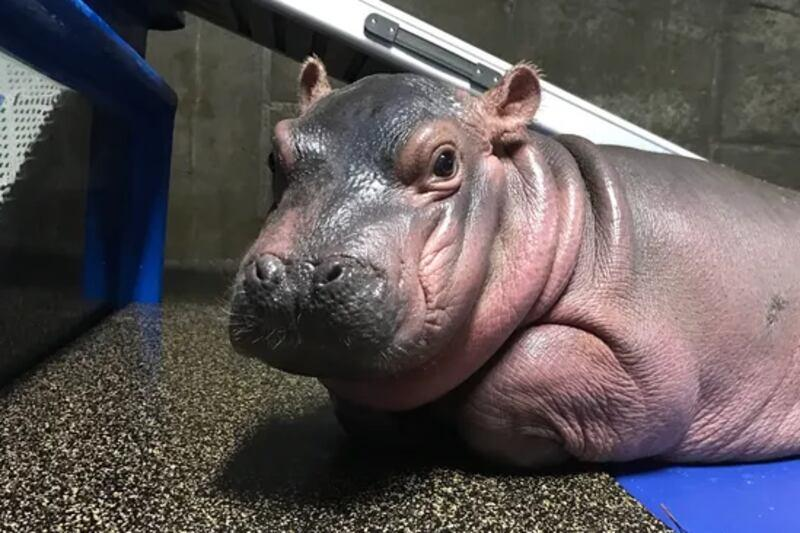
The veterinary team used multiple methods to support Fiona.
Staff monitored her hydration, appetite and behavior.
They attempted procedures intended to locate or move the obstruction.
One unusual effort involved a vibration platform borrowed from a horse farm.
The team encouraged Fiona to stand on it in the hope that movement would help stimulate her digestive tract.
The zoo also reported using medication and supportive care.
These measures were attempts to manage a difficult medical emergency.
They were not guarantees of recovery.
After Fiona died, the zoo explained that the obstruction's location had made safe removal impossible.
The findings provided medical context for the treatment decisions made during her final days.
A claim that the Cincinnati Zoo filed a $100 million lawsuit would represent a major legal development.
Such a filing would ordinarily identify the plaintiff, defendant, court and allegations.
It would also explain the legal basis for the requested damages.
The reporting reviewed does not identify those details.
The zoo's official announcement focused on Fiona's death and the efforts made to save her.
The Associated Press reported on the accident, public reaction and the zoo's earlier history involving Harambe.
Neither source established a $100 million claim against the visitor or the child's family.
The confirmed public controversy concerns whether someone should be held responsible.
That controversy is distinct from a filed civil lawsuit.
The second monetary figure raises an even more specific legal question.
A counterclaim is not simply a public statement disputing an accusation.
It is a legal claim brought by a party in an existing proceeding, subject to applicable procedural rules.
For a $200 million counterclaim to exist, there would need to be an identifiable legal action and a corresponding filing.
There is also no verified statement from an attorney representing the visitor announcing that amount.
Without those records, the reported escalation from $100 million to $200 million cannot be presented as a documented legal development.
Whether a visitor could successfully bring a claim against a zoo depends on the circumstances and the applicable law.
A claimant would generally need to establish a recognized legal basis for the action.
That could involve questions about the condition of the premises, an alleged injury or another legally protected interest.
The claimant would also need evidence supporting the allegations.
The Fiona incident has generated questions about the enclosure's design.
However, the reporting does not establish that the child or accompanying adults suffered a compensable injury.
Public criticism or emotional distress surrounding an animal's death does not automatically create a successful claim for damages.
Any legal assessment would require specific facts and legal analysis.
A zoo could potentially evaluate civil remedies after an incident involving damage or injury to an animal in its care.
But whether such a claim would succeed depends on the law and the facts.
A central issue would be the nature of the visitor's conduct.
The zoo has described the hat's entry into Fiona's enclosure as accidental.
The reported sequence also involved a ceiling fan redirecting the object.
Those facts would be relevant to any legal assessment.
The public record does not establish that the zoo has decided to pursue a civil claim.
Nor does it identify an attorney, court or requested damages.
The possibility of legal action should therefore not be confused with an actual lawsuit.
The reported involvement of a child creates additional legal and factual considerations.
Children may not understand the consequences of their actions in the same way adults do.
The exact age of the child has not been publicly established.
That limits any attempt to assess the child's conduct under a specific legal standard.
The zoo has said the hat entered accidentally.
There is no verified evidence that the child deliberately tried to harm Fiona.
The fan's role further complicates any simple account of responsibility.
The object followed an unusual path after being tossed into the air.
The publicly established facts do not support treating the child as someone who intentionally attacked an animal.
Public anger has also produced calls for criminal charges.
WCPO, reporting through Scripps News, examined Ohio's animal-cruelty laws and the circumstances of the incident.
The outlet concluded that criminal charges appeared unlikely because the reported conduct was accidental and there was no obvious evidence of malicious or willful harm.
That assessment is not a decision by prosecutors.
It is a legal analysis based on the facts available at the time.
The report also noted that some commenters wanted the child's parents held responsible.
However, public demands for punishment do not establish that a crime occurred.
Fiona's death generated widespread grief.
Many followers had watched her grow since her premature birth in 2017.
Her survival story created an unusually strong public connection.
When she died after swallowing an ordinary hat, the circumstances prompted questions about how the accident could have been prevented.
Some social media users focused on the child and accompanying adults.
Others questioned the zoo's barriers and the position of the ceiling fan.
These reactions reflect different interpretations of responsibility.
They do not establish that either party has been found negligent.
The zoo's official explanation remains that the hat entered the habitat accidentally.
That is an important distinction in a case where no deliberate wrongdoing has been established.
Online discussions can spread names, images or accusations before their accuracy has been determined.
Such claims may expose a child and family to harassment.
They can also complicate public understanding of the incident.
The relevant questions concern the documented action, the object's path and the surrounding safety conditions.
Those issues can be examined without identifying a minor.
Fiona's death has renewed discussion of another incident at the Cincinnati Zoo.
In May 2016, a 3-year-old boy entered the enclosure of Harambe, a western lowland gorilla.
Zoo personnel fatally shot Harambe because they believed the child was in danger.
The incident generated international criticism.
Some members of the public demanded punishment for the child's mother.
The Hamilton County prosecutor at the time determined there was no basis for criminal charges against her.
The Associated Press noted that Fiona's death has revived comparisons with Harambe.
Both incidents involved children, animal habitats and questions about responsibility.
However, the circumstances were different.
Harambe was shot during an emergency involving a child inside an enclosure.
Fiona died after swallowing an object that entered her habitat.
Fiona was not the first captive animal to die after ingesting an object that entered an enclosure.
The Associated Press reported that a rare antelope died at a Tennessee zoo after swallowing a plastic lid from a fruit pouch.
A polar bear at a German zoo also died after ingesting a jacket dropped into its enclosure.
These cases illustrate a broader animal-care risk.
Objects that appear harmless to visitors can become dangerous when swallowed by animals.
The circumstances vary by species, habitat and object.
The examples do not establish that Cincinnati Zoo violated a safety rule.
They do show why facilities seek to keep foreign materials out of animal habitats.
Preventing accidental entry is part of the wider challenge of zoo safety.
A review of Fiona's habitat could consider several physical features.
The opening above the viewing windows is an obvious area for examination.
The position of the ceiling fan is another.
A protective screen might reduce the chance of lightweight objects entering through the gap.
Moving equipment could also change how objects travel near the barrier.
However, modifications would need to account for ventilation, maintenance and animal welfare.
The public record does not establish which solution would be appropriate.
It also does not confirm that the zoo has approved a redesign.
The documented accident provides a reason to examine those options, but not proof that any specific design violated an existing standard.
A thorough assessment would seek to reconstruct the object's path.
It could establish where the child stood and how the hat contacted the fan.
It could measure the fan's distance from the opening.
Investigators might also review whether similar objects had previously entered the habitat.
Warning signs and staff procedures could be examined.
The goal would be to understand whether the accident revealed a recurring hazard.
Such an assessment would differ from a lawsuit.
A safety review focuses on identifying risks and possible preventive measures.
A civil case focuses on legal claims, duties and remedies.
The available reporting establishes neither a completed engineering review nor the multimillion-dollar legal proceedings described in the headline.
Fiona was born at the Cincinnati Zoo on January 24, 2017, approximately six weeks premature.
She weighed just 29 pounds.
Her survival was uncertain.
Veterinarians and keepers provided intensive care as she struggled to feed and gain strength.
The zoo shared updates documenting her recovery.
Those videos attracted attention far beyond Cincinnati.
Over time, Fiona became a symbol of survival and an ambassador for her species.
Visitors followed her development into adulthood.
Her popularity helped create an emotional connection between the zoo and audiences who had never visited Ohio.
That history explains why the circumstances of her death have attracted such intense attention.
On November 20, visitors gathered to remember Fiona.
The Associated Press reported that flowers, notes and children's drawings appeared near a hippopotamus statue.
One visitor brought a watermelon, a food associated with Fiona.
The memorial reflected her significance to the community.
Her story had become part of Cincinnati's identity.
The grief also extended beyond Ohio.
People who had followed her progress online shared memories and messages of sympathy.
The public response centered on the loss of an animal whose early survival had inspired millions.
That mourning occurred alongside questions about how the hat entered the habitat and whether future accidents could be prevented.
The Cincinnati Zoo confirmed Fiona's death in a statement dated November 19.
Director Dave Jenike said staff had not expected the outcome.
He praised the veterinary and animal-care teams for their efforts.
The statement explained that the hat had entered Fiona's habitat accidentally.
It also confirmed that treatment attempts had failed.
The zoo did not announce a $100 million lawsuit.
It did not identify the visitor or the child's family.
Nor did it report receiving a $200 million counterclaim.
The institution's public comments focused on Fiona's medical emergency and the impact of her death on staff and supporters.
Those statements remain central sources for understanding the incident.
The most important documented development since the hat entered the habitat is the confirmation of Fiona's cause of death.
Initially, veterinarians hoped she could pass the material naturally.
As her condition deteriorated, the team attempted additional treatments.
After her death, the necropsy established that the hat had lodged deep in her small intestine.
That finding explained why available procedures could not safely remove it.
Public discussion also shifted toward the enclosure's design and the possible responsibility of those involved.
However, that shift occurred in public debate rather than through a documented $200 million legal counterclaim.
The confirmed developments are medical findings and increased scrutiny, not an established courtroom reversal.
A civil lawsuit would require identifiable legal documents.
A complaint would set out allegations and the relief requested.
A counterclaim would identify the responding party's allegations.
A court docket would show that the documents had been filed.
Evidence such as security footage could become relevant during litigation.
But the footage would need to be authenticated and considered alongside other records.
The available sources do not identify a court case involving the alleged $100 million and $200 million figures.
They also do not establish that security footage has changed a judge's decision.
Those claims remain separate from the documented account of Fiona's death.
The Cincinnati Zoo faces questions about the physical layout of Fiona's habitat.
The reported accident involved a child tossing a hat, a ceiling fan redirecting it and an opening above the viewing windows.
That sequence may inform future safety discussions.
The zoo has also lost an animal that played a major role in its public identity for nearly a decade.
Whether the institution announces enclosure modifications remains an open question.
Any future legal development would need to be supported by a court filing or another reliable record.
For now, the public evidence documents an accidental entry of a foreign object, a fatal gastrointestinal obstruction and continuing debate about prevention.
The reported sequence of events is clear.
A child tossed a knit hat into the air.
The hat struck a ceiling fan and entered Fiona's enclosure through a narrow opening.
Fiona swallowed it.
Eleven days later, she died.
A postmortem examination confirmed that the hat caused a fatal intestinal obstruction.
The incident has prompted questions about the zoo's safety arrangements and the conduct of visitors.
The central change in the documented story is the medical confirmation of Fiona's cause of death and the resulting scrutiny of the enclosure.
The questions now concern whether the accident could have been prevented and what measures might reduce the risk of similar incidents.
Comments (0)
Loading comments...
May You Like

TRUMP CALLED FOR KIMMEL’S FIRING—THE FCC ACTED THE VERY NEXT DAY

IRAN WARNS WASHINGTON — HOW SERIOUS IS THE THREAT TO U.S. MILITARY BASES?

PENTAGON'S DECLASSIFIED UFO FILES — THE MYSTERY OF AN UNDERGROUND STORAGE PROJECT!












