
Boos, Politics and Pop: Why a Nicki Minaj Track Was Cut at a Detroit Rally
Boos, Politics and Pop: Why a Nicki Minaj Track Was Cut at a Detroit Rally
A brief musical interruption at a Democratic campaign event has become a talking point in the debate over celebrity politics, audience expectations and whether an artist’s public views can change how listeners hear the music.
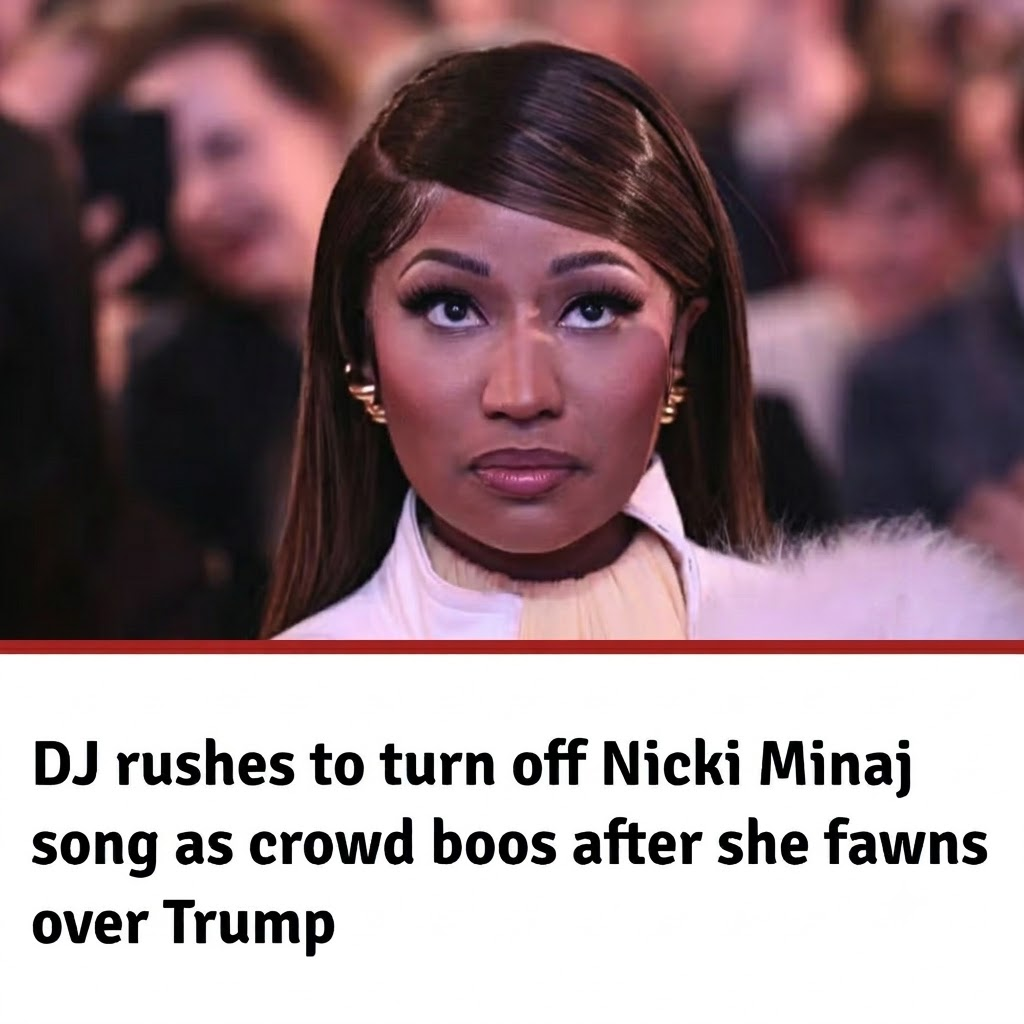
A moment that lasted only seconds has sparked a much larger conversation about music and politics. During a campaign event in Detroit, a Nicki Minaj track reportedly began playing over the speakers before the crowd responded with loud boos. The DJ then stopped the song and switched to another track, according to reports published after the event.
The incident drew attention not because a song was interrupted, but because Minaj has become increasingly vocal about her support for President Donald Trump. For some listeners, that political position now shapes their reaction to her music as much as the music itself.
A song meets an unexpected reaction
The episode took place during a rally connected to former President Barack Obama and Democratic political figure Abdul El-Sayed, as Democrats campaigned ahead of the November 2026 midterm elections. The event’s political setting made the choice of soundtrack especially noticeable to attendees who opposed Minaj’s public support for Trump.
Video described in media coverage showed the audience booing as the track played. One attendee reportedly shouted for the music to be turned off, while another suggested choosing a different artist. The song was subsequently cut short.
The available reporting supports a straightforward account: the track was played, some people in the crowd objected, and the DJ changed the music. It does not establish that every person at the rally shared the same view, nor does one crowd reaction prove that Minaj’s entire audience has turned against her.

How Minaj’s political profile changed
Minaj built her reputation through chart-topping rap, high-energy performances and a distinctive public persona. Her fan base spans different backgrounds and political outlooks, which makes her increasingly direct political statements especially likely to generate strong reactions.
Her current support for Trump marks a notable change from some of her earlier public comments. In 2018, she criticized the administration’s hard-line immigration policy and wrote about her own experience as an immigrant. In 2020, she also said she was not going to join the pro-Trump bandwagon.
Political views can evolve, and Minaj has argued that people should be free to change their minds. But a change of position can also invite questions from fans who remember an artist’s earlier statements and see the new stance as inconsistent with them.
In late 2025, Minaj appeared at Turning Point USA’s AmericaFest in Arizona, where she spoke with Erika Kirk and praised Trump and Vice President JD Vance. Her appearance drew national attention because it brought a major music star to a prominent conservative gathering.

From praise to active political support
Minaj’s involvement has gone beyond a single appearance. In January 2026, she described herself as one of Trump’s biggest supporters at a Washington event associated with a government-backed investment-account initiative for children. Her remarks reinforced the impression that her support was not simply a passing comment.
In October 2026, she appeared alongside Trump at a Republican campaign rally in Port Huron, Michigan. She praised his return to office, led chants supporting him and encouraged voters to back Republican candidates in the state. The appearance made her political alignment even more visible during the midterm campaign period.
That visibility helps explain why a song played at an opposing political event could become a news story. In a polarized campaign season, a performer’s name can carry political meaning even when the performer is nowhere near the venue.
Why the audience reaction matters
For critics, the boos were a spontaneous expression of disagreement with a celebrity whose politics they reject. For others, the scene raises a different question: should a musician’s political views determine whether their songs can be enjoyed in a public space?
There is no single answer. Some listeners separate an artist’s work from their personal beliefs; others view listening, streaming or buying tickets as a form of support that they would rather not give to someone whose politics conflict with their own.
Public events also have their own expectations. Music chosen for a campaign rally can help set a mood, signal a shared identity or energize supporters. A track associated with a politically divisive figure may therefore land differently at a partisan event than it would at a concert, nightclub or private gathering.
Still, the clip should not be treated as a scientific measure of public opinion. A short video captures a specific moment and a particular crowd. It cannot tell us how many attendees objected, what all rallygoers thought, or whether the incident will have a lasting effect on Minaj’s streaming numbers or ticket sales.
Celebrity endorsements in a polarized era
Minaj is not the first entertainer to discover that political endorsements can bring both new supporters and fierce criticism. Famous musicians have long been invited into election campaigns because they can attract attention, reach younger audiences and create moments that travel quickly through social media.
But celebrity influence is difficult to predict. An endorsement may energize people who already agree with a candidate, while alienating listeners who had connected with the artist for reasons unrelated to politics. The same public statement can be celebrated by one group and rejected by another.
Social platforms amplify these reactions. A brief exchange, a few seconds of video or a DJ changing a song can circulate far beyond the original event. Once reposted, the clip often becomes a symbol in a wider argument rather than a complete record of what happened in the room.
That is why context matters. The Detroit incident was a reaction to music being played at a politically charged event, against the backdrop of Minaj’s public support for Trump. It should not be confused with a performance at which she personally appeared, nor should it be presented as proof of a universal backlash.

What happens next?
The immediate episode may fade from the news cycle, but the underlying tension is likely to remain. As the midterms approach, artists who publicly support candidates may find their songs interpreted through the political identities attached to them.
Whether this moment changes Minaj’s relationship with her audience will require more evidence than a single viral clip. Sustained trends in audience response, concert attendance, streaming data and the artist’s own future statements would provide a clearer picture than online comments alone.
For now, the story is a snapshot of a broader cultural divide: a familiar song can become controversial when it enters a politically charged room. The DJ’s quick switch was a small action, but the reaction it captured shows how closely entertainment and politics can be intertwined in the current campaign season.
Comments (0)
Loading comments...
May You Like

EAST COAST CATASTROPHE — $20 BILLION AT STAKE, 5 MILLION AT RISK OF LOSING POWER, WATER AND HEAT!

STAR DIED AT 38, $10M LIFE INSURANCE INCREASED JUST 30 DAYS BEFORE WWE BRONSON REED'S DEATH!

COASTAL DISASTER — 112 KM/H WINDS, SEAWATER FLOODING, 79,000 NEW JERSEY HOMES AT RISK!








Popular Posts




