Why the U.S. and Japan Are Watching China
Jet-Engine Supply Chains Are Feeling a Yttrium Squeeze — Why the U.S. and Japan Are Watching China
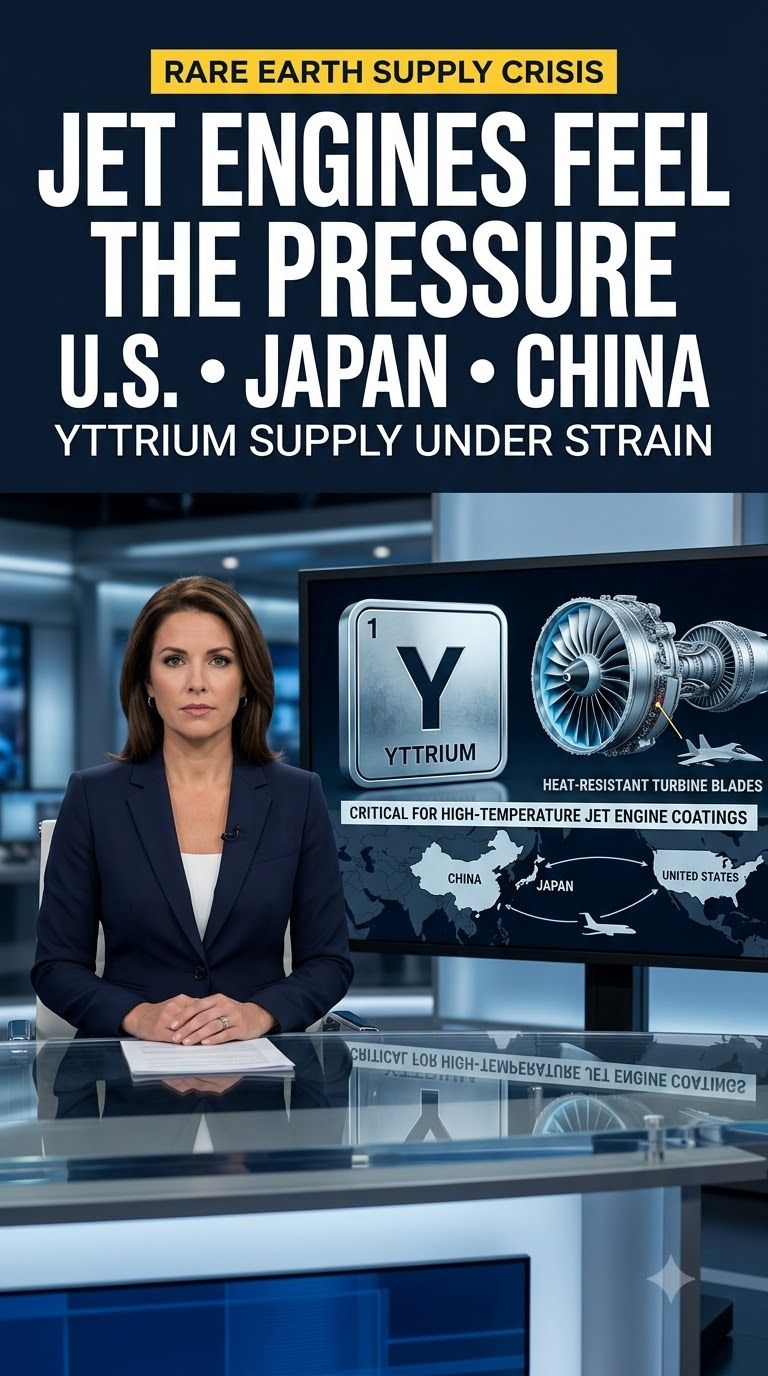
A little-known rare-earth metal has become one of the most important pressure points in the global aerospace supply chain.
Yttrium is not used in huge quantities compared with aluminum, steel or titanium. But it plays an outsized role in high-temperature coatings that protect some of the hottest parts of jet engines.
That has made supply disruptions especially painful.
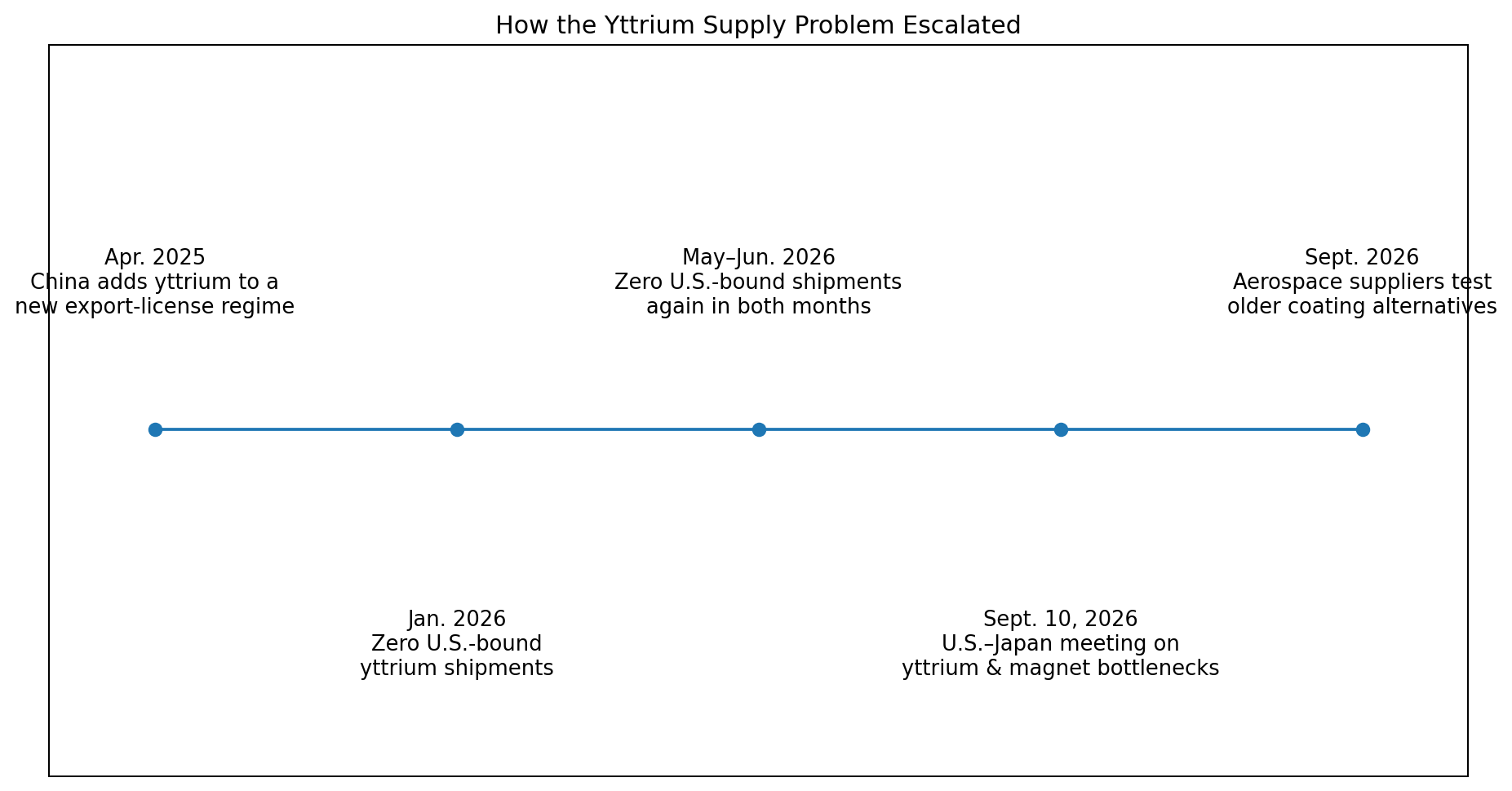
China dominates the global supply of yttrium and tightened export controls as trade tensions with the United States intensified. In 2026, U.S.-bound shipments fell to zero in several months, according to Chinese customs data reviewed by Reuters.
The result has been a problem that can sound almost absurdly narrow until it reaches a factory floor: a shortage of one relatively obscure material can delay a coating, which can delay a turbine component, which can slow the delivery of an entire engine.
Why Yttrium Matters Inside a Jet Engine
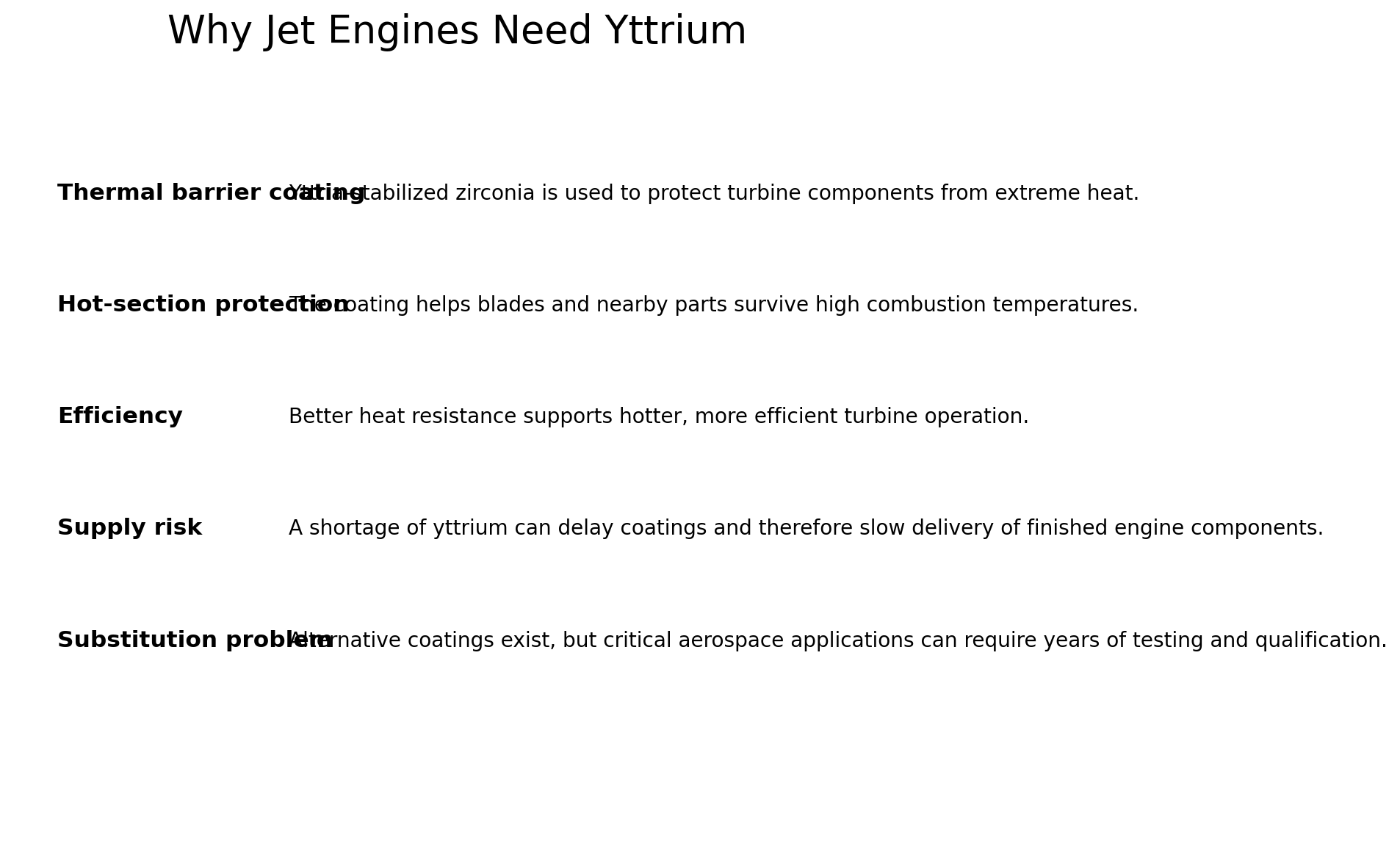
Modern jet engines operate at temperatures that would quickly damage unprotected metal components.
To survive that environment, turbine blades and other hot-section parts rely on advanced coatings that act as thermal barriers.
One of the most important materials is yttria-stabilized zirconia, a ceramic in which yttrium oxide helps stabilize zirconium oxide so the coating can tolerate extreme heat and repeated thermal cycling.
The coating is only one layer in a complex engine system, but it helps extend component life and allows turbines to operate at temperatures that improve efficiency.
That is why yttrium is difficult to treat as just another commodity. Manufacturers may use relatively small volumes, yet those volumes can sit at a critical point in production.
The United States Is Heavily Dependent on Imports
The U.S. supply position has been vulnerable for years.
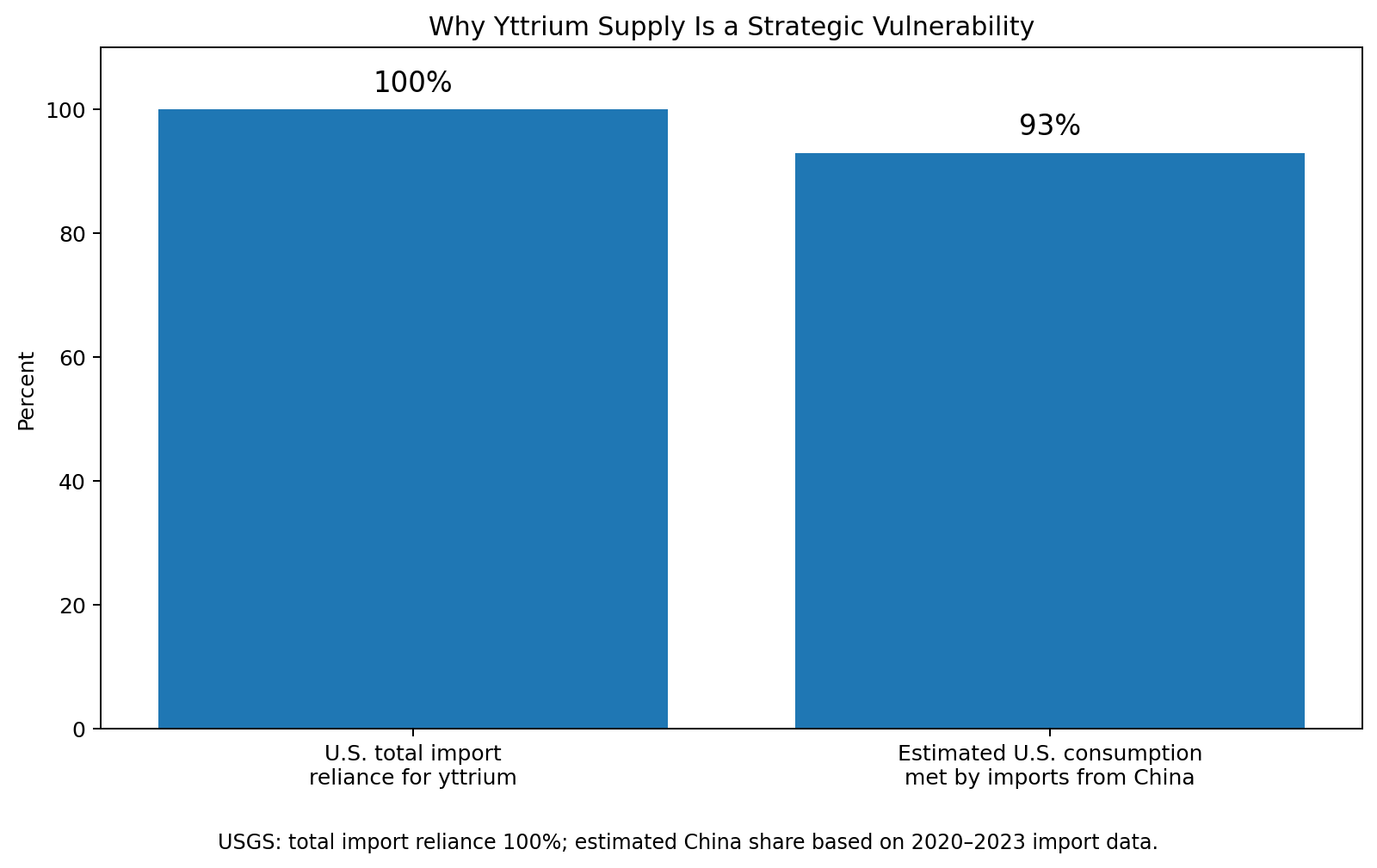
U.S. Geological Survey data show that the country is 100% import-reliant for yttrium. Based on recent historical import patterns, roughly 93% of U.S. consumption was supplied through imports from China.
That level of dependence is especially important because aerospace and defense companies cannot quickly redesign a certified engine component every time one material becomes difficult to obtain.
A new material may need laboratory work, durability testing, manufacturing trials and regulatory qualification before it can be trusted in a high-stress aviation environment.
In other words, the supply chain can be highly concentrated even when engineers know alternative materials exist.
China’s Export Controls Turned Dependence Into a Bottleneck
The problem intensified after China introduced a new licensing system for several critical minerals, including yttrium, in 2025.
The controls came amid a broader U.S.-China trade confrontation.
In practice, the licensing regime made shipments less predictable. Chinese customs data cited by Reuters showed no U.S.-bound yttrium shipments in January, May or June 2026.
Companies that rely on the metal were forced to work through inventories, seek licenses or search for alternative supply.
For some manufacturers, that translated into production interruptions and major financial losses.
Why Washington and Tokyo Met in September
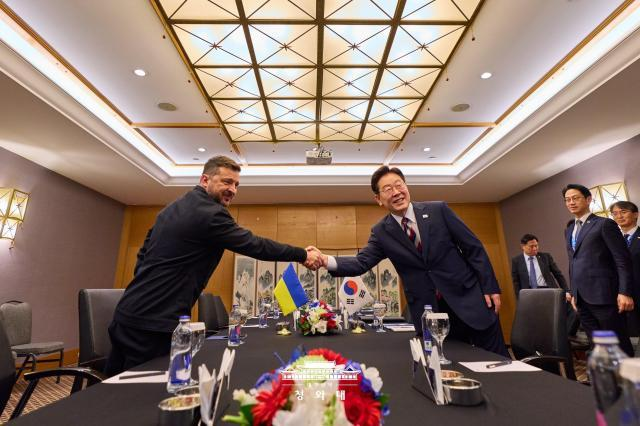
The shortage became serious enough that U.S. and Japanese officials held a senior-level meeting on September 10 focused specifically on permanent magnets and yttrium supply chains.
The session was hosted by the U.S. Department of Energy and included Japan’s Ministry of Economy, Trade and Industry as well as company representatives.
The purpose was to identify bottlenecks and look for ways the two countries could strengthen supply-chain resilience.
Japan has its own exposure because its manufacturing base depends heavily on critical minerals used in autos, electronics, machinery and aerospace.
That made yttrium more than a bilateral U.S.-China trade issue. It became part of a wider industrial-security problem involving multiple major manufacturing economies.
A Tiny Material Can Stop a Large Product
Yttrium’s strategic importance comes from where it sits in the production chain.
A jet engine contains thousands of parts and enormous quantities of more familiar materials. But if a specialized turbine coating cannot be applied because one key input is missing, a much larger assembly can be delayed.
That is why industry officials have described yttrium as a material capable of stopping production even though it represents only a small portion of the finished product.
The same dynamic exists in other sectors.
Yttrium is also used in semiconductor manufacturing tools, power-generation equipment and other high-temperature or high-performance applications.
Aerospace Suppliers Are Reopening Old Engineering Playbooks
The supply pressure has pushed aerospace suppliers to revisit technologies that had largely been overtaken by newer materials.
Researchers at Canada’s National Research Council and industry partners are examining thermal-barrier coating formulas based on zirconium dioxide and other ceramic oxides that date back to the 1970s and 1980s.
European coatings companies are also developing rare-earth-free products using materials such as magnesium- and calcium-modified zirconia.
Some U.S. suppliers are testing similar approaches for less critical components.
The logic is simple: older materials may not match the performance of modern rare-earth-enhanced coatings, but better manufacturing tools and modern engineering methods could make them useful in selected applications.
The Alternatives Are Not a Quick Escape
The search for substitutes does not mean the aerospace industry can rapidly walk away from Chinese rare earths.
High-performance aviation materials have long qualification cycles.
A coating that works in a laboratory still has to prove that it can survive vibration, temperature changes, oxidation and thousands of operating cycles without creating unacceptable risk.
For the most demanding engine components, that process can take years.
Industry experts therefore see substitution as part of a longer-term resilience strategy rather than an immediate fix for the current shortage.
Recycling Can Help, but Only at the Margins
Manufacturers are also looking at recycling surplus coating material and recovering more value from scrap.
That can reduce waste and stretch existing supplies.
But recycling cannot create enough material to replace a dominant primary supplier on its own, especially if demand for aerospace, energy and semiconductor equipment continues to grow.
The same limitation applies to stockpiles.
Inventories can bridge temporary disruptions, but they eventually run down if new shipments do not arrive.
Japan Faces an Even Sharper Version of the Same Problem
Japanese companies have been particularly vocal about rare-earth risks.
More than two-thirds of nearly 200 Japanese corporate filings reviewed by Reuters in May and June that mentioned rare earths said export controls were already hurting business or could do so in the future.
The concern goes beyond aviation.
Japan is a major producer of vehicles, electronics, machine tools and advanced industrial equipment, all of which can depend on specialized minerals and magnets.
That broad exposure helps explain why Tokyo has become an important partner in U.S. efforts to diversify critical-mineral supply chains.
China Says Its Controls Are Lawful
Beijing rejects the idea that its export-control system is simply an attempt to damage foreign industry.
The Chinese government has said the controls are lawful, consistent with international practice and intended to protect national security and manage sensitive materials.
Chinese officials have also said the country remains committed to stable global critical-mineral supply chains.
U.S. and Japanese officials, however, have focused on the practical result: licensing delays and inconsistent shipments can still create serious production risk even when exports are not formally banned.
Why This Has Become a Trade-Negotiation Issue
Rare earths now sit inside the broader bargaining relationship between Washington and Beijing.
Tariffs, technology restrictions, semiconductor controls and mineral exports have increasingly become linked negotiating tools.
That gives China leverage because replacing a dominant supplier is much harder than changing a tariff rate.
New mines take years to permit and build. Processing capacity is expensive. Aerospace qualification takes additional time.
Even a political agreement that improves shipments today does not remove the underlying concentration risk.
What the U.S. and Its Allies Are Trying to Change
Washington, Tokyo and other allies are pursuing several strategies at once.
They are looking for new mines and processing capacity, encouraging critical-mineral projects, building strategic inventories, supporting recycling and testing substitutes for the most vulnerable applications.
The goal is not necessarily to eliminate Chinese material from every supply chain.
A more realistic objective is to make sure one licensing decision or political dispute cannot stop an entire industry.
That is a much slower project than simply buying more material when the market is tight.
The Jet-Engine Problem Shows Why Rare Earths Matter
Yttrium is a useful example because almost nobody outside specialized industries thinks about it until the supply stops.
Passengers see aircraft. Airlines see engines. Engine makers see turbines, coatings and certification requirements. Deep inside that chain sits a metal most people have never heard of.
When supply is normal, it is nearly invisible.
When supply is disrupted, its importance becomes obvious.
That is why a dispute over a relatively small rare-earth market has reached government meetings in Washington and Tokyo and engineering laboratories across the aerospace industry.
The pressure on jet engines is ultimately a supply-chain story: modern technology can depend on tiny quantities of materials that are extremely difficult to replace when geopolitics suddenly interrupts the flow.
Comments (0)
Loading comments...
May You Like

Russian Drone Strikes Kyiv Bridge as German Chancellor Arrives in Ukraine

Obama Steps Back Into the Political Spotlight as Democrats Target Trump’s Senate Majority

Jack Smith Defends His Integrity as Trump Investigations Face Renewed Political Firestorm