
WNBA Commissioner Cathy Engelbert to Retire at Year's End After Transformative — and Tumultuous — Seven-Year Tenure
The league's first commissioner, who presided over an era of unprecedented growth, record-breaking viewership, and a landmark $3.1 billion media rights deal, will step down on December 31. But her legacy is also marked by public criticism from players and questions about leadership during a period of intense scrutiny.
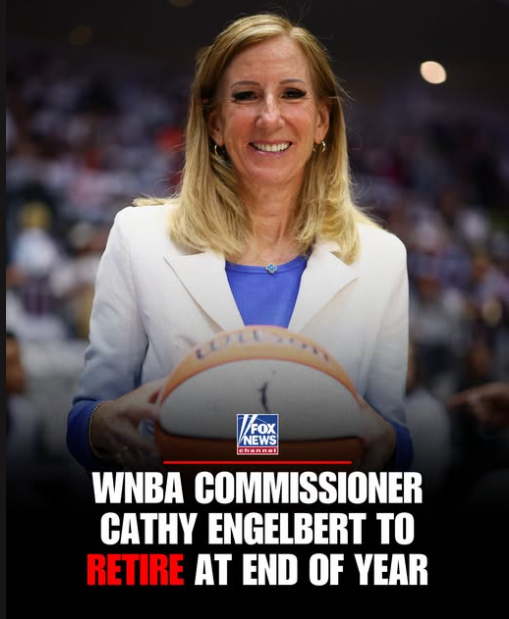
NEW YORK — A graphic circulating on social media this week captures a major development in the world of women's sports: "WNBA COMMISSIONER CATHY ENGELBERT TO RETIRE AT END OF YEAR." According to an official announcement from the WNBA and NBA Commissioner Adam Silver on September 4, 2026, the news is accurate .
Cathy Engelbert, who turns 62 in November, will retire on December 31, 2026, bringing to a close her seven-plus years at the helm of the WNBA . Her tenure, the second-longest of any WNBA president or commissioner, has been defined by a remarkable financial transformation that has elevated the league from questions about its "long-term viability" to a powerhouse with an average franchise value of approximately $460 million, up from just $10 million in 2019 .
A Legacy of Unprecedented Financial Growth
Appointed as the WNBA's first commissioner in May 2019 after a 30-year career at Deloitte — where she rose to CEO — Engelbert inherited a league with "enormous potential yet untapped awareness and significant undervaluation" . What followed was a period of exponential growth that exceeded even her own expectations.
Under her leadership, the WNBA secured an 11-year, $3.1 billion media rights deal with partners Amazon, Disney, and NBC, dramatically increasing the league's annual revenue . The league expanded from 12 to 15 teams, with plans to reach 18 by 2030 — including the addition of the Golden State Valkyries (2025), Portland Fire (2026), Toronto Tempo (2026), and future teams in Cleveland (2028), Detroit (2029), and Philadelphia (2030) .
Perhaps most significantly, Engelbert helped negotiate a historic collective bargaining agreement in March 2026 that delivered the league's first million-dollar player salaries . The new CBA raised the salary cap from $1.5 million to $7 million, increased supermax salaries to $1.4 million, established a $300,000 minimum salary, and gave players approximately 20% of shared revenue . The agreement also introduced a fully centralized replay center and a charter travel program, making WNBA players the first U.S.-based women's professional athletes to fly privately to all games .
"When I first came to the league I intended to do this for 3 1/2 years," Engelbert told the Associated Press. "The 7 1/2 years exceeded that time. This is a really good time given the financial transformation journey we've been on. Getting the collective bargaining agreement done, getting a long-term media rights deal done, getting expansion done."
Turmoil and Tension Alongside the Growth
However, Engelbert's tenure was not without significant controversy. As the league's profile skyrocketed — driven by the arrivals of Caitlin Clark, Angel Reese, and Paige Bueckers — so did scrutiny of its leadership .
Players have been increasingly vocal about their frustrations. In September 2025, Minnesota Lynx forward Napheesa Collier, a vice president of the players' union, delivered a stinging public rebuke: "We have the best players in the world. We have the best fans in the world, but right now we have the worst leadership in the world," she said, citing a "lack of accountability" from the league office . Indiana Fever guard Caitlin Clark subsequently voiced her support for Collier, stating she had made "a lot of very valid points" and emphasizing that "we need great leadership at this time" .
The CBA negotiations, while ultimately successful, were often contentious and strained the commissioner's relationship with players . Other issues — including inconsistent officiating, player safety concerns amid increased online vitriol, and questions about the league's policy on transgender athletes — also drew criticism .
Engelbert acknowledged that the "noise" affected her family and contributed to her decision to retire. "Obviously, some of the noise more bothered my family… wanting to spend more time with me and support me," she said. "I'm not going to lie about its impact on my kids, on my mother. And again, I have a huge family. My five brothers are like, 'Get out of there, Cathy.' "
The Search for a Successor
Engelbert has been working on a succession plan for the past three years and has already submitted a list of potential candidates to NBA Commissioner Adam Silver, who will make the final decision . She has vowed to stay on temporarily if a successor isn't found by year's end, stating: "We'll run a real succession process in the remaining four months. If we don't find someone I'll stay on. "
Potential candidates include both internal and external figures. Names circulating include Mark Tatum, NBA deputy commissioner and COO ; Swin Cash, former WNBA All-Star and CEO of She's Got Time ; Andrea Brimmer, chief marketing officer at Ally Financial ; Micky Lawler, commissioner of Unrivaled and former WTA president ; and Bethany Donaphin, head of WNBA league operations .
NBA Commissioner Adam Silver praised Engelbert in a statement: "Cathy has presided over the WNBA through the most significant period of growth in the league's 30-year history. We are grateful for Cathy's leadership and unwavering commitment to the advancement of women's basketball. "
Engelbert herself reflected on her legacy: "I retire knowing we have built something bigger, stronger and more enduring than we could have imagined. I am grateful to the WNBA and NBA team owners and staff, players, investors, fans and the powerhouse league office staff, who believed in what this league could become. I retire with immense gratitude and tremendous optimism for the future of the WNBA, with the best yet to come. "
The Bottom Line
| What the graphic suggests | What actually happened |
|---|---|
| Engelbert is retiring | Yes — effective December 31, 2026 |
| Her tenure was transformative | Yes — franchise values grew 4,600%, media deals reached $3.1B |
| She faced player criticism | Yes — public rebukes from Collier, Clark, and others |
| A successor is ready | Search underway; Engelbert will help find replacement |
The viral image of Engelbert's retirement captures a pivotal moment for the WNBA. The league has never been more valuable, more visible, or more scrutinized. As one era ends and another begins, the next commissioner will inherit a transformed league — and the weight of expectations from players, owners, and fans alike.
One thing is certain: the WNBA's best days, as Engelbert herself said, are "yet to come."
Comments (0)
Loading comments...
May You Like

South Korea–Ukraine Rift Deepens Over North Korean POW Transfer as PURL Draws New Scrutiny

South Korea–Ukraine Rift Deepens Over North Korean POW Transfer as PURL Draws New Scrutiny

Russian Drone Strikes Kyiv Bridge as German Chancellor Arrives in Ukraine












