
Women held in federal prisons under Trump... — A hot topic
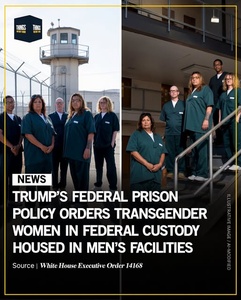
WASHINGTON — The Trump administration has sought to reshape federal prison policy for transgender inmates, directing officials toward sex-based housing while courts continue examining whether the approach complies with federal law.
Executive Order Sets New Direction
President Donald Trump’s Executive Order 14168, signed January 20, 2025, instructed the Justice Department to ensure that males are not detained in women’s prisons or housed in women’s detention facilities.
The order also directed the Bureau of Prisons to revise policies concerning medical care for inmates and prohibited federal funding for certain treatments intended to conform an inmate’s appearance.
The administration’s policy therefore goes beyond prison placement, forming part of a broader federal approach that defines sex as biological and separates it from gender identity.


Prison Transfers Trigger Court Fight
Transgender women in federal custody challenged the policy, arguing that categorical placement in men’s prisons can expose them to serious risks and that officials should consider individual circumstances.
In June 2026, a federal judge in Washington issued a preliminary injunction preventing the government from transferring 14 transgender women into men’s facilities while litigation continued.
The ruling did not establish that every transgender woman must be housed in a women’s prison, but specifically protected the plaintiffs involved in that lawsuit.
Judge Royce Lamberth’s order required federal officials to maintain the plaintiffs’ existing housing arrangements while the court considered their constitutional and statutory challenges.
The plaintiffs’ lawyers argued that federal prison officials should conduct individualized safety assessments rather than automatically transferring transgender women based solely on the administration’s sex-based classification policy.
What Does Federal Prison Law Require?
The dispute also involves the Prison Rape Elimination Act, known as PREA, which established federal standards designed to prevent sexual abuse and improve safety inside correctional facilities.
Advocacy groups have argued that individualized assessments are particularly important because incarcerated transgender people can face elevated risks of harassment, assault and other forms of violence.
The administration, meanwhile, has maintained that prison officials must protect female prisoners and that federal policy should recognize biological sex when determining access to sex-segregated facilities.
The Justice Department has separately pursued investigations into state prison systems, including California and Maine, over allegations involving the housing of transgender inmates in women’s facilities.
Those investigations demonstrate that the administration’s position extends beyond federal prisons and forms part of a wider dispute over sex-based classifications throughout the American correctional system.
Appeals Complicate the Picture
The Trump administration appealed Lamberth’s June ruling, arguing that the lower court lacked sufficient findings about the individual circumstances of the transgender women involved in the case.
The D.C. Circuit later vacated the operative preliminary injunctions and sent the dispute back to the lower court for additional proceedings and factual analysis.
The appellate decision did not create a nationwide requirement that transgender women must be placed in men’s prisons, nor did it establish that they must always be housed alongside women.
Instead, the continuing litigation leaves open questions about how prison officials should evaluate individual safety concerns when applying the administration’s broader sex-based housing policy.
For transgender women currently held in federal custody, future court decisions could determine how much discretion the Bureau of Prisons retains when evaluating housing, safety and medical circumstances.


A Broader Policy Battle
The prison dispute is part of a larger series of Trump administration policies addressing transgender issues across federal agencies, including military service, healthcare and official government definitions of sex.
For the administration, the policy reflects its stated objective of maintaining sex-separated facilities and recognizing biological sex throughout federal government programs and regulations.
For opponents, the central concern is whether categorical rules can adequately account for individual prisoners whose circumstances may create different levels of vulnerability or security risk.
The legal battle is therefore unlikely to end with a single administrative directive, as courts continue examining constitutional protections, federal statutes and the limits of executive authority.
For now, Executive Order 14168 remains the foundation of the administration’s federal policy, while ongoing litigation continues to determine how those directives can legally be enforced inside federal prisons.
Comments (0)
Loading comments...
May You Like

Shocking news from Ohio: an unexpected development ahead of Trump's rally

South Korea–Ukraine Rift Deepens Over North Korean POW Transfer as PURL Draws New Scrutiny













