Yellowstone “Rejected Euthanasia” for Bison That Threw a Tourist? The Viral Graphic Gets the Story Wrong
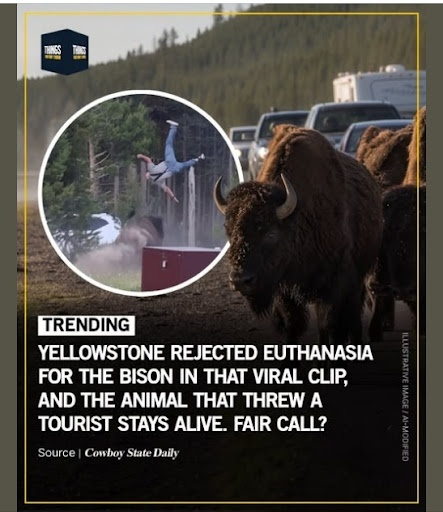
A viral graphic circulating online claims that Yellowstone National Park rejected euthanasia for a bison that threw a tourist into the air — and that the animal was allowed to stay alive after the attack.
There is a real bison attack behind the viral discussion. But the graphic mixes together two separate 2026 incidents in two different states — and one of them was fatal.
Verdict: MISLEADING.
The Yellowstone Attack Really Happened
On July 10, 2026, a bull bison at Yellowstone's Bridge Bay Campground became agitated and charged people.
A tourist walking with his grandson was attacked and thrown roughly 8 feet into the air. Professional photographer Mike MacLeod captured the encounter on video, and the footage subsequently went viral. The victim suffered serious injuries, including broken bones.
The incident was unusual because reports indicate the victim had been keeping a respectful distance from the animal before the bison became aggressive.
Cowboy State Daily's account described the bull as extremely agitated and charging at people and objects around the campground.
So there absolutely was a Yellowstone bison that tossed a tourist into the air.
But that is where the graphic begins to go off track.
There Was No Reported Yellowstone “Euthanasia Rejection”
The viral graphic says Yellowstone “rejected euthanasia” for the attacking animal.
I could not find credible evidence that Yellowstone officials announced such a decision.
The National Park Service's official 2026 reporting emphasizes a different point: bison are wild animals, and the park requires visitors to remain at least 25 yards away from them. NPS says bison have injured more people in Yellowstone than any other animal and can run roughly three times faster than humans.
The NPS also documented another 2026 Yellowstone bison attack in June, when a 12-year-old visitor was injured near Mud Volcano. That incident remained under investigation.
There is no comparable NPS announcement saying the July Bridge Bay bull was sentenced to death and then spared.
That appears to be the first major problem with the meme.
The “Bison Was Spared” Story Happened in South Dakota
The viral graphic appears to be borrowing a completely different story from Custer State Park in South Dakota.
In May 2026, a 70-year-old Canadian woman was killed by a bull bison while hiking the Grace Coolidge Trail.
According to the Custer County Sheriff's Office, she and her husband encountered a group of bull bison. One bull charged, hooked her and threw her into the air. She later died from her injuries.
That was not Yellowstone.
It was Custer State Park, more than 300 miles away in South Dakota.
And Yes — That Bison Was Spared
This is probably the event that inspired the “stays alive” portion of the viral graphic.
After the fatal attack, there was public discussion about whether the bull should be killed.
Cowboy State Daily reported that South Dakota officials were considering their options, while advocates pushed back against killing the animal. But officials did not publicly confirm that a formal kill order had actually been issued.
On June 10, the Rosebud Sioux Tribe Game, Fish and Parks Department announced that it would take custody of the bison instead.
Rather than euthanizing the animal, the tribe planned to move it to a secure location where it could live out the remainder of its natural life away from the public.
So there really was a case in 2026 in which a bison involved in a fatal human attack was not euthanized.
But again: that was South Dakota, not Yellowstone.
Two Bison Incidents — Two Very Different Outcomes
| Yellowstone | Custer State Park | |
|---|---|---|
| Location | Wyoming | South Dakota |
| Incident | Bull bison attacked tourist | Bull bison attacked tourist |
| Date | July 10, 2026 | May 2026 |
| Human outcome | Tourist seriously injured | Tourist killed |
| Bison outcome | No credible report of a euthanasia decision | Relocated rather than euthanized |
| Tribal relocation | No | Rosebud Sioux Tribe took custody |
The graphic essentially combines the Yellowstone attack footage with the South Dakota bison's controversial reprieve.
Yellowstone Has Euthanized a Bison Before — But It Was a Completely Different Case
There is another reason the meme may sound plausible.
In 2023, Yellowstone really did euthanize a bison — but it was a newborn calf, not the adult bull involved in the 2026 tourist attack.
A visitor named Clifford Walters encountered a struggling calf in the Lamar Valley, pushed it from the river onto the roadway and interacted with it. The calf subsequently began approaching cars and people.
Rangers repeatedly attempted to reunite it with the herd, but those efforts failed. Park officials ultimately euthanized the calf because it had been abandoned and was creating a hazardous situation around the roadway. Walters later pleaded guilty to intentionally disturbing wildlife and was fined.
That is a third, separate bison story.
So there are actually three different events that can easily become confused online:
- 2023 Yellowstone: visitor interfered with a bison calf → calf was euthanized.
- May 2026 Custer State Park: bull killed a woman → animal was relocated instead of euthanized.
- July 2026 Yellowstone: bull threw a tourist roughly 8 feet → tourist survived with serious injuries; no verified “euthanasia rejected” decision has been reported.
Why the Distinction Matters
There is a legitimate debate here about how parks should respond when wildlife seriously injures or kills a person.
But the management philosophy of Yellowstone is not simply “kill any animal that hurts someone.”
The National Park Service explicitly treats Yellowstone as a wild ecosystem and warns visitors that animals can be unpredictable. Its current guidance says people should never approach wildlife and should maintain at least 25 yards from bison.
That philosophy is different from saying an individual dangerous animal can never be removed.
In the South Dakota case, relocation offered a way to remove the specific bull from public contact while allowing it to remain alive under tribal management. Officials described the relocation as a way to protect public safety while respecting the animal's natural behavior.
The Viral Graphic Is Asking the Right Question — But Giving the Wrong Answer
The image asks:
“Fair call?”
That's ultimately an opinion question.
Someone can reasonably argue that an animal that kills a person should be euthanized. Others can argue that the bison was behaving naturally and should not be punished for being a wild animal.
But before debating that question, the facts have to be straight.
Yellowstone did not announce that it “rejected euthanasia” for the bison that threw the July 2026 tourist.
The non-euthanasia decision involved a different bison, in Custer State Park, South Dakota, after a fatal attack.
Bottom Line
The viral post is MISLEADING because it merges separate incidents.
- ✅ A Yellowstone bull bison really did throw a tourist about 8 feet into the air in July 2026.
- ✅ The tourist survived but suffered serious injuries.
- ❌ There is no credible evidence Yellowstone announced that it had rejected euthanasia for that particular bull.
- ✅ A different bull bison in Custer State Park, South Dakota, killed a 70-year-old woman in May 2026.
- ✅ That South Dakota bison was ultimately relocated rather than euthanized under the care of the Rosebud Sioux Tribe.
- ❌ The South Dakota bison was not the Yellowstone animal shown in the July attack story.
The viral graphic takes two real stories and turns them into one. The reality is considerably more complicated — and geographically very different.
Comments (0)
Loading comments...
May You Like

Obama Steps Back Into the Political Spotlight as Democrats Target Trump’s Senate Majority

South Korea–Ukraine Rift Deepens Over North Korean POW Transfer as PURL Draws New Scrutiny

Jack Smith Defends His Integrity as Trump Investigations Face Renewed Political Firestorm