Yellowstone Will Not Euthanize Bison That Threw Tourist Into the Air, Officials Say
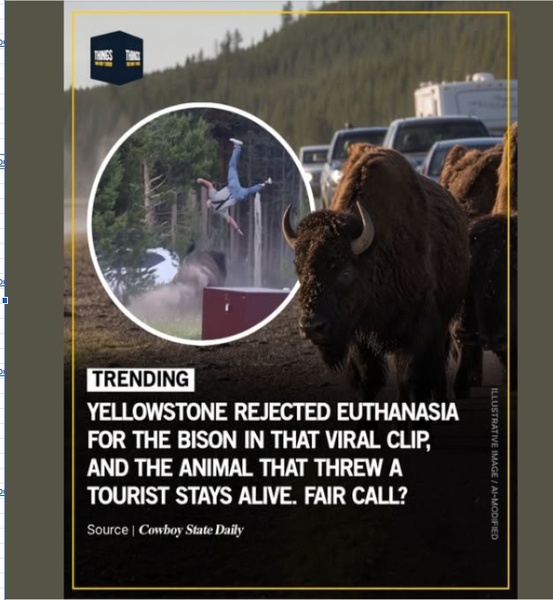
A Yellowstone bison that tossed a 65-year-old tourist about eight feet into the air during a viral encounter will remain in the park, despite the man's serious injuries.
A bull bison that violently charged and tossed a Yellowstone National Park visitor into the air will not be euthanized, according to reports citing park officials.
The decision follows a dramatic July 10 encounter at Bridge Bay Campground near Yellowstone Lake, where 65-year-old Carl Isom-McDaniel was thrown roughly eight feet into the air by the animal. Video of the incident quickly spread across social media, drawing millions of views and renewed debate over how Yellowstone should respond when wildlife seriously injures visitors.
The viral graphic supplied with this report summarizes the development as: “Yellowstone rejected euthanasia for the bison in that viral clip, and the animal that threw a tourist stays alive.”
Tourist suffered serious injuries
According to multiple reports, McDaniel was visiting Yellowstone with his 13-year-old grandson when the bison suddenly charged.
The animal reportedly pursued McDaniel and caught him with its horn, sending him approximately eight feet into the air. The encounter was captured on video by professional photographer Mike MacLeod.
McDaniel suffered significant injuries, including a femur fracture that required surgery. His grandson escaped without physical injury.
Despite the severity of the encounter, McDaniel later said the situation could have ended much worse. He expressed relief that the bison did not continue attacking him after he hit the ground.
Yellowstone decided the bison would live
Following the incident, Yellowstone officials determined that no management action would be taken against the bison, according to reports citing park officials. In practical terms, that means the animal will not be euthanized or removed because of the encounter.
The decision is consistent with Yellowstone's broader approach to wildlife management, which emphasizes maintaining a wild, free-ranging ecosystem rather than removing animals simply because they behave aggressively in their natural environment.
The National Park Service says it has sole authority to manage bison inside Yellowstone and maintains a specific management framework designed to preserve a sustainable wild population.
Why wasn't the bison euthanized?
A key distinction is that a dangerous wildlife encounter does not automatically mean the animal will be killed.
Yellowstone's mission is to preserve a functioning natural ecosystem. The park has repeatedly emphasized that bison are wild animals and can be unpredictable, even when they appear calm.
The NPS currently manages Yellowstone's bison population within a target range of approximately 3,500 to 6,000 animals, using a combination of conservation transfers, Tribal and state harvests and other population-management measures when necessary.
That is different from euthanizing an individual animal solely because it attacked a visitor.
Yellowstone had already warned visitors about bison
The incident came just weeks after another bison-related injury at Yellowstone.
On June 26, a 12-year-old visitor was injured by a bison near Mud Volcano, north of Fishing Bridge, and was taken to a hospital. The National Park Service said the incident remained under investigation.
The agency stresses that visitors must stay at least 25 yards from bison and other large animals. Visitors are also instructed never to approach, touch, feed or crowd wildlife.
The NPS notes that bison have injured more people in Yellowstone than any other animal. They can run approximately three times faster than humans and may defend their space when they feel threatened.
The viral video tells only part of the story
The footage of McDaniel being thrown into the air is shocking, but reports indicate the circumstances were more complicated than a simple case of a tourist deliberately approaching an animal.
McDaniel said he and his grandson had been watching the bison from a considerable distance before deciding to leave. The animal then became agitated and charged.
Photographer Mike MacLeod, who recorded the encounter, later said the bison appeared highly agitated and was also charging at vehicles and other objects in the area. He intervened after seeing the animal standing near McDaniel following the attack.
That context matters because Yellowstone's safety guidance is based on the understanding that even keeping a reasonable distance cannot guarantee that a wild animal will not approach or charge.
A reminder that Yellowstone wildlife is truly wild
The decision to leave the bison alive has generated mixed reactions online, but wildlife experts and park officials consistently emphasize the same principle: visitors enter Yellowstone's habitat, not the other way around.
Yellowstone's bison are an important part of the park's ecosystem and one of the most significant surviving wild bison populations in North America. The National Park Service describes their recovery as one of the major conservation successes in the United States.
The latest incident therefore serves as both a viral spectacle and a serious safety warning.
The bison will remain in Yellowstone. The injured visitor survived. And the park's message to future visitors remains unchanged: admire wildlife from a safe distance, but never assume a seemingly calm bison is harmless.
Comments (0)
Loading comments...
May You Like

South Korea–Ukraine Rift Deepens Over North Korean POW Transfer as PURL Draws New Scrutiny

Shocking news from Ohio: an unexpected development ahead of Trump's rally
OBAMA STEPS BACK INTO THE POLITICAL SPOTLIGHT