
“You’re Crazy Anyway”: Inside Trump’s Scathing Rally Attack on Black and Jewish Voters—and the ‘Send Him Back’ Firestorm
“You’re Crazy Anyway”: Inside Trump’s Scathing Rally Attack on Black and Jewish Voters—and the ‘Send Him Back’ Firestorm
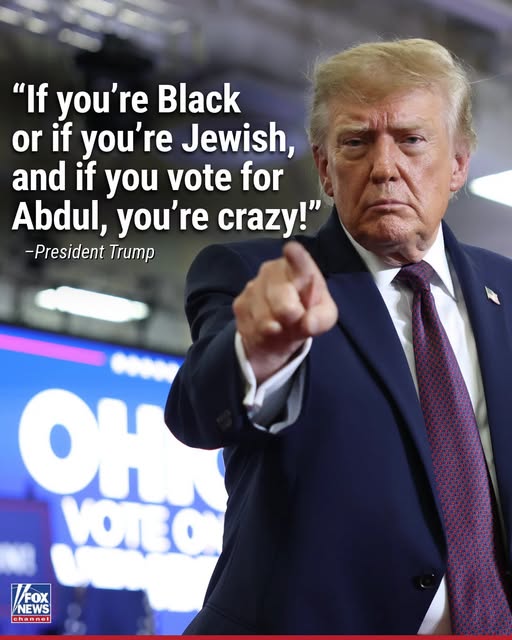
The image is pure, unvarnished political combat: Donald Trump, pointing directly at the camera, his expression a mix of contempt and confidence. The quote below is designed to land like a grenade in the final days of the 2026 midterms: “If you’re Black or if you’re Jewish, and if you vote for Abdul, you’re crazy!”
The post, which has circulated widely across social media, captures a moment of extraordinary rhetorical escalation. It was not a policy critique or a nuanced discussion of the issues. It was a blunt, almost taunting appeal to two key Democratic constituencies, delivered at a rally in the Deep South, aimed at derailing the candidacy of a progressive Senate hopeful in Michigan.
This is the story behind the quote, the context in which it was delivered, and the political earthquake it has triggered in the final, frantic hours before Election Day.
The Verdict: A Real Quote, A Deliberate Strategy
Unlike many viral political headlines, this one is grounded in verifiable reporting and direct quotes. According to USA Today, Trump delivered the line during a GOP campaign rally in Rock Hill, South Carolina, on October 29, 2026. The crowd cheered as he said, “If you’re Black, or if you’re Jewish, and if you vote for Abdul, you’re crazy, OK”. He then added, almost as an afterthought, “You’re crazy anyway” .
The quote was not a one-off gaffe. It was part of a deliberate, sustained messaging strategy. The very next day, at a rally in Daytona Beach, Florida, Trump doubled down, tweaking the language but sharpening the attack: “If you’re Black or if you’re Jewish and you vote for Abdul, you’re not smart,” he said. “Abdul is not a big fan of Jewish people, and he’s not a big fan of Black people….I hope you’re going to vote against him and send him back to where he came from” .
The Target: Abdul El-Sayed and the Battle for Michigan
The “Abdul” in question is Dr. Abdul El-Sayed, the Democratic nominee for the U.S. Senate in Michigan. A former public health official and progressive activist, El-Sayed is vying to become the first Muslim senator in American history. His candidacy has been a lightning rod from the start, particularly because of his strident criticism of Israel’s military actions in Gaza.
Trump’s rally attacks were not random. They were a calculated attempt to exploit the deep fissures within the Democratic coalition. El-Sayed, who is Muslim, has faced a complicated relationship with some Jewish voters over his stance on Israel. He also faced a contentious primary against centrist Representative Haley Stevens, which left lingering questions about his ability to solidify support among Black voters, a crucial Democratic constituency .
The Trump campaign’s strategy was clear: to peel away Black and Jewish voters from El-Sayed by framing him as hostile to their interests. As Trump put it at the Florida rally, “You outta vote for Mike Rogers, not that other guy, because he doesn’t like Jewish people and he doesn’t like Black people. I’m talking about Abdul” .
The “Send Him Back” Firestorm
The most explosive moment, however, came not with the “crazy” line, but with the follow-up. Trump’s demand to “send him back to where he came from” was widely condemned as a racist trope, particularly because El-Sayed was born in Rochester Hills, Michigan, to Egyptian immigrant parents .
Critics immediately pointed out the historical resonance of the phrase, which Trump had previously used against a group of Democratic congresswomen of color in 2019 . The comment was seen not as a policy disagreement, but as an attempt to question El-Sayed’s very belonging in the country—a familiar tactic in Trump’s political playbook.
The Reactions: A Party on the Brink
The response from Democrats was immediate and furious. Senate Minority Leader Chuck Schumer, who is Jewish, condemned the attacks. And in a stunning development that underscored the chaos of the race, Representative Haley Stevens—El-Sayed’s former primary rival—endorsed his Republican opponent, Mike Rogers, just days before the election .
Stevens’ defection was the culmination of a bitter feud, primarily over Israel. In a video posted to X, she declared, “I don’t belong in Abdul’s campaign... That’s why I am endorsing Mike Rogers” . The move drew the condemnation of Democratic leaders, with Schumer calling it a “despicable betrayal” .
Trump, for his part, gleefully welcomed Stevens’ endorsement, saying he would “love her to join the Republican Party” . The episode laid bare the deep divisions within the Democratic Party over Israel, identity, and the direction of the progressive movement.
The Bottom Line
The viral graphic is right about one thing: Donald Trump did say that Black and Jewish voters would be “crazy” to support Abdul El-Sayed. But the story is not just about a single insult. It is a story about a president who is willing to use the most inflammatory language to win a political fight, a Democratic Party fractured over identity and ideology, and a Senate race in Michigan that has become a national referendum on the future of the American left.
As voters head to the polls, the question is not just who will win. It is whether the political discourse can ever recover from the kind of attacks that Trump has normalized. In the final days of the campaign, the answer appears, once again, to be no.
📸 Suggested Images
-
The Rally: A photo of Trump at the Rock Hill, South Carolina rally, with a quote overlay of “If you’re Black, or if you’re Jewish, and if you vote for Abdul, you’re crazy.”
The Candidate: A photo of Abdul El-Sayed on the campaign trail, with a caption noting his background as a former public health official and his bid to become the first Muslim U.S. senator.
The “Send Him Back” Moment: A screenshot of the headline from Mediaite or HuffPost covering Trump’s “send him back” comment, illustrating the escalation of the rhetoric.
The Defection: A split image of Haley Stevens and Mike Rogers, with a caption noting Stevens’ stunning endorsement of the Republican candidate in the final days of the race.
The Stakes: A map of Michigan highlighting the Senate race, with a caption noting that the contest could determine control of the chamber.
Comments (0)
Loading comments...
May You Like

NYC EMERGENCY—MILLIONS FACE EVACUATION RISKS, MACY'S GIANT BALLOONS REMOVED FOR SAFETY!

TOLEDO I-75 TRUCK CRASH — POTENTIAL BRIDGE COLLAPSE AND MILLIONS IN DAMAGE!

I-75 THANKSGIVING NIGHTMARE — MAIL TRUCK CRASH RAISES OVERPASS COLLAPSE FEARS!

Latest Posts








Popular Posts




