
Zelenskyy signals willingness to freeze the front line—but says security guarantees are essential
KYIV, October 21, 2026


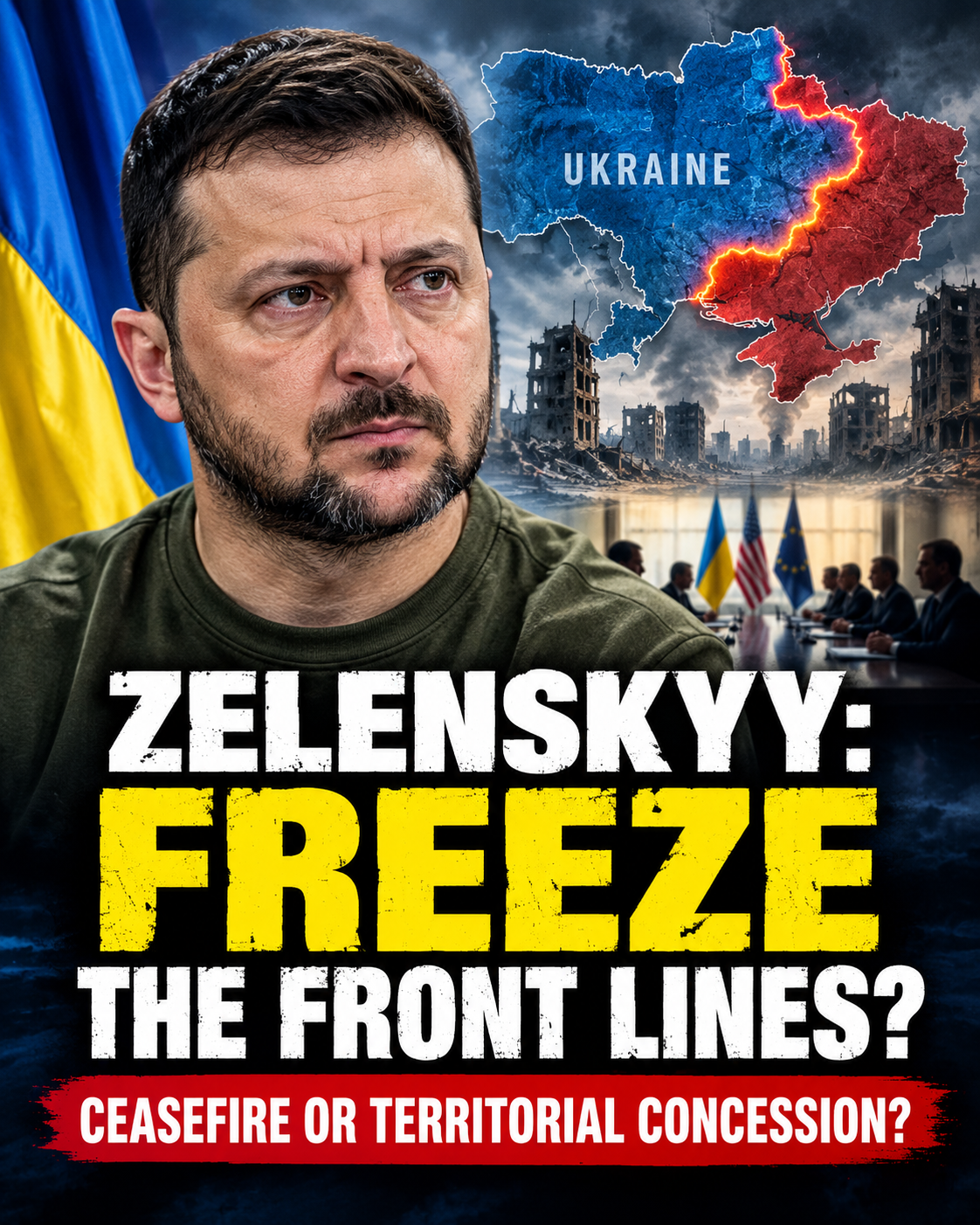
Ukrainian President Volodymyr Zelenskyy has made a significant public statement about the possibility of ending the war with Russia, saying Ukraine is prepared to freeze the current front line as a first step toward a ceasefire and further diplomatic negotiations. His comments, delivered in a Fox News interview broadcast on October 21, mark an important development in the debate over how to stop the fighting without abandoning Ukraine's claims to its internationally recognized territory.
Asked whether he would accept an arrangement that froze the conflict where the opposing forces currently stand, Zelenskyy answered: “Yes, right now we have to freeze, and I think this is a real way to end this war.”
He described the objective as a ceasefire or a decision to stop the killing, framing a halt to hostilities as a practical starting point for a broader peace process. The remarks came as diplomatic contacts involving Ukrainian, American and European officials continued, while U.S. envoy Steve Witkoff met Russian President Vladimir Putin in St. Petersburg.
But the statement should not be interpreted as confirmation that Ukraine has accepted a finalized peace agreement, formally surrendered territory or agreed to recognize Russian sovereignty over occupied areas. Zelenskyy's comments indicate openness to freezing military positions; the terms of any eventual settlement remain unresolved.
The distinction is crucial. A ceasefire can stop or reduce active fighting without settling the legal status of territory, establishing permanent borders or resolving the political causes of a war. For Kyiv, the central challenge is whether a ceasefire could bring immediate relief while providing enough protection to prevent another Russian attack.
What does “freezing the front line” actually mean?


In practical terms, freezing the front line would mean stopping major offensive operations around the positions held by each side when a ceasefire takes effect. Rather than requiring Ukraine and Russia to settle every territorial disagreement before the guns fall silent, the parties could first agree to halt fighting and address more difficult questions through negotiations.
That approach could reduce immediate battlefield casualties, ease pressure on communities near the front and create space for discussions about prisoner exchanges, humanitarian access, security arrangements and the future status of occupied territory.
It would not, by itself, guarantee peace.
A ceasefire requires clear rules, effective monitoring and a process for responding to alleged violations. The parties would need to determine where the line is drawn, how military movements are restricted, how incidents are investigated and what happens if either side resumes attacks.
Even a successful ceasefire could leave major disagreements unresolved. Ukraine could continue to regard occupied territory as Ukrainian land, while Russia could maintain its own claims. A frozen front line would therefore represent a military arrangement, not necessarily a mutually accepted international border.
This distinction explains why Zelenskyy's statement is consequential without being conclusive. He has publicly acknowledged that halting the fighting along current positions may offer a realistic path toward negotiations. He has not announced that a comprehensive settlement has been agreed or that Ukraine is abandoning its territorial claims.
The price of a ceasefire: Territory, sovereignty and the future of Ukraine


The question of territory remains among the most difficult obstacles to any peace agreement. Russia occupies parts of Ukraine and claims several regions that Kyiv continues to regard as Ukrainian territory. A ceasefire based on existing military positions could leave Moscow in control of areas it currently holds, at least temporarily, without resolving their ultimate status.
That possibility carries serious political and legal implications.
For Ukrainians living under occupation, a freeze in the fighting would not automatically restore access to their homes, guarantee their rights or return local administration to Ukrainian control. For people displaced by the war, a ceasefire could offer hope of safer travel and eventual return, but those outcomes would depend on security conditions and the provisions of any agreement.
For Kyiv, accepting a halt to the fighting is therefore different from formally conceding territory. Zelenskyy has rejected the suggestion that Ukraine should surrender the Donbas region as the price of peace, and reporting on his latest interview indicates that he continues to insist on security guarantees alongside any ceasefire.
The European Union has also reiterated its support for Ukraine's independence, sovereignty and territorial integrity within its internationally recognized borders. Its position underscores the distinction between a temporary military line and a legally recognized national boundary.
A settlement that freezes fighting without resolving sovereignty could reduce immediate violence while leaving a long-term territorial dispute in place. Whether that arrangement could endure would depend partly on how effectively the ceasefire was monitored and whether the parties accepted a process for managing future disagreements.
Why Zelenskyy is emphasizing security guarantees


Zelenskyy's central condition is that an end to the fighting must be backed by credible measures to protect Ukraine against renewed aggression.
In his October 21 interview, he said Ukraine would turn to the United States and European partners to seek security guarantees after a ceasefire. He also supported trilateral negotiations involving Ukraine, the United States and Russia, arguing that European countries should be included in the broader process.
The concern is straightforward: a ceasefire that merely pauses military operations could give either side time to rebuild its forces before fighting resumes. Kyiv therefore has an interest in ensuring that any agreement contains more than a promise to stop shooting.
Potential elements of a security framework could include continued assistance to Ukraine's armed forces, commitments to supply defensive equipment, monitoring mechanisms, diplomatic coordination and clearly defined responses to violations. The exact terms would have to be negotiated; Zelenskyy's latest comments do not establish that such a package has already been agreed.
The role of the United States is particularly significant because Washington has substantial diplomatic influence and provides capabilities important to Ukraine's defense. Reuters reported on October 21 that Zelenskyy welcomed the restoration of intelligence sharing with the United States and hoped restrictions affecting Starlink and Starshield services would be lifted. These issues form part of the wider security context surrounding the renewed diplomatic effort.
European participation also matters. European governments have repeatedly emphasized that a durable settlement requires credible guarantees and respect for Ukraine's sovereignty. Their involvement could help distribute responsibility for supporting any agreement, although the precise commitments each country would be willing to make remain a matter for negotiations.
Diplomacy accelerates as Witkoff meets Putin


Zelenskyy's remarks came during renewed diplomatic activity involving Washington, Kyiv, Moscow and European capitals.
U.S. envoy Steve Witkoff met Zelenskyy and European leaders in Oslo on October 20. The following day, Witkoff held discussions with Putin in St. Petersburg, with the conflict in Ukraine and the possibility of resuming trilateral negotiations among the subjects of interest. Reuters reported that Zelenskyy hoped the meeting would produce a positive result and expressed support for talks involving the three countries' leaders.
The sequence of meetings suggests that diplomatic channels remain active. It does not, however, demonstrate that the parties have reached agreement on a ceasefire, territorial arrangements or security guarantees.
The central challenge is that the parties enter negotiations with different objectives. Ukraine wants the fighting to stop without being left vulnerable to another attack. Russia's territorial claims and military objectives remain major obstacles to a settlement acceptable to Kyiv. The United States is seeking a diplomatic route to end the war, while European governments are concerned about Ukraine's security and the broader implications for European stability.
Even if the parties agree that a ceasefire is desirable, translating that shared objective into an enforceable arrangement will require decisions on timing, monitoring, territorial lines, military restrictions and the consequences of violations.
A meeting between senior officials can create an opening for progress, but the outcome ultimately depends on the terms the participants are willing to accept and whether those terms can be implemented.
The human cost behind the negotiations


Behind the diplomatic language are millions of people whose lives have been shaped by the war: families displaced from their homes, communities facing repeated attacks, soldiers serving along the front and civilians trying to maintain basic services amid continuing insecurity.
On October 19, The Associated Press reported fresh Russian attacks on Ukrainian energy infrastructure that caused power outages affecting more than half a million people. Zelenskyy also raised concerns about gaps in early-warning information and the difficulties Ukraine faces in defending its cities and infrastructure.
These developments help explain why a ceasefire carries such urgency. A sustained halt to attacks could reduce immediate risks to civilians, make repairs to damaged infrastructure easier and improve conditions for humanitarian assistance. It could also create opportunities for displaced people to assess whether returning home is safe.
But a ceasefire announcement alone would not guarantee those benefits. Residents near the front would need confidence that hostilities had genuinely stopped. Infrastructure would need repairs, unexploded ordnance would remain a danger in some areas, and the status of occupied communities would still require resolution.
There is also the question of accountability and justice. A political agreement designed to stop the fighting would not automatically settle disputes concerning alleged violations of international law or the rights of people affected by the war.
For these reasons, humanitarian relief and long-term political settlement are related but distinct goals. Stopping the immediate violence could be an essential first step, even if negotiations over territory, accountability and future security continued for years.
What could prevent the ceasefire from becoming lasting peace?
Three challenges stand out.
First, the parties must agree on the terms. A proposal to freeze the front line is a starting point, not a complete agreement. Both sides would need to establish the military positions covered by the arrangement and decide what activities would be prohibited.
Second, the ceasefire would need credible monitoring and enforcement. If one side accused the other of violating the agreement, there would need to be a way to verify the claim, investigate incidents and prevent local clashes from escalating into renewed warfare.
Third, the agreement would need a workable security framework. Ukraine's concern is that a pause in hostilities without sufficient guarantees could leave the country exposed. Russia's willingness to accept the proposed terms and the extent of international participation remain important unanswered questions.
There is no confirmation that these issues have been resolved. The latest statements from Kyiv and the ongoing diplomatic contacts show that negotiations are being pursued, but they do not establish that a comprehensive agreement is imminent.
The distinction between diplomatic momentum and an actual breakthrough is important. Statements of readiness can help establish negotiating positions, but only agreed terms, concrete commitments and implementation can turn them into a functioning ceasefire.
What happens next?
The immediate focus is likely to remain on the results of U.S. diplomatic engagement with Moscow, whether trilateral negotiations can resume and whether Ukraine's demands for security guarantees can be incorporated into a workable framework.
A potential sequence would involve the parties agreeing on a cessation of hostilities, defining the lines to be monitored, establishing procedures for reporting violations and beginning more difficult negotiations over territorial and political questions. This is a possible framework, not an announced timetable or a confirmed agreement.
The response from Moscow will be particularly important. Zelenskyy has indicated that Ukraine is willing to pursue diplomacy, but Ukraine cannot implement a bilateral ceasefire on its own. Russia would also have to accept the terms and comply with them.
The United States and European governments would then face questions about the nature and reliability of any guarantees they were prepared to provide. Those decisions could shape whether a ceasefire is viewed as a temporary pause or as the foundation for a more durable settlement.
For now, the strongest conclusion supported by the latest reporting is that Zelenskyy has publicly endorsed freezing the current front line as a realistic route toward ending active hostilities. He has also emphasized that peace must be supported by security guarantees and negotiations involving Ukraine itself.
Conclusion: A significant opening, not yet the end of the war
Zelenskyy's October 21 remarks represent a notable public signal that Kyiv is prepared to consider a ceasefire based on existing battlefield positions. After years of fighting, the prospect of halting the front line could offer a route toward reducing casualties and beginning more sustained negotiations.
But the headline claim that Ukraine has already agreed to surrender a quarter of its territory goes beyond what the interview establishes. The proposal concerns freezing the fighting along the current line; it does not, by itself, settle territorial sovereignty or confirm a finalized peace deal.
The decisive questions remain whether Russia will accept a ceasefire, what security guarantees Ukraine can obtain, how the agreement would be monitored and whether the parties can negotiate the unresolved territorial issues without returning to war.
The next stage of diplomacy may determine whether this proposal develops into a practical framework for peace or remains another opening in a long and difficult negotiating process.
For Ukrainians, the stakes are immense: an end to the immediate fighting could save lives, but a lasting peace would also need to offer security, sovereignty and a credible path away from renewed conflict.
Comments (0)
Loading comments...
May You Like


DAVENPORT AIRBNB HORROR — 40 OF 50 TEENS TEST POSITIVE FOR DRUGS SUPPLIED BY THE HOST'S MOM!

WEYMOUTH HORROR—80-MPH WIND GUSTS, FIRE TRUCK FLIPS, 3 FIREFIGHTERS CRITICAL!








Popular Posts





